For hundreds of thousands of years, Homo erectus was a bit of a mystery. The first human species to venture out of Africa, they're crucial to our story, but their molecular secrets have been locked away. Why? Because the very tests needed to unlock them would, well, damage priceless fossils. It's a classic scientific Catch-22.
Enter a team from China's Institute of Vertebrate Paleontology and Paleoanthropology (IVPP), who decided there had to be a better way than smashing up ancient relics. They developed a new, less invasive method to study six Homo erectus teeth, and what they found is making scientists rethink our family tree.
The Protein Plot Twist
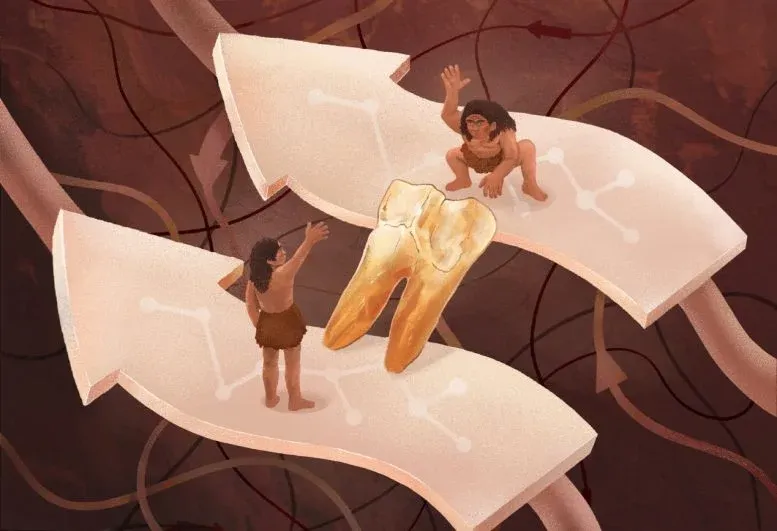
Instead of pulverizing bone for DNA, the researchers focused on enamel proteins. Using a special acid etching technique, they managed to extract molecular information from the teeth while keeping their original shape intact. Because apparently, you can have your ancient fossil and study it too.
We're a new kind of news feed.
Regular news is designed to drain you. We're a non-profit built to restore you. Every story we publish is scored for impact, progress, and hope.
Start Your News DetoxPublished in Nature, these findings revealed two specific mutations in teeth at least 400,000 years old, pulled from sites across China including the famous Zhoukoudian (Peking Man) site. And these weren't just any mutations.
One, AMBN-A253G, is brand new to science, suggesting it could be a unique marker for these early East Asian H. erectus groups. The other, AMBN-M273V, was previously thought to be exclusive to Denisovans — an enigmatic ancient human group known for passing genes to some modern populations. But here's the kicker: H. erectus had it too. This suggests that AMBN-M273V might have hitched a ride into the Denisovan lineage through some ancient intermingling. And from the Denisovans, it eventually made its way into some modern human groups, particularly in Southeast Asia and Oceania. Suddenly, our family tree just got a whole lot more tangled, and a 400,000-year-old connection is now staring us in the face.
This isn't just a win for understanding ancient humans; it's a win for how we study them. The team also introduced new methods for future research, including a way to determine the sex of ancient humans using a male-specific enamel protein. Which, if you think about it, is both impressive and slightly terrifying for anyone who ever tried to hide their gender from a dentist.
It means we can learn more from our ancestors without turning their remains into scientific dust. And that's a legacy worth preserving.