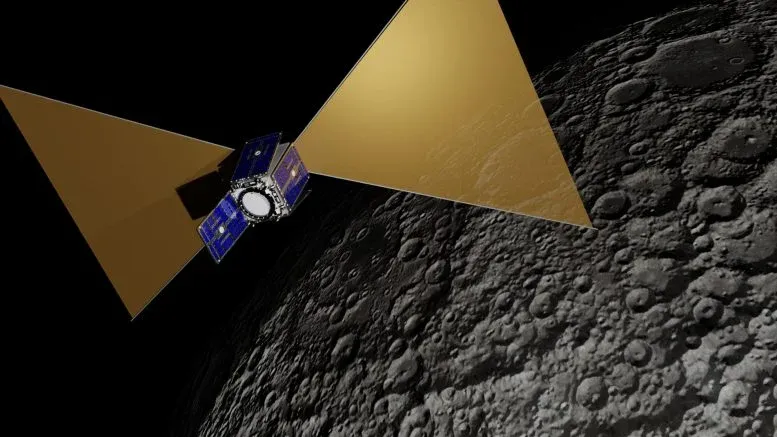
China is about to send a spacecraft to the Moon's south pole, a place so dark and cold it makes your freezer look like a tropical resort. The mission, Chang’e-7, is on the hunt for water ice that’s been chilling there, untouched, for billions of years.
We're talking about the bottom of craters that haven't seen a ray of sunshine since, well, ever. Temperatures hover below a brisk minus 328°F (minus 200°C). Which, if you think about it, is both impressive and slightly terrifying.

The launch date is a bit up in the air thanks to a recent rocket hiccup, but the goal is clear: figure out exactly how much accessible ice is hiding in those permanent shadows, how deep it goes, and what form it’s in. Because apparently, knowing there's some water isn't quite enough anymore.
We're a new kind of news feed.
Regular news is designed to drain you. We're a non-profit built to restore you. Every story we publish is scored for impact, progress, and hope.
Start Your News DetoxBuilt for Darkness, Literally
The Chang’e-7 mission is a four-part harmony of space tech: an orbiter, a lander, a rover, and the real star of the show, a hopper. There's also a relay satellite, Queqiao-2, already parked in space, doing its cosmic switchboard thing.
The hopper is the main event. Forget wheels and slow crawls; this thing jumps. It can leap over the kind of gnarly terrain that would send a conventional rover into an existential crisis. This makes it perfect for diving into craters with steep walls, broken ground, and shadows so deep they're practically philosophical.

China isn't trying to prove water exists — the evidence is already pretty solid. Instead, they want to map it, quantify it, and determine if it's actually usable. It's a subtle but significant shift from simply exploring the Moon to eyeing it as a potential pit stop for resources. Because a future lunar base isn't going to run on good vibes alone.
Different Strokes for Lunar Folks
The exact landing spot is still TBD, but a sunny ridge near the Shackleton crater is a strong contender. Because even when you're going into the dark, a little sunshine never hurts.
The U.S. has similar long-term ambitions, facing the same challenges that Chang’e-7 is designed to tackle. But the two space agencies are taking very different paths. China's approach is a single, coordinated mission with a laser focus. NASA, on the other hand, is building a lunar marketplace, buying services from private companies through its Commercial Lunar Payload Services program. They've got 17 contracts out there, ferrying over 60 instruments to the Moon.

Case in point: Intuitive Machines' IM-2 mission, Athena, aimed for similar goals, complete with a drill, a mass spectrometer, and its own mini-hopper. Unfortunately, the lander took a tumble on arrival and was effectively decommissioned a day later. Proof that lunar real estate is a tough market.
Finding resources is just the first step. Chang’e-7 will identify what's there; Chang’e-8, possibly launching in 2028, will demonstrate how to actually use it. Because knowing there's ice is one thing; making a moon-pop is another.
After these missions, human exploration is the next logical (and slightly terrifying) step, leading to the International Lunar Research Station, a joint venture between China and Russia. Meanwhile, NASA’s commercial efforts are laying the groundwork for its larger Artemis program. The Moon's south pole, however, remains blissfully unaware of international rivalries. It just sits there, eternally dark, cold, and challenging, waiting for whoever dares to jump in.