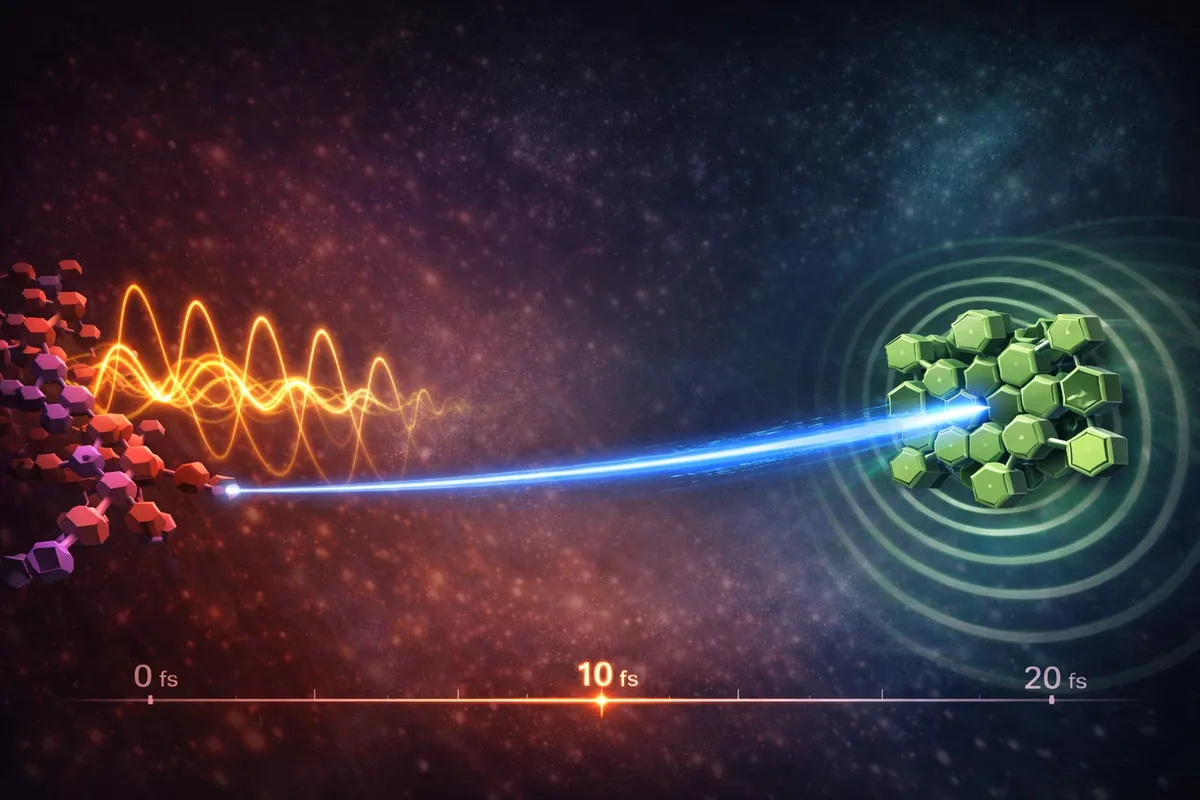
Electrons in solar materials can be launched across molecules at nearly the speed limit set by physics itself — and the secret is atomic vibrations that researchers previously thought were the enemy.
For decades, solar scientists assumed that to move electrons quickly through solar cells, you needed to fight against the natural vibrations of atoms. The Cambridge team just proved that assumption wrong. In experiments lasting 18 femtoseconds — less than 20 quadrillionths of a second — they watched electrons zip across a molecular boundary in conditions that should have been terrible for charge transfer. Instead of slowly drifting through the material, the electron was launched in one coherent burst, like being catapulted across a gap.
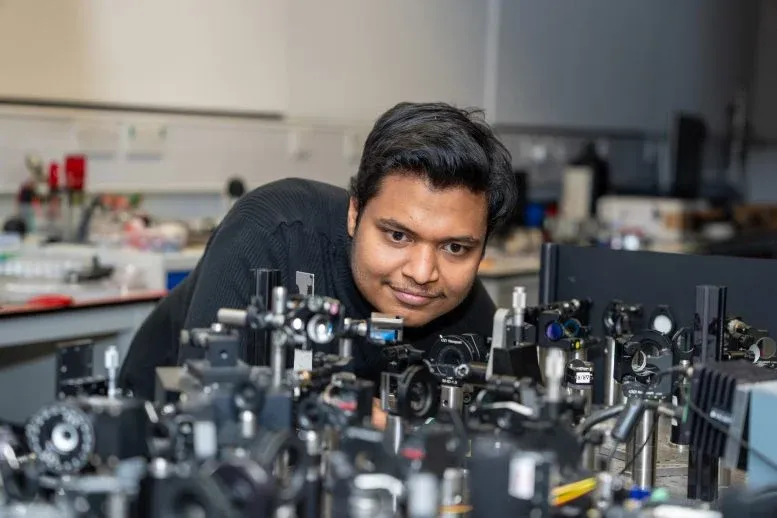
"We deliberately designed a system that, according to conventional theory, should not have transferred charge this fast," said Dr. Pratyush Ghosh, the lead researcher. "Instead of drifting randomly, the electron is launched in one coherent burst. The vibration acts like a molecular catapult."
We're a new kind of news feed.
Regular news is designed to drain you. We're a non-profit built to restore you. Every story we publish is scored for impact, progress, and hope.
Start Your News DetoxWhat's Actually Happening at the Atomic Scale
When sunlight hits a solar cell, it creates a paired electron and hole — essentially trapped energy. For a solar cell to work, that pair needs to separate into free charges as quickly as possible. The slower the separation, the more energy gets lost as heat. This is one of the biggest reasons solar panels aren't more efficient than they are.
The problem is that researchers thought there was a built-in trade-off. To get fast charge transfer, you needed materials with very different energy levels and strong interactions — conditions that actually reduce the voltage a solar cell can produce and increase energy losses. You were supposed to choose: fast charge transfer or high efficiency. Pick one.
The Cambridge team tested this assumption by building a system that should have failed. They paired a polymer donor with an acceptor material that had almost no energy difference and barely interacted with each other — the worst possible conditions by the old rulebook. Yet the electron still crossed the boundary in 18 femtoseconds, faster than most organic solar materials studied before.
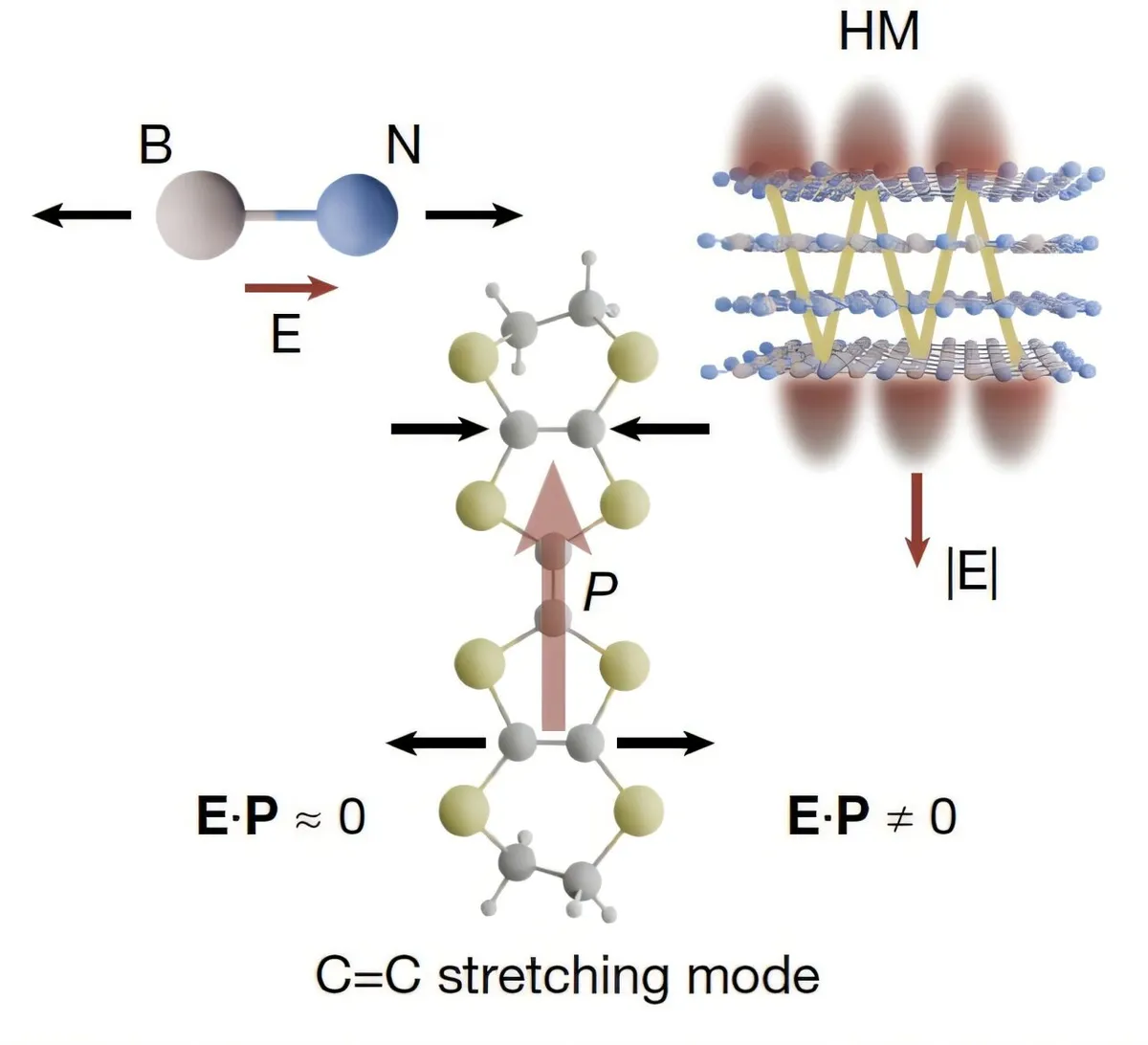
What made this possible wasn't brute force. It was vibration. When the polymer absorbed light, it began vibrating at specific high frequencies. These vibrations didn't fight the electron transfer — they facilitated it, essentially pushing the electron across the interface in one smooth, directed motion instead of letting it bounce around randomly.
A Fundamental Shift in How We Think About Solar Design
This changes the game. For 40 years, the solar industry has been trying to minimize molecular vibrations — dampening them, designing around them, treating them as noise. The new finding suggests that's been backwards. Instead of suppressing vibrations, you could design materials that use the right vibrations as a tool.
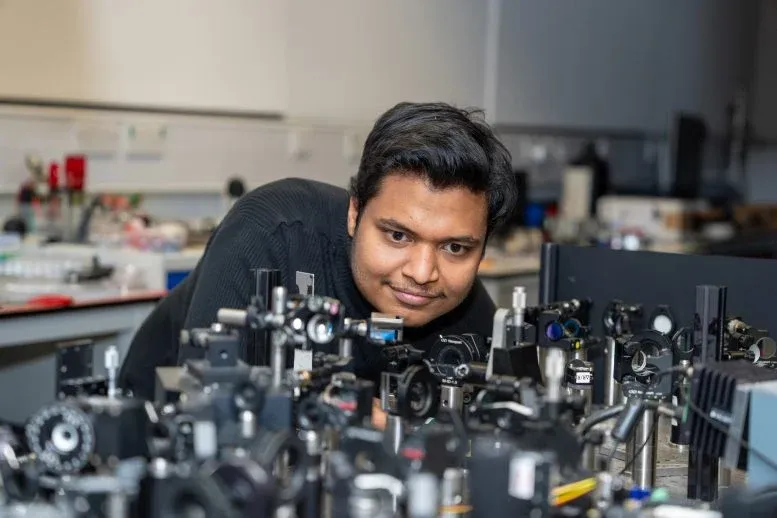
"Instead of trying to suppress molecular motion, we can now design materials that use it — turning vibrations from a limitation into a tool," said Professor Akshay Rao, who co-authored the study.
The implications reach beyond just solar cells. The same ultrafast charge separation process happens in organic photodetectors (which sense light) and photocatalytic systems (which use sunlight to split water and generate hydrogen fuel). It also occurs in natural photosynthesis, suggesting that plants have been using this vibration trick for millions of years — and we're only now understanding how.
The research was published in Nature Communications in March 2026 and involved teams from Cambridge, along with collaborators in Italy, Sweden, the United States, Poland, and Belgium. The next step is moving from observation to design: figuring out which vibration patterns work best and how to engineer materials that exploit them deliberately rather than stumbling upon them by accident.