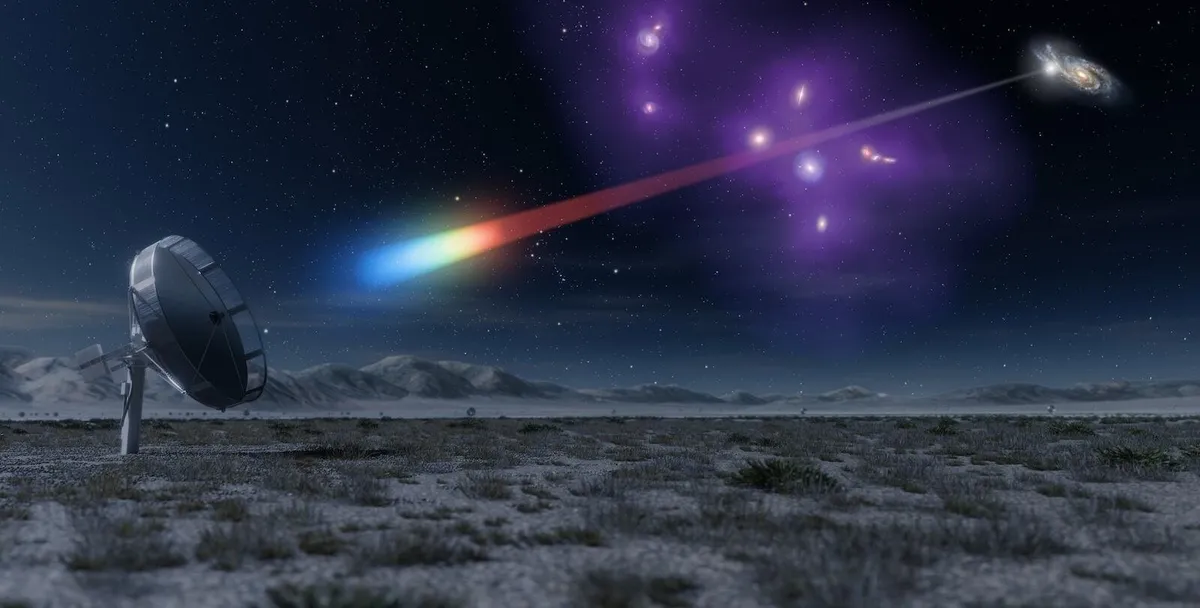
Intense, brief flashes of radio light, called fast radio bursts (FRBs), travel billions of light-years to Earth. On their journey, they pass through a "fog" of matter. The origins of these bursts are not fully understood, but they might come from highly magnetized dead stars called magnetars.
The denser the matter an FRB travels through, the more its signal spreads out. This is similar to how a prism splits white light into a rainbow. This property makes FRBs excellent tools for mapping how ordinary matter is spread out in the universe. Ordinary matter is what makes up people, planets, and stars. As FRB radio beams pass through this matter, they can show how much is present and how it clumps together.
A new study in Nature Astronomy shows how these FRB measurements can help answer big questions in cosmology. Kritti Sharma, the lead author and a graduate student at Caltech, explained that FRBs are a key way to study how matter is distributed. She noted that FRB data can improve cosmology experiments that explore dark matter, dark energy, and the mass of neutrinos.
We're a new kind of news feed.
Regular news is designed to drain you. We're a non-profit built to restore you. Every story we publish is scored for impact, progress, and hope.
Start Your News DetoxThe Challenge of Clumping
Scientists still have many questions about dark energy, which is a force making the universe expand faster. They also want to understand dark matter, a substance that is much more common than ordinary matter but cannot be seen. Neutrinos are also a mystery. These ghostly particles pass through ordinary matter easily, and their mass could reveal how large structures like galaxies formed.
Dark energy, dark matter, and neutrinos are all thought to affect how matter clumps together. Scientists use sky surveys to map this clumping, hoping to find clues about these cosmic phenomena. However, processes inside galaxies can also change how smooth or clumpy matter is. This makes it harder for researchers to precisely measure the effects of dark matter and energy.
All galaxies have supermassive black holes at their centers. These black holes consume nearby matter but also shoot out winds of hot, charged gas. Exploding stars also release energy into galactic areas. This "feedback" helps smooth out the material outside galaxies, making it less clumpy.
Vikram Ravi, a professor of astronomy at Caltech and a co-author, explained that feedback thins the gas around galaxies. This redistributes matter over vast distances. It smooths out clumps of matter in a way that looks very similar to what massive neutrinos, dark energy, or dark matter are predicted to do. He added that unless scientists can measure this feedback separately, they can't tell these effects apart.
FRBs Offer a Clearer View
The new study looked at about 100 FRBs. It is the first to directly measure how feedback affects clumpy matter in the large areas around and between galaxies. The results show that galactic feedback does smooth out surrounding material, making it less clumpy. However, it does so less than what previous surveys, like the eROSITA X-ray telescope and the Atacama Cosmology Telescope, had measured.
Elisabeth Krause, a co-author and professor at the University of Arizona, noted that their FRB analysis shows how gas from astrophysical feedback reduces cosmic structure. She said these findings provide limits that are competitive with X-ray and microwave surveys. She found this remarkable, given that their sample only had about 100 FRBs, suggesting this is just the beginning.
Deep Dive & References
Signatures of suppressed matter clustering revealed by fast radio bursts - Nature Astronomy, 2026