Imagine a machine so small it’s literally just a single atom bouncing between two mirrors. Now, imagine trying to figure out what "heat" even means in that scenario. That's the mind-bending problem physicists at the University of Basel in Switzerland just took on, and they found a surprising answer: some of that so-called "waste heat" might actually be useful.
For a long time, the worlds of thermodynamics (the science of heat and work, born from steam engines) and quantum physics (the science of tiny particles) have been like two brilliant but stubborn siblings. They each explain the world perfectly, just at wildly different scales. But with modern quantum tech shrinking machines down to atomic sizes, these two siblings have to talk.
The Atom in the Box
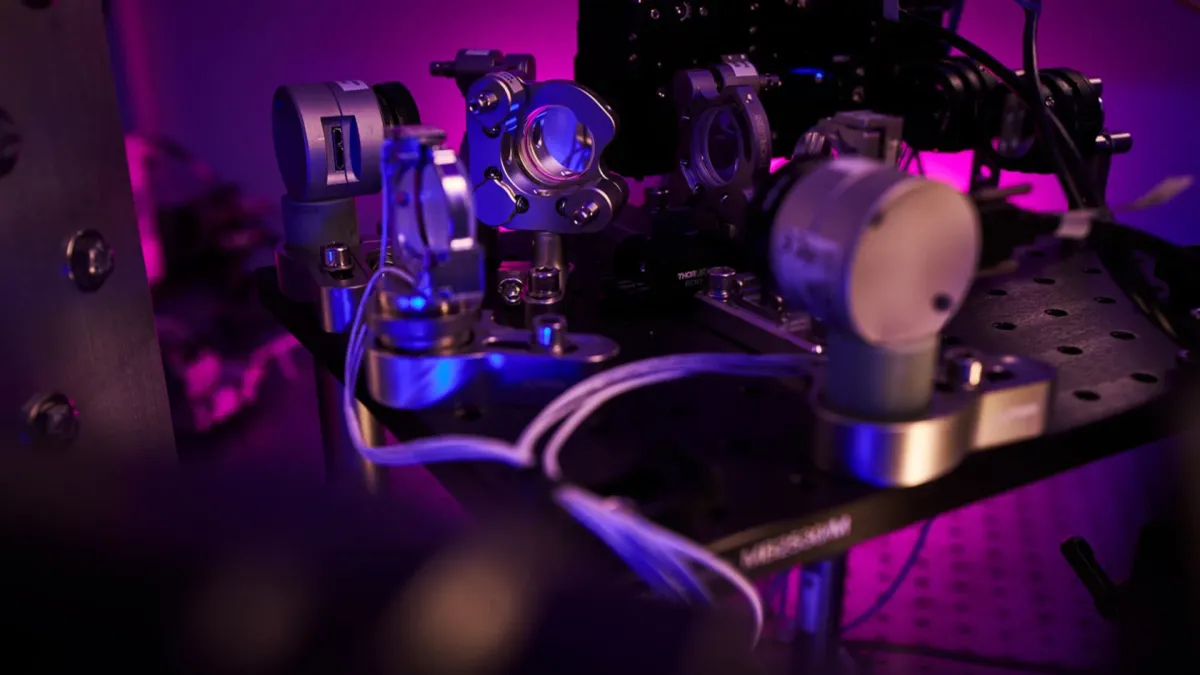
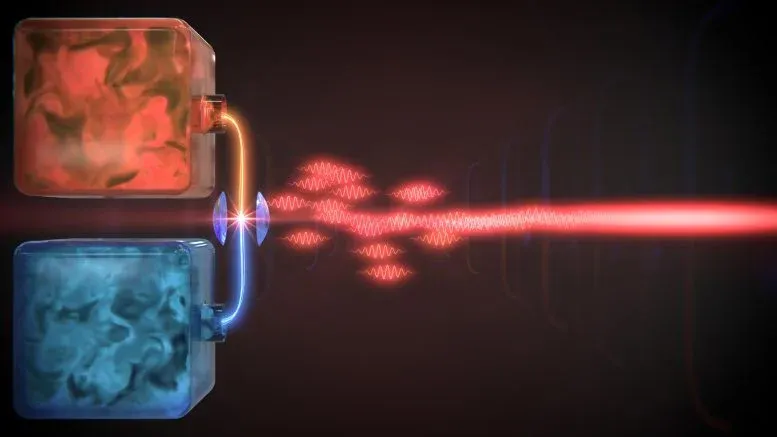
Professor Patrick Potts's group focused on a very specific setup: an atom chilling in a cavity between two mirrors, constantly bombarded by laser light. The atom absorbs and emits photons, and some of those photons escape through the partly reflective mirrors. Think of it as a microscopic, perpetually running light engine.
We're a new kind of news feed.
Regular news is designed to drain you. We're a non-profit built to restore you. Every story we publish is scored for impact, progress, and hope.
Start Your News DetoxPreviously, Potts's team had a hunch: those escaping photons weren't all just useless "waste heat." Some of their energy could still be harnessed to do work on another quantum system. The big question was whether this distinction — between actual heat and useful energy — held up when you nudged the system from pure quantum weirdness toward something a little more, well, classical.
That's where postdoc Marcelo Janovitch stepped in. He and his colleagues mathematically proved that their theory works. When you treat some of that emitted light as usable work, their quantum framework smoothly transitions into the semi-classical world. The old way, which just labeled all escaping energy as heat, simply didn't compute.
This isn't just an abstract theoretical win. It means that the very thing we thought caused problems in quantum systems – heat – could actually be a resource. Instead of being a chaotic energy sink, it might be a subtle, controllable force. This could lead to wild new possibilities, like creating specialized light states for super-precise measurements in quantum metrology.
So, the next time your phone gets a little warm, just remember: somewhere, a tiny atom is showing us that even "waste" can have a secret purpose. Which, if you think about it, is both impressive and slightly terrifying. It makes you wonder what else we've been dismissing.