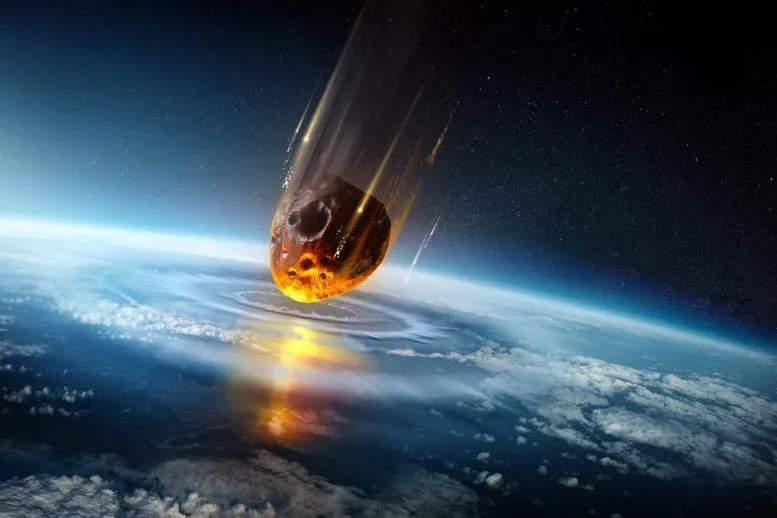
Scientists have found seven distinct stages a meteoroid goes through before it hits Earth. They looked at 75 meteorite falls captured in videos and photos. This research shows that melting and breaking apart are key to how these space rocks lose mass and slow down.
How Space Rocks Transform
When a space rock enters Earth's atmosphere, it doesn't just burn up. Instead, it goes through a complex process. Researchers found that melting and fragmentation, not just evaporation, change the rock. These changes determine how much mass it loses, how fast it slows down, and if it reaches the ground as a meteorite.
Dr. Peter Jenniskens, a meteor astronomer and lead author from the SETI Institute and NASA Ames Research Center, explained this. He said they used to think rocks would just evaporate from the intense heat. But they discovered that melting and then breaking apart are what control how a rock loses mass.
We're a new kind of news feed.
Regular news is designed to drain you. We're a non-profit built to restore you. Every story we publish is scored for impact, progress, and hope.
Start Your News DetoxThe study, published in Meteoritics & Planetary Science, outlines seven phases. Each phase involves different physical processes.
The Seven Stages of Descent
Melting Dominates Early On
Phase 1 starts high above Earth. The atmosphere becomes dense enough to create a shock wave in front of the rock. Air molecules hit the object and the gas around it, making them glow. This is what we see as a meteor or "shooting star."
Phase 2 begins as the object moves into denser air, and its brightness increases. Some meteors spin quickly, causing their brightness to flicker. The fastest ones rotated every 0.5 to 5 seconds.
In Phase 3, the meteor gets much brighter and becomes a fireball. Here, most of the rock's mass is lost due to melting. Fast-moving air strips away the molten material, creating tiny droplets that then evaporate behind the rock.
Eric Stern, formerly at NASA Ames, noted that lab tests can't replicate the radiation levels of a natural atmospheric entry. He added that if the rock just fragmented, they wouldn't see the consistent way fireballs brighten.
Around 60 kilometers (about 40 miles) above Earth, the fireball enters Phase 4. Its brightness either stays steady or increases at a constant rate. At this point, melting alone can remove up to 40% of the rock's original mass.
Fragmentation Drives the Slowdown
As the fireball goes deeper into denser air, the increasing pressure starts to break the rock apart. This is Phase 5. Several flares can appear as pieces separate from the main body.
The researchers found that fragmentation starts when the air pressure in front of the rock is only about one-fifth of the strength measured for meteorites on the ground. They think that heating and cracks from earlier space collisions might weaken the rocks, causing them to break up sooner than expected.
During this phase, the object shrinks quickly and loses speed much faster, especially if it breaks apart severely. Co-author Stu Pilorz of the SETI Institute said they could link this slowdown from fragmentation to earlier mathematical descriptions based on ablation.
If the back part of the main rock stays whole, it creates a low-pressure area behind it. This can pull smaller fragments along. Darrel Robertson of NASA Ames Research Center explained that as long as the back of the rock is intact, it creates a vacuum that fragments tend to flow into. This causes small meteorites to fall in a narrow strip on the ground.
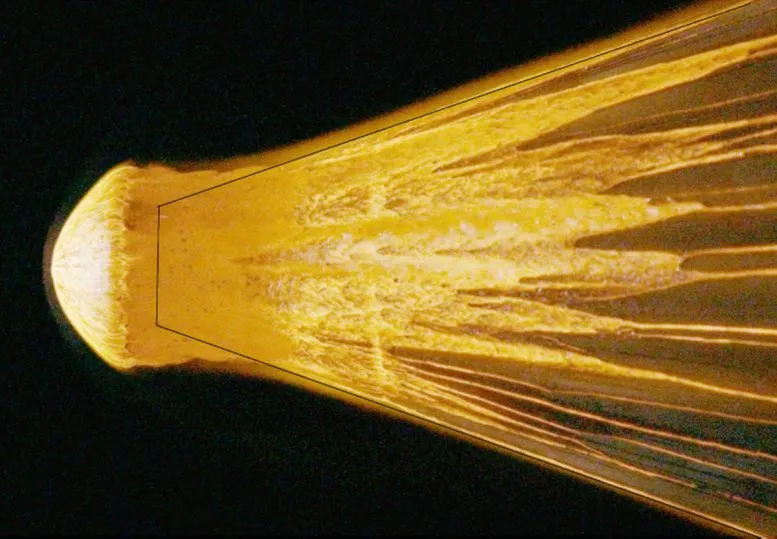
Phase 6 begins when the back of the main rock finally breaks apart. This causes a final bright flare and sends fragments flying outward at higher speeds. Since the object has already slowed down a lot, these late flares often look red, unlike the bright green seen earlier.
Jenniskens noted that this final disruption sends fragments flying faster. He said that in past falls, meteorites larger than about 20 grams were scattered wider and many came from close to the surface of the original rock, which must have been its backside.
The meteorites that eventually land started this stage as larger fragments. They continued to melt and break apart until they slowed enough to survive the rest of the fall.
The Final Phase Determines Survival
In Phase 7, melting and fragmentation continue until the remaining pieces slow down so much that they no longer glow. Melting then stops, leaving a thin crust on the surface of the surviving fragments. As they fall through the lower atmosphere, winds can push these darkened pieces off their original paths before they finally hit the ground as meteorites.
The study included 75 events with different types of meteorites. By comparing them, researchers figured out at what altitudes different materials went through each stage.
Understanding how small, solid space rocks slow down in the atmosphere can also help us understand more dangerous asteroids. These can range from car-sized objects to ones as big as city blocks. Jenniskens pointed out that asteroids up to tens of meters in size are also solid rocks because they spin faster than larger "rubble pile" asteroids. He noted that the 20-meter asteroid that caused the airburst over Chelyabinsk, Russia, in 2013 went through the same phases.
Deep Dive & References
Bolide Light Curve Systematics from 75 Recovered Meteorites - Meteoritics & Planetary Science, 2026