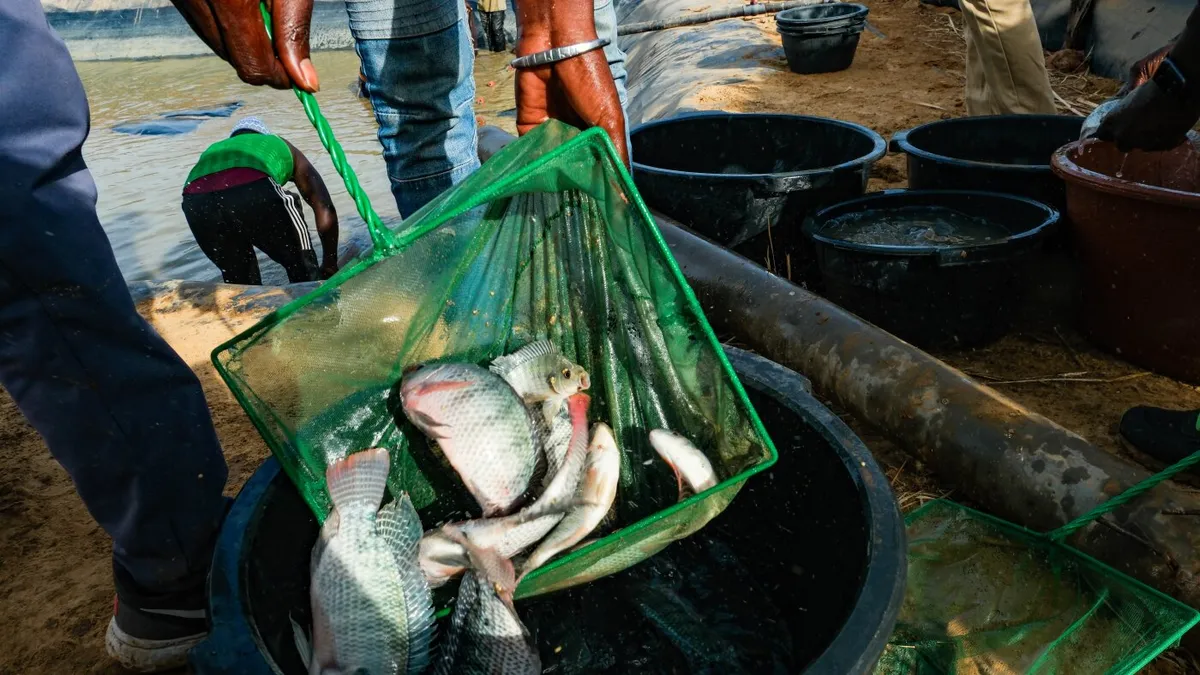
You've heard of superfoods, but have you met blue foods? No, we're not talking about Smurf-colored smoothies. We're talking about everything from the oceans, rivers, and fish farms — the finned, the shelled, and even the delightfully slimy seaweed.
Turns out, these aquatic edibles aren't just for seafood Sunday. They're ancient, culturally vital, and quietly keeping millions fed, employed, and surprisingly healthy. Consider them the unsung heroes of global nutrition, ready for their close-up.
The Original Food Source
Humans have been reeling in blue foods for over 100,000 years, making it one of our oldest culinary traditions. Fast forward to today, and a staggering 800 million people worldwide depend on blue foods for their income. Just wild fishing alone keeps 33 million folks employed, which, if you think about it, is both impressive and slightly damp.
We're a new kind of news feed.
Regular news is designed to drain you. We're a non-profit built to restore you. Every story we publish is scored for impact, progress, and hope.
Start Your News DetoxCoastal communities, especially, live and breathe (and eat) by the water. In West Africa, fishing supports 7 million livelihoods and pulls in a cool US$5 billion annually. Pacific islands? They're riding the tuna wave to the tune of US$7 billion each year. And for 30 million Indigenous coastal people, the ocean isn't just a pantry; it's a way of life, providing four times more seafood than the global average.
These aren't just commodities; they're cultural cornerstones. In the Philippines' Batanes Province, families actually relocate during fishing seasons to stay close to prime spots. Western Korea hosts the Daedonggut, an annual festival honoring fishers lost at sea and praying for a bountiful catch. And in Fiji, women from Dawasamu have historically harvested from seagrass meadows, feeding their communities while staying close to home. As Kii’iljuus Barbara Wilson of the Cumshewa Eagle Clan put it, "Our food, medicine, and life came and continues to come from the ocean. We are Ocean People."

Nutritional Powerhouses (Without the PR Hype)
Forget the latest fad diet. Blue foods are the OG nutritional heavyweights, providing sustenance for 3.3 billion people. In some places, they make up 90% of protein intake. We're talking iron, zinc, calcium, vitamin A, and those all-important healthy fatty acids — basically, everything your brain, heart, and immune system could ever want. They’re even linked to lower rates of stunting and maternal deaths, because apparently, fish are just that good.
Jim Leape of Stanford’s Center for Ocean Solutions called them "huge opportunities for better nutrition and healthier diets." And here’s the kicker: even small amounts pack a punch. Rosamund Naylor, a Blue Food Assessment (BFA) Science Committee member, noted that fish actually help your body better absorb nutrients from other foods. It’s like a nutritional force multiplier.
The Future is Blue (If We Don't Mess It Up)
While industrial giants dominate much of the food world, the blue food sector is still largely powered by small-scale producers. They haul in 40% of the global catch, generating US$77 billion annually. And half of that workforce? Women, playing a crucial role that often goes unnoticed. Let that satisfying number sink in.
Globally, fisheries recently produced a record 178 million tons of aquatic animals and 36 million tons of algae in a single year. The U.N. expects that to jump another 15% by 2030, which means a lot more deliciousness on the horizon. Plus, most blue food systems offer animal protein with relatively low greenhouse gas emissions and less impact on biodiversity. Some, like mussel and clam farming, can even improve the environment. Take that, carbon footprint!
But before we all dive in, a reality check: Over 90% of blue food production is currently threatened by environmental changes. Overfishing is depleting stocks, with one-third of wild seafood populations unable to recover fast enough to meet demand. Mark Kaplan of Wholechain, a blockchain-based traceability system, points out that these systems are often rife with unethical practices. "Integrity and supply chain stakeholders are not synonymous," he quipped, which is a very polite way of saying some folks are cutting corners.
His solution? Transparency. Because apparently, knowing where your fish came from can lead to more sustainable practices. Advocates also argue that blue foods need to be included in policy-making alongside land-based foods. As Chef Andrew Zimmern put it, "we have to include our blue spaces everywhere that we’re talking about our green spaces." Which makes perfect sense, because who doesn't want more delicious, sustainable, brain-boosting food?