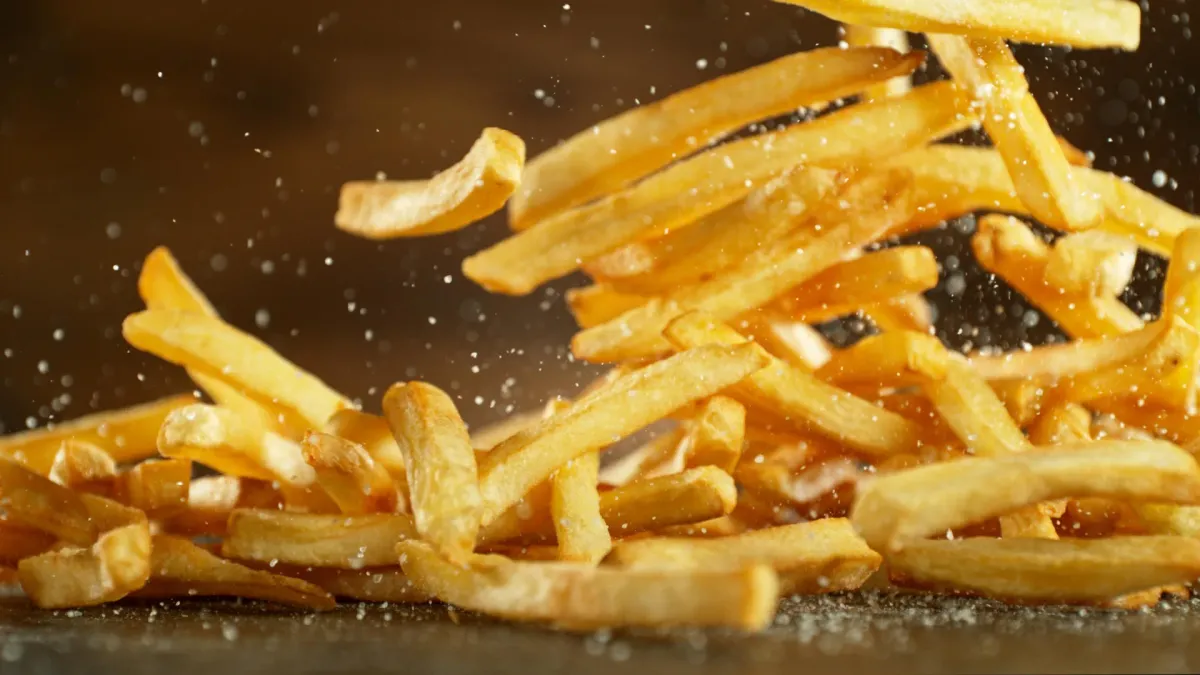
Good news, fry fanatics: that perfectly crisp, golden stick of potato might soon come with significantly less guilt. Scientists are cooking up a new method that promises to make French fries healthier, faster, and just as delicious. Because apparently, we can have nice things.
The secret? A culinary mashup that combines traditional frying with — wait for it — microwave energy. Yes, the same tech that reheats your sad desk lunch is now coming for your fries, but in a much more sophisticated way.
The Great Oil Escape
French fries are, undeniably, a masterpiece of texture and flavor. They're also notorious oil sponges, which isn't exactly a recipe for a long and healthy life. All that fat and all those calories contribute to things like, well, things you'd rather not have, like high blood pressure.
We're a new kind of news feed.
Regular news is designed to drain you. We're a non-profit built to restore you. Every story we publish is scored for impact, progress, and hope.
Start Your News DetoxEnter the food engineers at the University of Illinois Urbana-Champaign. Led by Professor Pawan Singh Takhar, their mission is to strip the oil out of fries without stripping away the joy. Because, as Takhar wisely points out, we all want to eat healthy, but sometimes a craving just hits different.
So, Takhar and doctoral student Yash Shah dove deep into the physics of the fry, publishing their findings in a couple of papers that explore how microwave energy changes potatoes at a molecular level. They even teamed up with Washington State University, using a special microwave fryer that could operate at different gigahertz frequencies — basically, tweaking how the energy vibrates water molecules inside the spud.
Here's the problem they're trying to solve: when you drop a potato into hot oil, the water inside starts to boil and escape as vapor. This creates tiny empty spaces. And here's the kicker: as the potato cools, or even during frying, these empty spaces create a negative pressure, essentially sucking oil right into the potato. Takhar likens it to a straw: positive pressure pushes liquid out, negative pressure pulls it in. And apparently, your fries are full of tiny straws.
Most of the frying process happens under this oil-sucking negative pressure. Not ideal for your arteries.
The Microwave Intervention
This is where the microwave swoops in. Unlike conventional ovens that heat from the outside-in, microwaves heat from the inside-out. They make water molecules vibrate like crazy, creating more vapor inside the potato. This internal pressure then pushes outwards, keeping those tiny potato-straws positively pressurized for longer, which means less oil gets sucked in.
They found that microwave frying made moisture vanish faster, cut down cooking time, and significantly reduced oil absorption. The catch? Microwaved-only fries were, to put it mildly, soggy. Not the crispy, golden perfection we all dream of.
So, the brilliant solution is a hybrid system. Imagine a fryer that uses conventional heat for that irresistible golden crisp and browning, while simultaneously zapping the potato with microwaves to speed up moisture removal and keep the oil out. It’s the best of both worlds: all the crunch, less of the grease.
This isn't just a lab experiment; the researchers say large food processing plants could easily integrate microwave generators into their existing continuous fryers. The components are common and affordable, meaning healthier, crispier fries might be coming to a fast-food joint near you sooner than you think. Your cardiologist (and your taste buds) can thank them later.