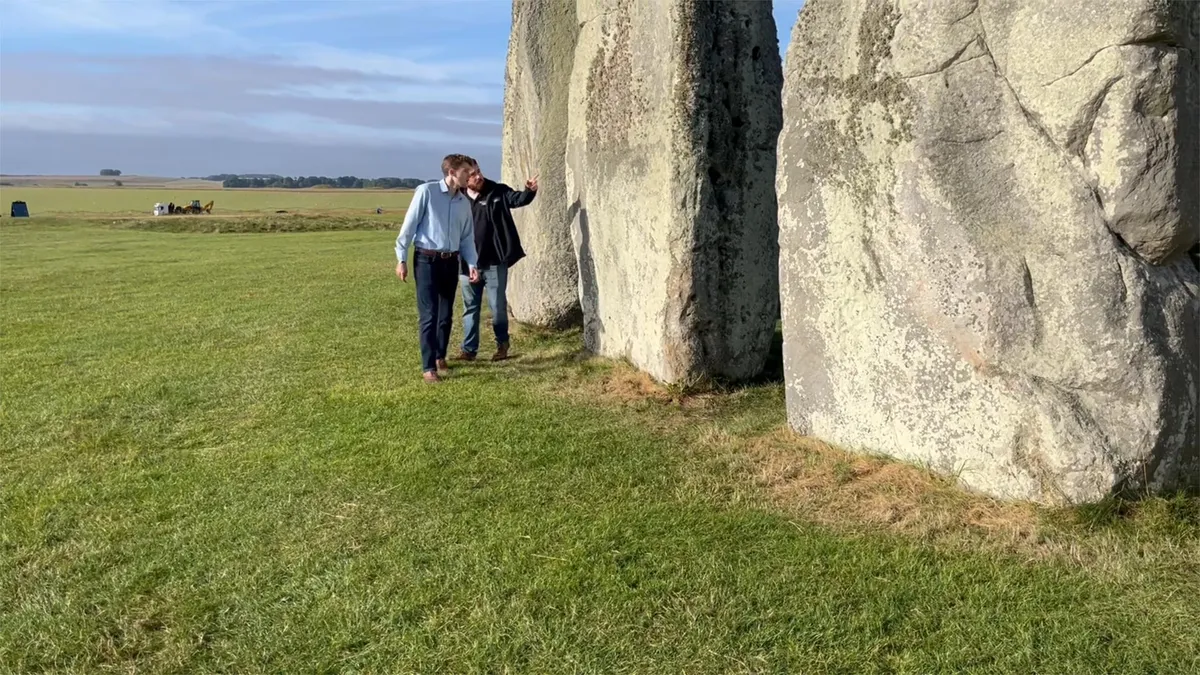
Stonehenge's six-ton Altar Stone traveled about 700 kilometers (435 miles) from northeast Scotland. New research suggests ancient people, not glaciers, moved this massive stone. This journey highlights the impressive capabilities of early communities.
Curtin University led the new study. It focuses on the Altar Stone, a large sandstone rock at the center of Stonehenge. Researchers now believe it came from far away, raising questions about how it got there.
This new evidence supports earlier findings. These findings challenged the idea that glaciers alone moved the stone. The latest research confirms that humans were likely responsible for moving it across challenging landscapes.
We're a new kind of news feed.
Regular news is designed to drain you. We're a non-profit built to restore you. Every story we publish is scored for impact, progress, and hope.
Start Your News DetoxTracing the Altar Stone's Journey
To find the stone's origin, researchers used mineral grain dating. They also used computer models to track ancient ice sheets. Their goal was to see if glaciers could have carried the stone south.
The models showed that glaciers might have moved rocks from northeast Scotland during the last Ice Age. These rocks could have reached Dogger Bank in the North Sea. However, the models found no realistic way for glaciers to carry the Altar Stone all the way to southern England.
Dr. Anthony Clarke, a co-lead author from Curtin University, explained the findings. He said the evidence points to a planned human effort. The stone was not carried by ice. Instead, it was moved carefully across a difficult and varied landscape.
Evidence Points to Human Transport
Since no glacial paths led directly to Stonehenge, researchers believe people moved the stone. This journey would have covered hundreds of kilometers.
Dr. Clarke noted that glaciers might have moved rocks part of the way. But people would still have needed to move the stone hundreds of kilometers.
The study suggests the stone's journey was complex. It likely involved several stages. Ancient people might have dragged it over land. They also could have used rivers or coastal routes to make parts of the trip easier.
What This Reveals About Ancient Britain
Dr. Clarke said these findings show a high level of planning and cooperation. This level of organization is not always linked with Neolithic societies.
Moving such a large stone over a long distance would have required careful planning. It also needed coordination and a deep understanding of the land. And, of course, great determination.
Researchers plan to keep studying the Altar Stone. They want to pinpoint its exact source in northeast Scotland. Future studies will also look into the routes prehistoric communities might have used to transport the stone across Britain.
Deep Dive & References
From Highlands to Henge: Refining the Provenance and Transport Pathways of Stonehenge’s Altar Stone - Journal of Quaternary Science, 2026