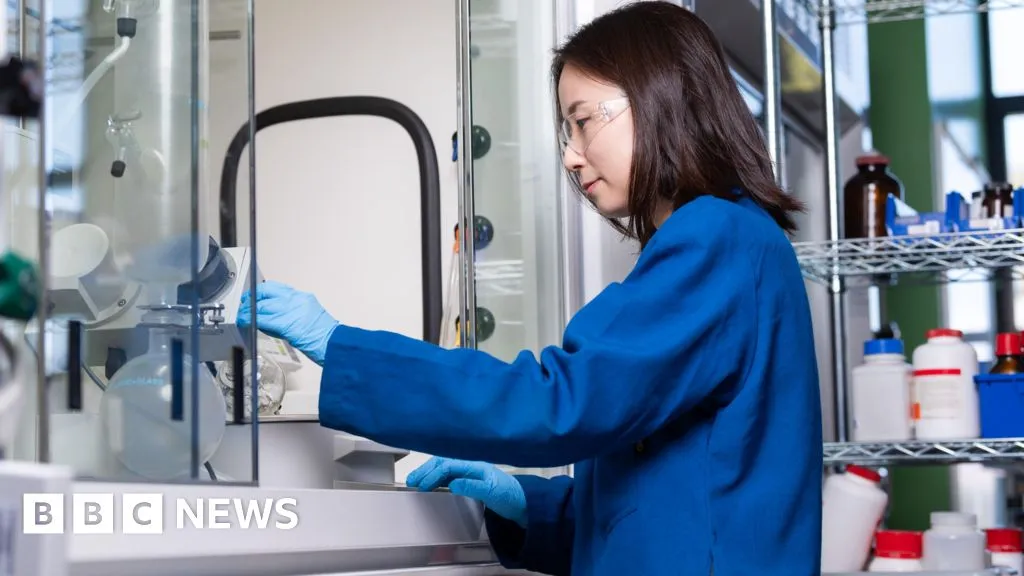
When chemistry professor Grace Han moved to California, she noticed how quickly her skin would tingle in the strong sun. This experience, combined with her leisure reading about DNA photochemistry, sparked an idea for a new way to store energy.
Sunburn Inspires Energy Storage
Han realized that DNA molecules in skin change shape when damaged by the sun. They flex into a strained version of their normal form. For decades, scientists have looked for molecules that can twist their shape to store energy and then release it on demand. This process is called molecular solar thermal (Most) energy storage. It could be a cheap and emissions-free way to provide heat. These Most systems could store energy for months or even years.
Our skin's DNA molecules have evolved to repair their sun-damaged shape with an enzyme called photolyase. Han realized these molecules were perfect for an energy storage system. They are very small and can store a lot of energy for their size.
We're a new kind of news feed.
Regular news is designed to drain you. We're a non-profit built to restore you. Every story we publish is scored for impact, progress, and hope.
Start Your News DetoxA Breakthrough in Molecular Storage
Han and her team published a paper in February describing the most promising Most system to date. It had a high energy density. The system was powerful enough to boil a small amount of water in a tiny kettle. Han was amazed by how quickly the solution boiled.
Her collaborator Kendall Houk and his team at the University of California, Los Angeles, provided crucial computer analyses. Kasper Moth-Poulsen, another Most researcher, was impressed by the results. He noted that Han's system achieved 1.6 megajoules of energy per kilogram, which is higher than his team's best systems. This 1.65 megajoules per kilogram is also more than the energy density of lithium-ion batteries.

Challenges and Future Potential
The current Most system has some limitations. It needs "very harsh UV light" at 300 nanometers to activate the molecules. This type of light comes from the sun in small amounts. Also, the system uses hydrochloric acid to release the stored energy. This is a corrosive substance that needs to be neutralized. Han hopes to improve the system's response to natural light and find a non-toxic way to release energy.
The goal of this research is to decarbonize heating, which often relies on fossil fuels. Most systems store chemical energy without burning anything. They could also be available anywhere, unlike fossil fuels. Moth-Poulsen believes Most could store energy for decades.
Harry Hoster from the University of Duisberg-Essen notes that Most systems need to be thin, about 5mm thick, for light to penetrate. Also, liquid-based systems require pumping, which adds cost and complexity.
Researchers like John Griffin at Lancaster University and Han are working on solid-state versions of Most technology. These could be transparent window coatings that release heat to prevent condensation or warm rooms. While Hoster is skeptical Most can heat an entire building, he believes it could warm sensitive components on satellites or aircraft. He praises the science, calling it "beautiful."
This field is still niche, with about 70 researchers worldwide. However, the innovations continue, showing promise for future energy solutions.
Deep Dive & References
- Paper published in February - Science, 2024
- Decarbonizing heating - Frontiers in Thermal Engineering, 2022