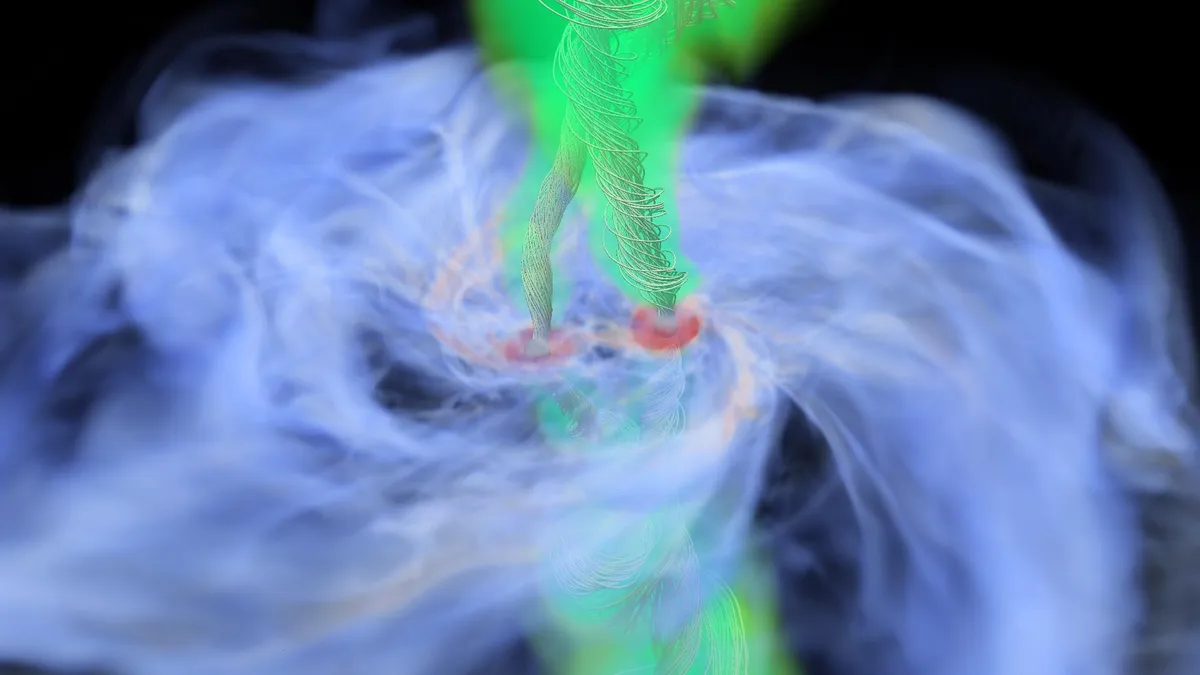
Magnetic fields might be the secret force that brings both newborn stars and giant black holes together.
New computer simulations suggest that magnetic fields are crucial for forming pairs of young stars. This could explain why binary star systems are so common in the Milky Way. It might also offer clues about how supermassive black holes grow.
Stars form when huge clouds of gas in space collapse due to gravity. This creates dense areas called molecular cloud cores. Often, multiple stars form in the same cloud. Some of these stars become linked by gravity, forming binary systems where two stars orbit each other.
We're a new kind of news feed.
Regular news is designed to drain you. We're a non-profit built to restore you. Every story we publish is scored for impact, progress, and hope.
Start Your News DetoxAstronomers have thought for a long time that many binary systems start forming very early, even before the stars are fully developed. However, it has been hard to explain how these young protostars get close enough to become a stable pair.
Magnetic Fields Bring Protostars Closer
To solve this puzzle, researchers ran advanced simulations using several supercomputers. These included the National Astronomical Observatory of Japan’s ATERUI III system and its older version, ATERUI II.
The simulations showed that magnetic fields in space interact with the gas around young protostars. This interaction removes angular momentum from the pair. When angular momentum decreases, the protostars can move closer together. This allows a binary system to form within a realistic timeframe.
The importance of magnetic fields became very clear in a comparison simulation. When there was no magnetic field, the two protostars moved farther apart instead of closer. This highlights how essential magnetism is in this formation process.
Implications for Binary Black Holes
The researchers also found that a similar process might happen with pairs of massive black holes.
When two smaller galaxies merge, they create a new galaxy with gas-rich central regions. In these areas, magnetic fields might help massive binary black holes lose angular momentum and move closer. This process could explain how black holes eventually get close enough to merge, forming a supermassive black hole.
Simulating massive binary black holes over the huge timescales needed for them to spiral inward is still very difficult for computers. Because of this, researchers say that more detailed study is needed to understand how magnetic fields influence binary black hole evolution.
Deep Dive & References
Magnetic-field-induced inspiral of binaries with circumbinary disc: black hole and protostellar systems - Monthly Notices of the Royal Astronomical Society, 2026