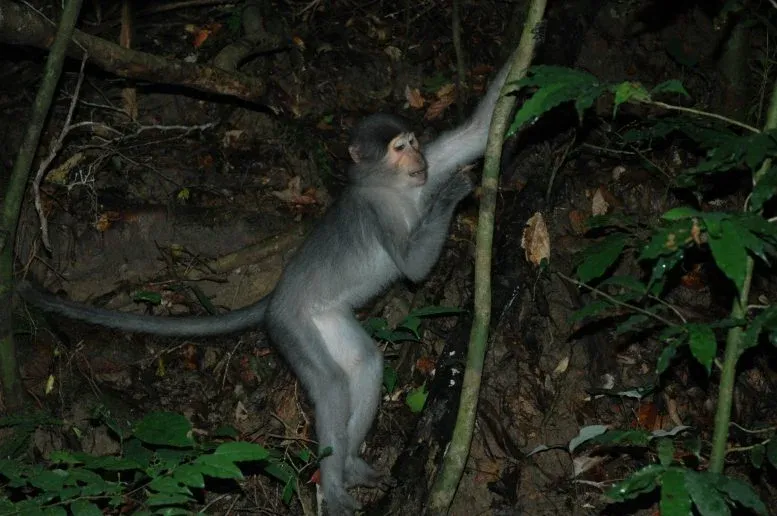
A new study challenges old ideas about how our early human ancestors climbed trees. It suggests that the last common ancestor of humans and chimpanzees was likely a skilled tree climber. This ancestor lived about 6 to 7 million years ago.
Scientists often look at how primates climb to understand our own evolutionary past.
Monkey Feet Can Climb Like Apes
For a long time, researchers thought monkeys mainly used their arms to move through trees. They believed chimpanzees were better vertical climbers because their ankles are very flexible. This difference was important for figuring out if our common ancestor climbed tree trunks or mostly stayed in the tree canopy.
We're a new kind of news feed.
Regular news is designed to drain you. We're a non-profit built to restore you. Every story we publish is scored for impact, progress, and hope.
Start Your News DetoxNew evidence from West Africa changes this view. Researchers from The Ohio State University filmed wild sooty mangabey monkeys. They found that these monkeys can climb narrow tree trunks vertically, even without the super flexible ankles of chimpanzees. The monkeys use their midfoot bones to flex enough for climbing. They do this to hide, find food, or sleep.
Luke Fannin, an assistant professor of anthropology at Ohio State, explained that this means you can't rule out vertical climbing just because an animal doesn't have a chimpanzee-like foot. The study's findings were published in Proceedings of the National Academy of Sciences.
Understanding how our last common ancestor moved helps explain why humans started walking on two legs. This study shows that an ancestor with a monkey-like foot could still climb as well as an ape.
Challenging Old Assumptions
W. Scott McGraw, professor and chair of anthropology at Ohio State and senior author of the study, co-directs the Taï Forest Monkey Project field station in Ivory Coast. Fannin filmed the mangabeys there. The videos allowed researchers to precisely see how the monkeys' joints moved.
Chimpanzee ankles can flex upward about 45 degrees during a vertical climb. Most human ankles can only flex about 20 degrees. Fannin's measurements showed that the mangabey midfoot could flex by 46 degrees when climbing vertically.
This discovery makes it harder to say exactly what kind of foot our last common ancestor had. Some theories suggested an ape-like foot was necessary for vertical climbing. This study proves that isn't true. Monkeys, who are not extinct, are very good at this challenging behavior.
McGraw noted that the videos provide some of the first detailed records of this type of movement in monkeys. This behavior was previously not well understood.
Climbing is Still Part of Being Human
Even today, some hunter-gatherers are skilled vertical climbers. Their ability comes more from flexible muscles, tendons, and ligaments than from their foot bones.
Fannin and McGraw point out that while humans are known for walking on two feet, climbing is still a human behavior. This connection to trees, or arboreality, has greatly shaped primate bodies, including our hands, feet, wrists, and ankles.
Fannin believes that to truly understand if our last common ancestor had monkey-like or ape-like features, more fossils are needed.
Deep Dive & References
A kinematic convergence in ape and monkey vertical climbing informs debates on early hominin arborealism - Proceedings of the National Academy of Sciences, 2026