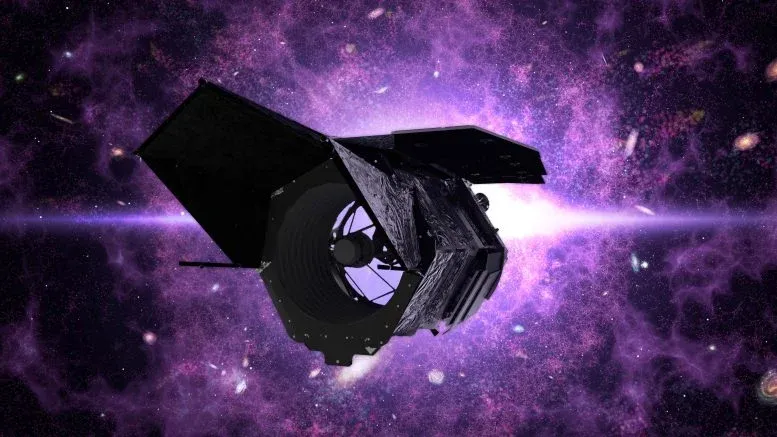
NASA's Nancy Grace Roman Space Telescope, a machine designed to peer into the universe's deepest secrets, just hit a major pre-launch milestone. It got tucked into its protective fairing — essentially, a giant, very expensive blanket — at NASA’s Kennedy Space Center in Florida. Because even a state-of-the-art observatory needs a cozy, controlled environment before it gets blasted into the cosmos.
This 43-foot-tall fairing, built by SpaceX, is more than just a cover. It’s Roman’s personal bodyguard, shielding the sensitive telescope from the rather aggressive conditions of a rocket launch. Think intense sound, crushing pressure, and enough heat to make you question every life choice. All of which happen as a Falcon Heavy rocket punches its way through Earth’s atmosphere.
Once the rocket is sufficiently high and the cosmic tantrum subsides, the fairing’s job is done. A few minutes after liftoff, its two halves will gracefully separate and tumble back to Earth, leaving Roman free to continue its journey. SpaceX, ever the pragmatist, plans to recover both halves. Because why waste a perfectly good, giant shell?
We're a new kind of news feed.
Regular news is designed to drain you. We're a non-profit built to restore you. Every story we publish is scored for impact, progress, and hope.
Start Your News DetoxOff to the Cosmic Quiet Zone
Roman is headed to Sun-Earth Lagrange point 2 (L2), a rather chill spot in space perfect for telescopes that want to avoid Earth's messy glow. From this cosmic quiet zone, Roman will embark on a mission to find thousands of exoplanets – worlds orbiting stars far beyond our own solar system. Scientists hope to compare these distant discoveries to our neighborhood, getting a much broader view of planetary systems across the galaxy. It’s like finally getting to see what the neighbors are doing, but on a galactic scale.
But Roman isn't just a planet hunter. It's also going to tackle two of the biggest head-scratchers in astronomy: dark matter and dark energy. Dark matter, the invisible glue holding galaxies together, and dark energy, the mysterious force accelerating the universe's expansion, are still largely unknown. Roman will observe the universe on a massive scale, providing new clues to these hidden cosmic forces and how the universe has grown up over time.
Launch is targeted for August 30. So, get ready for Roman to shed its protective shell and start asking some very big questions.