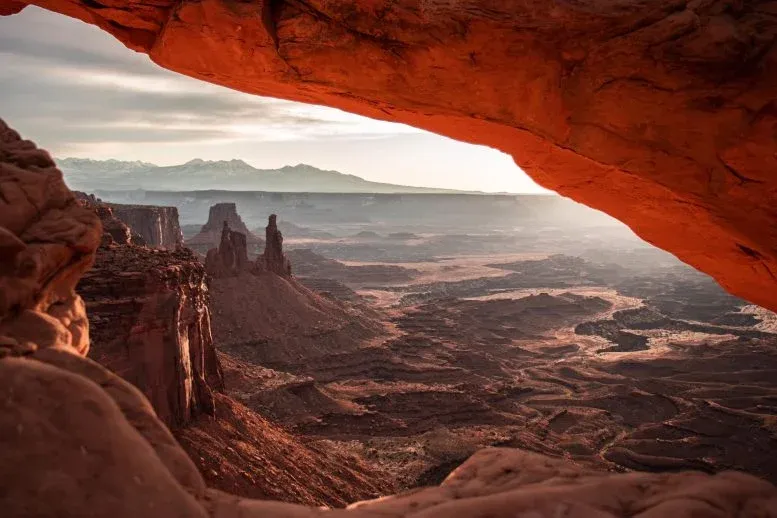
Long before the Grand Canyon was carved by the Colorado River, a massive system of cliffs may have stretched across North America. This ancient wall, possibly a kilometer high, could have exposed some of the oldest rocks now found deep within the Grand Canyon.
New research suggests this huge cliff system began reshaping the landscape almost a billion years before the modern canyon formed. It may have stretched for thousands of kilometers across the continent.
A Giant Cliff Across Ancient America
A study led by the University of Southampton in the UK proposes that a "great escarpment" formed as the supercontinent Rodinia started to break apart about 800 million years ago. These tall cliffs might have run across much of what is now western North America.
We're a new kind of news feed.
Regular news is designed to drain you. We're a non-profit built to restore you. Every story we publish is scored for impact, progress, and hope.
Start Your News DetoxThis process caused intense erosion, removing vast amounts of rock. This erosion eventually exposed the ancient crystalline basement rocks that are visible today in the Grand Canyon in southern Arizona.
Professor Thomas Gernon, lead author from Southampton, explained that the Grand Canyon's geological record spans about two billion years. However, more than half of that rock record is missing. He suggests the canyon's deepest rocks were brought to the surface by this immense escarpment during the supercontinent's breakup.
The findings also help explain the Great Unconformity, a mysterious gap in the rock record that covers over a billion years. The study, published in Geology, involved researchers from the University of Southampton, the GFZ Helmholtz Centre for Geosciences, the University of Potsdam, and the University of Illinois Urbana-Champaign.
The ancient escarpment might have once crossed areas that are now Arizona, Utah, Idaho, Wyoming, Colorado, Texas, Oklahoma, Arkansas, Missouri, and Illinois. Professor Gernon noted that intense erosion along this vast landscape uncovered some of North America's oldest rocks, famously seen in the Grand Canyon.
How the Ancient Cliff Reshaped the Land
To understand this lost landscape, researchers combined models of plate tectonics with data on how landscapes change. This allowed them to track how western North America evolved as Rodinia broke apart. Their analysis showed that the future Grand Canyon was in a similar spot relative to the ancient continental edge as large escarpments found today in South Africa and Brazil.
As this huge cliff system moved inland over tens of millions of years, the model suggests that erosion removed as much as eight kilometers of rock in some places. This estimate matches geological evidence that five to ten kilometers of rock were stripped from parts of the region long before the modern Grand Canyon existed.
Professor Gernon said this long-lasting geological feature helps explain why erosion linked to the Great Unconformity varies so much across the southwestern US. He added that tectonic uplift from continental rifting and breakup created steep slopes and high ground, providing mountainous terrain for rivers and glaciers to erode.
This proposed escarpment might have influenced more than just the rocks in the Grand Canyon. By forming a long-term mountainous border around western Laurentia (the ancient core of North America), it could have affected river paths, where sediments collected, and when seas covered the continent before the Cambrian explosion, a time when complex life rapidly diversified.
Professor Gernon noted that modern escarpments in Africa, Brazil, India, and Antarctica offer clues about how continents change over hundreds of millions of years. By comparing the Grand Canyon's ancient past with active landscapes like South Africa's Great Escarpment, scientists can see North America's iconic landmark in a new way. These findings could help geologists understand other ancient continental interiors with similar large gaps in their rock records, offering a better grasp of Earth's continental changes over vast periods.
Deep Dive & References
Exhumation of Grand Canyon’s basement along the Great Escarpment of Laurentia - Geology, 2026