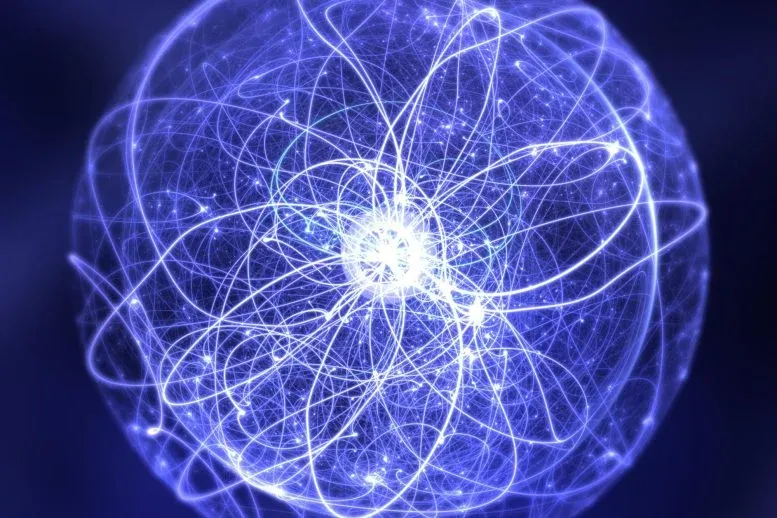
Physicists believe two very different quantum particles can combine into a new, stable form of matter. This was once thought unlikely. Researchers at Monash University predict that ultracold bosons and fermions can create self-bound "quantum droplets" under specific conditions.
Bosons and fermions follow different quantum rules. However, new theoretical work suggests that strong interactions between them can keep them bound. This challenges the old idea that stable droplets would be hard to form in such systems.
This prediction offers experimental physicists a new state of matter to explore. It could also help us better understand quantum materials. These materials are important for technologies like precise sensors and quantum computing.
We're a new kind of news feed.
Regular news is designed to drain you. We're a non-profit built to restore you. Every story we publish is scored for impact, progress, and hope.
Start Your News DetoxSam Foster, a lead author and PhD candidate at Monash University, said these findings open up new quantum states for study.
"Quantum systems can act in ways that seem impossible in our everyday world," Foster explained. "We've shown that these two very different particles can perfectly balance each other. This creates a stable droplet that holds itself together."
How Quantum Droplets Stay Together
A quantum droplet stays together differently than a regular liquid droplet. The particles attract each other, but this attraction is balanced by pressure from the fermions. This pressure stops the system from collapsing, even as the particles bind.
Foster noted that the new theory helps describe these systems better.
"Older theories could only describe these systems when particles interacted weakly," Foster said. "Our new method lets us see what happens when interactions are much stronger. That's where the most interesting physics appears."
Testing the Prediction
The calculations suggest that these droplets can be made using existing ultracold atom experiments. This means scientists could test the prediction soon.
The researchers also saw signs of quantum behavior that look like the change between a liquid and a gas. This suggests the system can support more complex quantum phases than just the droplets.
Foster believes the findings have broad implications.
"Understanding how matter organizes itself under extreme quantum conditions gives us new tools," Foster said. "These tools can help us design and control quantum systems. While this is basic research, such discoveries often become the basis for future quantum technologies."
Deep Dive & References
- Quantum Droplets in a Resonant Bose-Fermi Mixture - Physical Review Letters, 2026