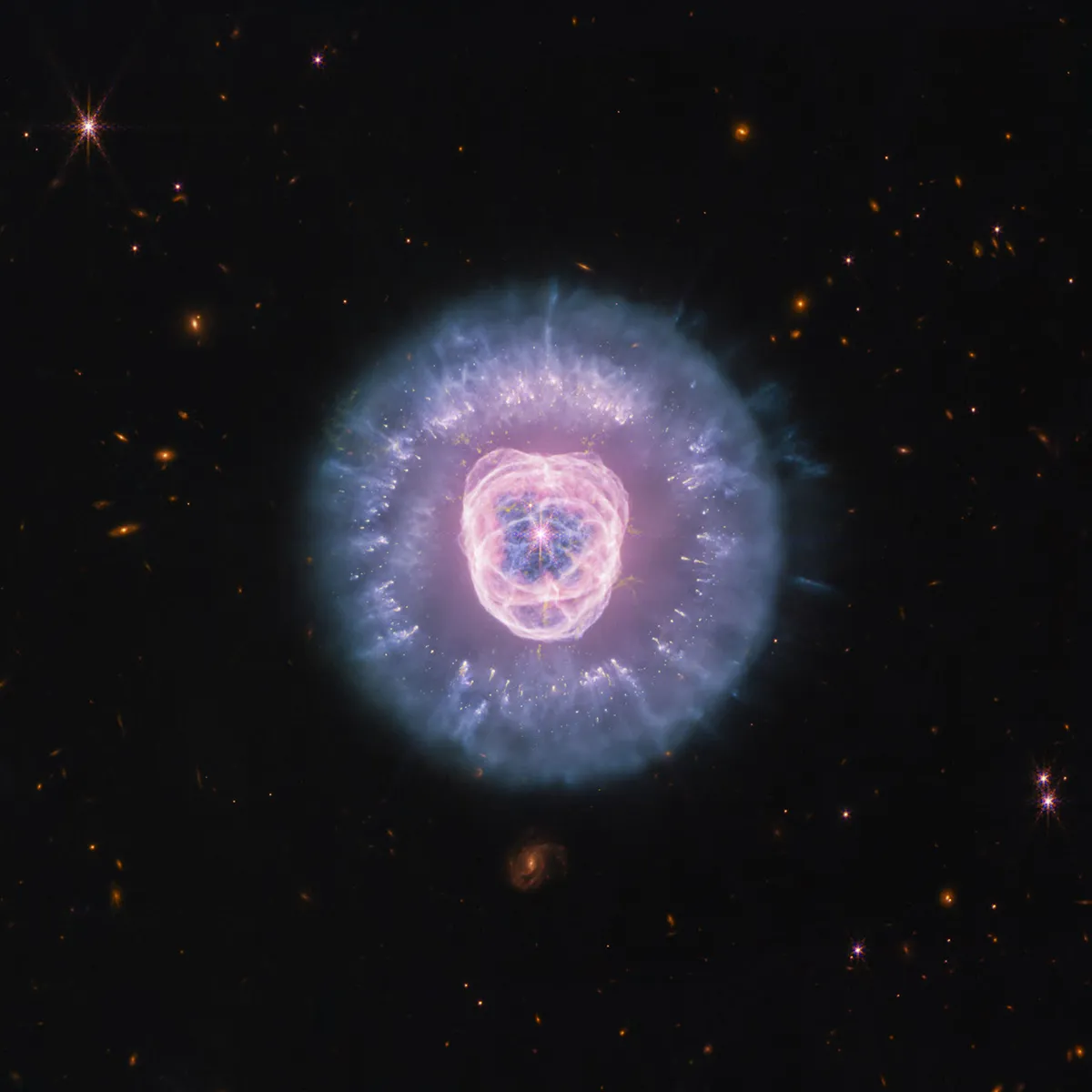
Imagine a star powered not by the fiery nuclear fusion we know and love, but by something far more mysterious: dark matter. These are "dark stars," theoretical cosmic behemoths that might have roamed the early universe. If they existed, they could have grown ridiculously large before collapsing into black holes, potentially solving one of the universe's biggest head-scratchers: how the first supermassive black holes formed so quickly.
Now, a new study suggests we might actually hear their echoes, billions of years later, in the faint gravitational hum of the universe.
Cosmic Detectives and Ancient Seeds
Researchers Sohan Ghodla and Cosmin Ilie from Colgate University have peered into the cosmic past, connecting two seemingly disparate observations: the surprisingly massive black holes spotted when the universe was just a toddler, and the gravitational waves detected today by pulsar timing arrays (PTAs).
We're a new kind of news feed.
Regular news is designed to drain you. We're a non-profit built to restore you. Every story we publish is scored for impact, progress, and hope.
Start Your News DetoxPTAs are essentially vast cosmic antennae, using networks of rapidly spinning neutron stars (pulsars) as ultra-precise clocks. As gravitational waves ripple through spacetime, they ever-so-slightly alter when these pulsar 'ticks' arrive at Earth. By monitoring many pulsars over years, scientists have detected a subtle, persistent background hum of gravitational waves.
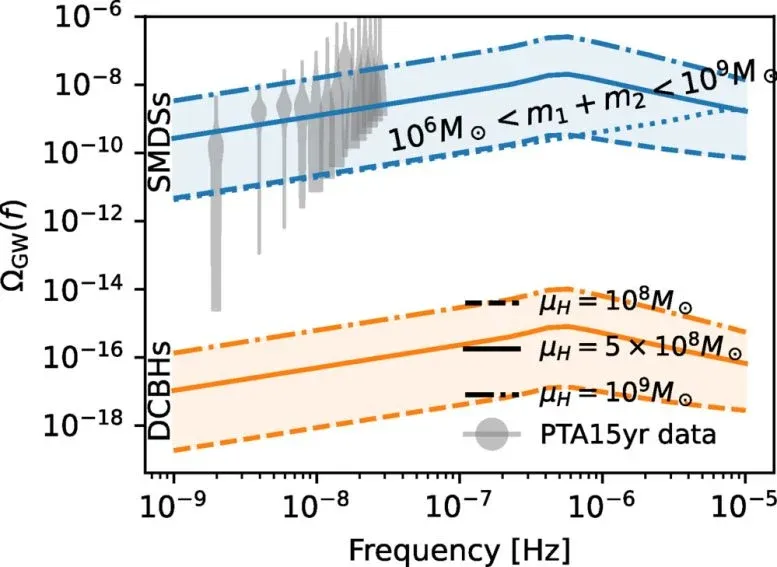
Most explanations for this hum point to pairs of supermassive black holes in the recent universe, slowly spiraling towards each other before an epic merger. But Ghodla and Ilie found a compelling alternative: the gravitational wave signal could also be a whisper from the very first black holes, born over 13 billion years ago. Specifically, the "seeds" left behind by those hypothetical supermassive dark stars.
Think about it: the James Webb Space Telescope and Chandra have shown us these unexpectedly huge black holes in the universe's infancy. How did they get so big, so fast? Dark stars offer an answer. These early universe oddities, fueled by dark matter, could have stayed relatively cool and continuously gathered matter, swelling to a million times the Sun's mass or more before collapsing.
Dark Star Legacies in Today's Waves
Ghodla and Ilie modeled how black holes born from these dark star seeds would evolve over cosmic history, merging and creating gravitational waves. Their calculations suggest that if these dark star remnants were common enough, their descendants could be a major, even dominant, source of the gravitational wave background we detect today.
Which means, incredibly, that current PTA observations can already put a limit on how many of these ancient black hole seeds could have existed. As Ilie puts it, "Dark stars were first thought of as objects that might be seen directly at cosmic dawn. This work points to a completely different way to test their possible role in cosmic history." Their echoes might be ringing in our gravitational wave detectors, right now.
So, the next time you hear about gravitational waves, remember: you might just be listening to the distant, rumbling ghosts of stars powered by the universe's deepest mystery. And that's a story worth telling.