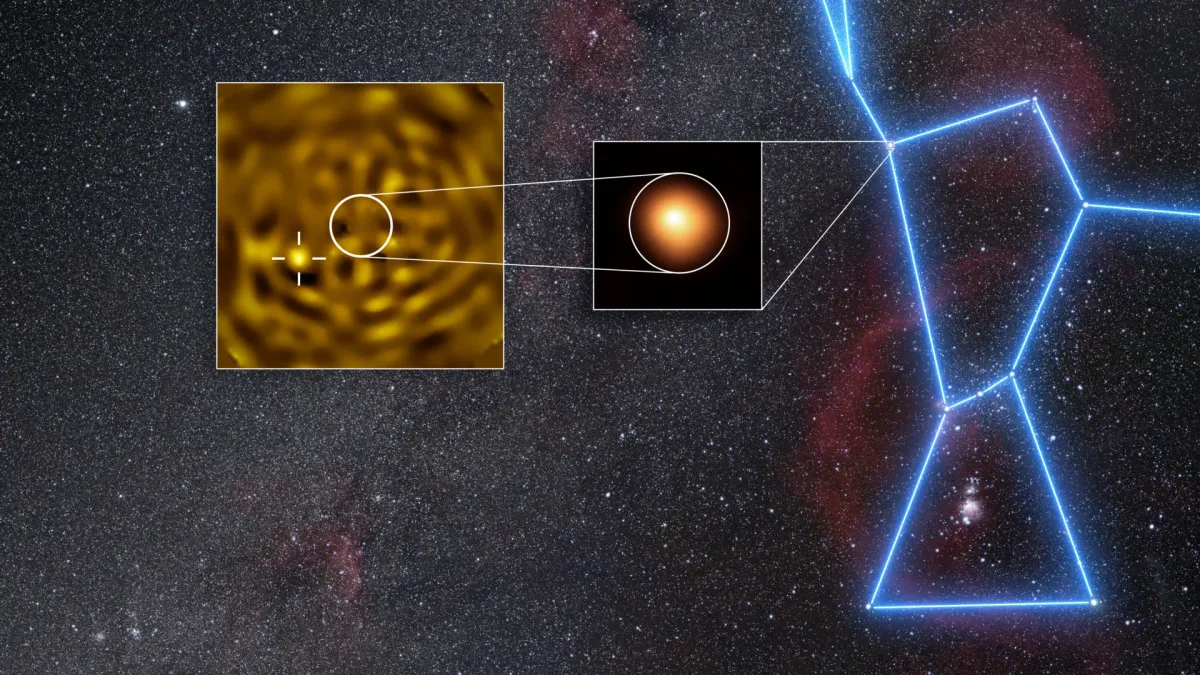
Astronomers have captured the clearest image yet of what they believe is Betelgeuse B. This star is thought to orbit Betelgeuse, a well-known red supergiant. This discovery could end a search that has lasted about 100 years.
The newly imaged companion star is surprisingly massive. It might help explain why Betelgeuse's brightness changes. It could also affect Betelgeuse's future supernova explosion.
Finding Betelgeuse's Companion
Miguel Montargès, a French astronomer, led the team that made this discovery. They used the European Southern Observatory's Very Large Telescope (ESO's VLT). Montargès described the moment he saw the images, saying he "jumped from my chair."
We're a new kind of news feed.
Regular news is designed to drain you. We're a non-profit built to restore you. Every story we publish is scored for impact, progress, and hope.
Start Your News DetoxThe idea that Betelgeuse had a companion first came up about a century ago. Scientists thought it might explain the star's changing brightness. But for decades, no one could clearly see such a star.
In 2024, two studies predicted where the companion should be. They suggested December 2024 would be the best time to see it. This is when Betelgeuse B would appear furthest from Betelgeuse from Earth's view.
Montargès and his team observed Betelgeuse that December. They spent months analyzing the data. They found Betelgeuse B was more massive than expected. Earlier estimates put its mass around that of the Sun. The new observations suggest it's two to three times larger.
The researchers used the SPHERE instrument on ESO's VLT to directly image Betelgeuse B. This means they detected light coming from the companion itself. Previous observations had hinted at its existence, but these new images are the clearest evidence yet.
The case isn't completely closed. Astronomers want to observe the companion again in a year. This would confirm its orbit.
Impact on Betelgeuse's Future
A few years ago, Betelgeuse dimmed significantly. This led to speculation that it might be about to explode as a supernova. However, Montargès' team found that a dust cloud was blocking its light.
The discovery of Betelgeuse B adds a new factor to consider. Researchers will now study if this companion could affect Betelgeuse's evolution. This includes its eventual supernova explosion.
"The question is truly opened whether this companion is going to have an impact on the evolution of the red supergiant," Montargès noted.
Deep Dive & References
VLT/SPHERE images of the candidate companion of Betelgeuse - Astronomy & Astrophysics, 2026