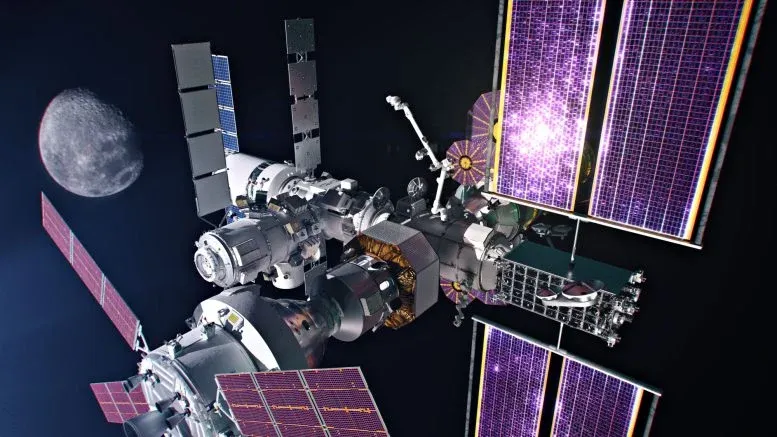
NASA is creating a "space traffic control" system for the moon. This system will manage spacecraft safely and efficiently around the planned Gateway lunar spaceport.
The Gateway is expected to be humanity's first lunar spaceport within the next two decades. It will serve various spacecraft, including Orion crew capsules, lunar landers, and cargo vehicles.
Navigating the Lunar Neighborhood
Unlike Earth airports, Gateway won't have runways. Instead, spacecraft will move through an invisible network shaped by the gravity of Earth and the moon. Their paths will follow precise mathematical rules.
We're a new kind of news feed.
Regular news is designed to drain you. We're a non-profit built to restore you. Every story we publish is scored for impact, progress, and hope.
Start Your News DetoxEngineers from Texas A&M University, NASA’s Johnson Space Center, and Purdue University are developing algorithms and strategies for this traffic control. Their work provides mathematical guidelines and "rules of the road" for spacecraft to share this challenging region safely.
Their findings, published in Acta Astronautica, focus on balancing fuel use with operational needs and reducing collision risks. Dr. Diane Davis, an associate professor of space engineering at Texas A&M, noted that future lunar exploration depends as much on traffic management as on rocket science.
Gateway's Unique Orbit
A sustained human presence near the moon needs an infrastructure for spacecraft to move without interfering with each other. Gateway and its visiting spacecraft will use a Near Rectilinear Halo Orbit (NRHO).
"The Gateway NRHO is a nearly stable and highly elongated orbit around the moon," Davis explained. It offers an uninterrupted view for communications with Earth and needs little fuel to maintain.
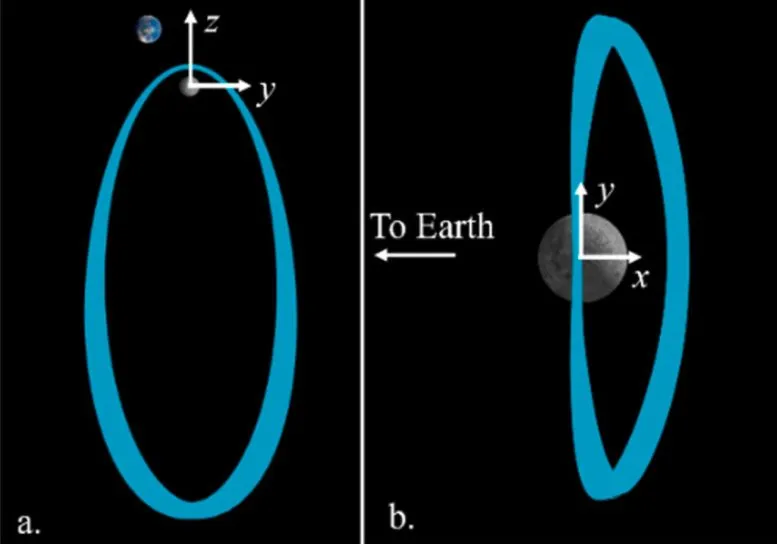
However, Gateway and nearby vehicles will experience constant gravitational pulls from both Earth and the moon. This orbit is unlike any previously used for crewed spacecraft. It takes Gateway within 1,000 miles of the moon's north pole and then nearly 40,000 miles beyond the south pole.
Managing a single station is straightforward, but it gets complex when multiple vehicles, like an Orion capsule, a cargo vehicle, and a lunar lander, need to approach, dock, or wait in the same area. Davis stressed that effective traffic management in the NRHO is vital for crew safety and mission success.
Loitering for Safety
A key concept for this traffic system is "loitering." This means carefully keeping a spacecraft in a specific position relative to an orbit while it waits.
"Loitering in space means maintaining a spacecraft relative to a specific orbit or trajectory without executing an immediate maneuver," Davis said. This is similar to how aircraft wait at gates or circle before landing.
Spacecraft approaching Gateway might need to wait for hours, days, or even weeks. The main difference is that in space, there's no fixed surface, and every vehicle is always moving.
"Every spacecraft is constantly moving," Davis noted. "It’s a Goldilocks zone of keeping ‘parked’ vehicles far enough from each other to be safe, but close enough to their destination so that resources are used efficiently.”
The research used thousands of computer simulations to find this balance. Engineers tested ways to keep spacecraft separated around Gateway, accounting for navigation errors, thruster performance, and small disturbances.

The simulations showed that small increases in station-keeping maneuvers could keep spacecraft much closer to their planned positions. This required only minor changes in fuel use.
"Greater positional accuracy means mission planners can better predict where every spacecraft will be, preserving valuable fuel," Davis explained. This predictability simplifies coordinating docking times, planning rendezvous, and reducing risks for missions.
A "String of Pearls" Formation
Instead of allowing visiting vehicles to wait independently, spacecraft could stay at carefully calculated positions ahead of or behind Gateway. This arrangement is called a "string of pearls" formation.
"Similar to the arrangement of pearls on a string necklace, spacecraft would arrange themselves naturally along the lunar orbit and relative to Gateway," Davis said. This closer formation reduces the risk of vehicles drifting too close together.
This seemingly small change could provide an important framework for managing complex operations around the moon. Davis calls it "the beginning of a new kind of traffic control" and an "exciting frontier in planning the infrastructure for an entire transportation system."
Davis's work builds on her decade at NASA’s Johnson Space Center, where she was a principal engineer and mission design lead for Gateway. Now at Texas A&M, she studies cislunar astrodynamics and space traffic management. She also prepares students for future lunar missions.
"Nothing excites me more than training and developing future engineers and scientists," Davis said. "They’ll be the ones planning lunar missions and managing space traffic for humanity beyond Earth.”
If lunar travel becomes common, safe traffic management will rely on these mathematical rules. They will determine how vehicles wait, move, and stay separated nearly 240,000 miles from Earth.
Deep Dive & References
Cislunar traffic management: Orbit maintenance and loitering in the Gateway NRHO - Acta Astronautica, 2026