NASA engineers recently did something rather dramatic: they took a brand-new, super-sleek wing design, strapped it down, and pushed it until it snapped. Not because they’re aviation sadists, but because they needed to know its breaking point. And apparently, it held up remarkably well.
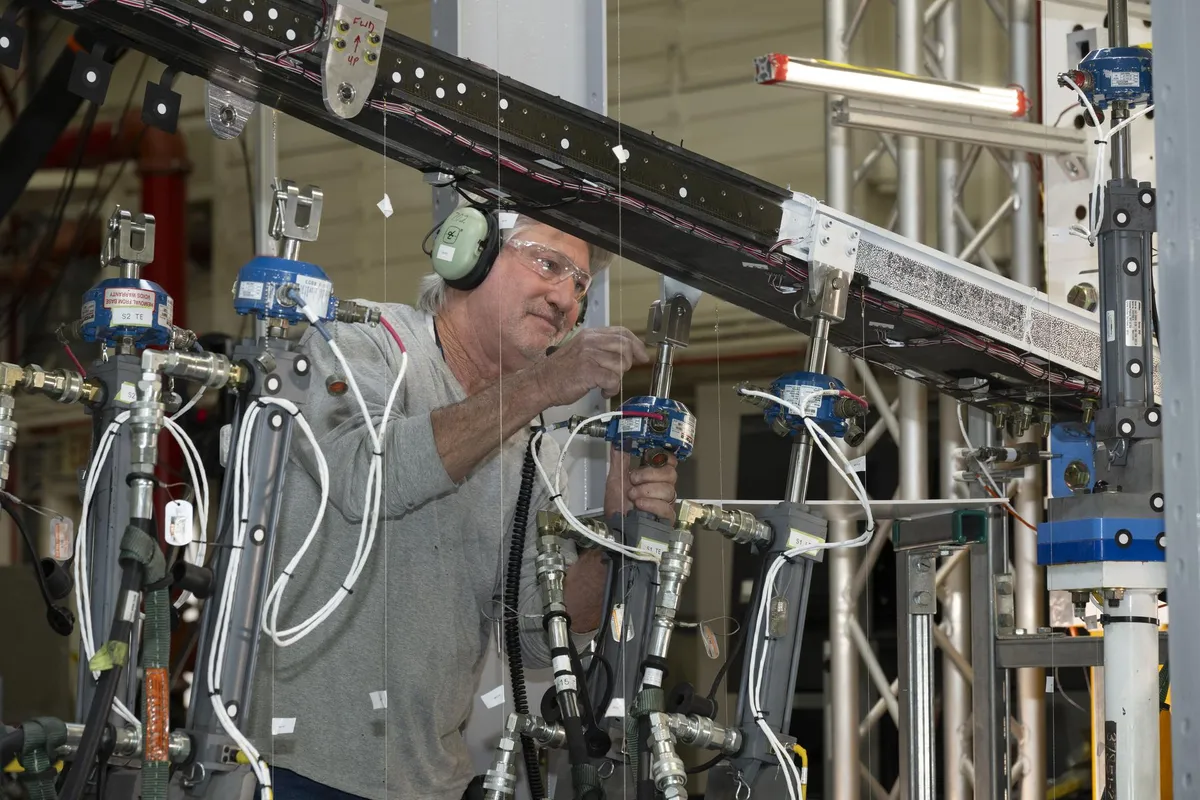
This isn't just any old wing. It’s the aptly named Structural Wing Experiment Evaluating Truss-bracing, or SWEET-15 for short. A 15-foot-long, remarkably thin, and lightweight marvel, it's a key player in NASA's quest for the hyper-efficient aircraft of tomorrow. The secret sauce? A long, slender wing supported by an aerodynamic strut, a concept that evolved from NASA's earlier Transonic Truss-Braced Wing.
Their big question: Can SWEET-15's design, crafted with five advanced composite manufacturing methods, help commercial planes sip fuel instead of guzzling it? Before they could answer that, they needed to see if it could handle the kind of forces wings experience on a Tuesday flight, let alone a turbulent one.
We're a new kind of news feed.
Regular news is designed to drain you. We're a non-profit built to restore you. Every story we publish is scored for impact, progress, and hope.
Start Your News DetoxThe Bend, The Break, The Breakthrough
For months, this cutting-edge wing, built in Virginia and shipped to California, endured a deliberate torture test in the Flight Loads Laboratory. Imagine a workout so intense, it would make a bodybuilder weep. Sensors — including super-precise fiber-optic strain sensors — meticulously tracked every groan and flex as the forces piled on.
The good news? The wing's real-world reactions perfectly matched NASA's computer models. It shrugged off expected flight forces like they were nothing, giving the team serious confidence in both the design and the innovative manufacturing processes. These methods, which use a robot named Integrated Structural Assembly of Advanced Composites (because apparently that's where we are now), create lighter, stronger structures.

Then came the grand finale: a planned test-to-failure. Engineers cranked the loads beyond the wing's design limits, just to see where it would finally give up the ghost. It finally failed at a rather impressive 127% of its design limit. The visible damage appeared near the back edge and in the upper wing cover, offering crucial insights into how the joints connecting the wing to its main strut (and a secondary "jury strut") behave under truly extreme stress.
This was a first: a composite truss-braced wing undergoing such a comprehensive structural test. The data collected from this heroic bending and breaking will be vital for future aircraft designs, pushing us closer to a future where planes are not just faster, but also significantly greener. Because who doesn't want less turbulence and more efficient travel? Exactly.