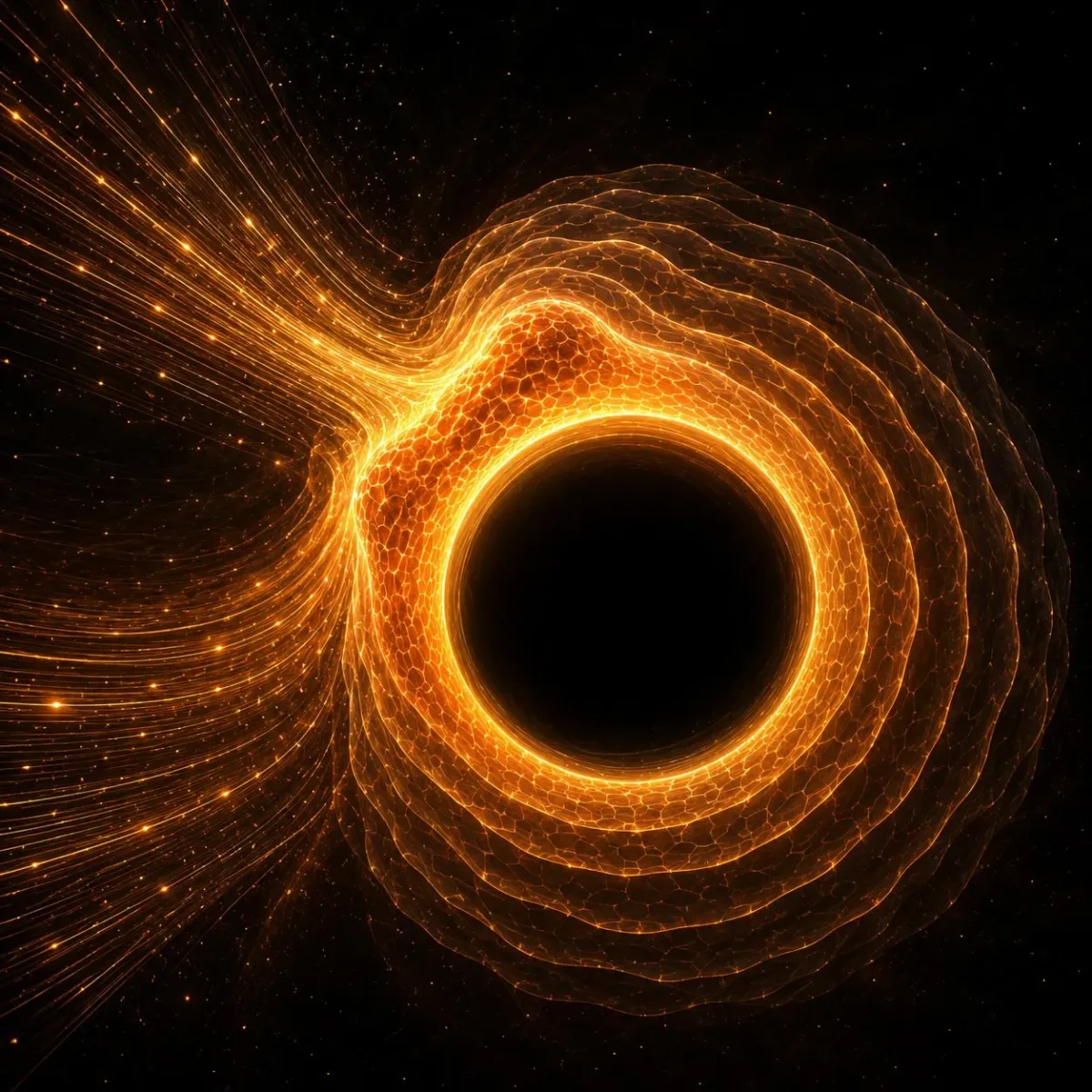
For half a century, physicists have been trying to wrangle black holes into something that makes thermodynamic sense. You know, like how boiling water behaves. Because apparently, those cosmic behemoths are just like your tea kettle, but with more existential dread.
The problem? The old rules, brilliant as they were, only worked for black holes that were, well, boring. Stable. Not doing much. Which, as anyone who’s watched a sci-fi movie knows, is not how black holes roll. They merge. They devour. They occasionally decide to evaporate just for kicks.
Now, a new theory from Penn State might finally solve this cosmic conundrum, offering a more realistic way to calculate a black hole's 'disorder' — its entropy — especially when it’s having a very dramatic day.
We're a new kind of news feed.
Regular news is designed to drain you. We're a non-profit built to restore you. Every story we publish is scored for impact, progress, and hope.
Start Your News DetoxThe Black Hole Identity Crisis
Back in the 1970s, Stephen Hawking and other brilliant minds realized black holes seemed to follow rules similar to thermodynamics. Things like heat, energy, and disorder. It was a neat trick, connecting the most extreme objects in the universe to, say, why your coffee gets cold.
But there was a catch. These laws were built for black holes at “equilibrium.” As in, perfectly still, unchanging. “But black holes are always changing. They form, merge, and eventually disappear,” says Abhay Ashtekar, the lead researcher.
Think of it this way: the old laws were like trying to understand a teenager's life by only observing them while they're asleep. You're missing all the action. Real black holes are anything but static. They hoover up matter, smash into other black holes, and even slowly leak energy through quantum processes.
Early ideas about black holes were even weirder. Since you couldn't see inside, some thought their entropy (disorder) could be infinite. And since they only absorbed, never emitted, their temperature was zero. Which, if you're trying to fit them into standard physics, is like trying to fit a square peg into a black hole.
Then Hawking dropped a bombshell: black holes can release particles and energy. He called it Hawking radiation. Suddenly, black holes had a temperature, and they could slowly lose mass. They were no longer just cosmic vacuum cleaners; they were slowly boiling, too.
Hawking suggested a black hole's entropy was tied to its event horizon — that point of no return where not even light can escape. And its temperature linked to its mass and spin. Perfect for a stable black hole. But what about the ones that are, you know, doing stuff?
When Horizons Get Teleological (It's Not a Good Thing)
Here’s where it gets weird. The event horizon, the boundary that defines a black hole, is a bit of a tricky customer. “These ideas only really work for a black hole that is stable,” explains Jonathan Shu, another author on the paper. “In changing situations, event horizons can form and grow in empty space. This makes them ‘teleological.’”
Teleological. It sounds like a philosophical debate, and in a way, it is. It means the event horizon's properties depend on future events that might or might not happen. So, measuring a black hole's true physical entropy based on something that’s still making up its mind about the future? Not ideal.
Enter the “dynamical horizons.” These aren't some new-age concept; they're already used in computer simulations of black holes. Crucially, a dynamical horizon can be defined by a black hole's properties right now, at a specific moment. No crystal ball needed.
“This lets us extend the first and second laws of thermodynamics to black holes that are not stable,” Ashtekar notes. Finally, a way to understand black holes that are actually living their best, chaotic lives. This new framework could help scientists figure out what happens when black holes merge (like those gravitational wave detections by LIGO) or when they eventually evaporate into nothingness.
Because apparently, even the most extreme objects in the universe deserve a proper thermodynamic accounting.