Future spacecraft might travel further by using forces from planets, sunlight, and the solar wind. This means they would not need to carry heavy fuel.
Every rocket today needs to carry its own fuel. This fuel is burned and pushed out to make the rocket move forward. But more fuel means more weight, which then needs even more fuel to speed up. This makes long-distance space travel, especially to other stars, very hard.
What if a spacecraft could move without any fuel? A new review looks into this idea. It explores technologies that get energy or push from forces already in space. These methods could allow missions that regular rockets cannot do.
We're a new kind of news feed.
Regular news is designed to drain you. We're a non-profit built to restore you. Every story we publish is scored for impact, progress, and hope.
Start Your News DetoxHow Spacecraft Can Move Without Fuel
Gravity Assists
Gravity assists are a proven way to move spacecraft without fuel. For decades, engineers have used this method. A spacecraft flies past a planet at just the right time and angle. It "borrows" a tiny bit of the planet's movement, gaining speed without burning any fuel.
The Voyager spacecraft used gravity assists to visit all four outer planets. The main challenge is timing. The planets must be lined up correctly, so launch chances are rare, and routes are limited.
Solar and Magnetic Sails
Solar sails offer a more constant way to move. They use the pressure from sunlight. These huge, thin membranes reflect photons, which creates a gentle but steady push. This push slowly speeds up the spacecraft without any fuel.
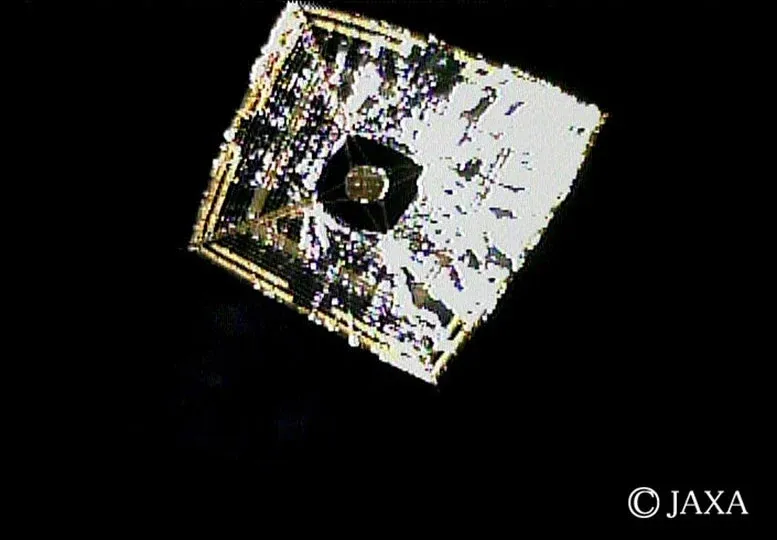
In 2010, Japan's IKAROS probe showed this works by traveling to Venus using only sunlight. However, solar sails need very large, thin materials that must last for years in space. Their power also drops a lot the farther they get from the Sun.
Magnetic sails work differently. They use special loops that create strong magnetic fields. These fields push against the solar wind, which is a stream of charged particles from the Sun. By pushing against this plasma, magnetic sails create thrust without using fuel. They could offer faster acceleration than solar sails and might not wear out as quickly.
The problem is that these magnetic fields need huge superconducting coils, possibly 50 kilometers wide. These coils also need to be kept extremely cold. The technology to build and launch such large structures does not exist yet.
Electric sails are a newer idea. They use charged wires instead of magnetic fields to push away solar wind particles. These systems could lead to lighter spacecraft than magnetic sails. But they also need very long, light wires and a lot of electricity to keep them charged.
The Future of Propellantless Travel
Each of these methods has its own benefits and challenges. Gravity assists work now but need perfect planetary alignments. Solar sails give a steady push but need huge, delicate structures. Magnetic and electric sails avoid material problems but rely on technology still being developed.
The review shows that no single method solves all problems. But together, these technologies could change how we explore space. For very ambitious missions to other star systems, not carrying fuel might be absolutely necessary.
Deep Dive & References
Propellantless space exploration - Acta Astronautica, 2026