Imagine trying to track something you can't see, that rarely interacts with anything, and moves incredibly fast. That's the daily grind for particle physicists. But now, a new detector called PLATON is stepping into the ring, promising to make the invisible visible, in full 3D.
Instead of the usual million tiny pieces, PLATON uses a single block of material, a specialized camera, sensitive light sensors, and AI to map particle paths with uncanny speed and detail. Simulations suggest it could out-perform current detectors while being much easier to scale up. It might even give us clearer medical scans down the line.
The Absurdity of Tracking Nothing
Sometimes, big physics breakthroughs come from a brand-new theory. More often, though, it's about taking familiar tools and smashing them together in a clever new way. This is especially true when you're hunting for things like neutrinos or dark matter candidates — particles so elusive they make a teenager avoiding chores look like an overachiever. They barely interact with regular matter, which is great for them, terrible for us.
We're a new kind of news feed.
Regular news is designed to drain you. We're a non-profit built to restore you. Every story we publish is scored for impact, progress, and hope.
Start Your News DetoxTo catch these phantoms, detectors need to be huge and have incredible resolution. The problem? Bigger usually means vastly more complex and wallet-draining. The typical solution involves filling a space with scintillator material (which flashes tiny bits of light when a charged particle passes through it) and then chopping that material into millions of miniature sections. Each section gets its own optical fiber, which funnels the light to a sensor. It's precise, yes. It's also a logistical nightmare. The T2K experiment in Japan, for example, uses two million cubes and 60,000 fibers. Just building and reading all that is a full-time job for a small army of engineers and a larger army of accountants.
A Plenoptic Plot Twist
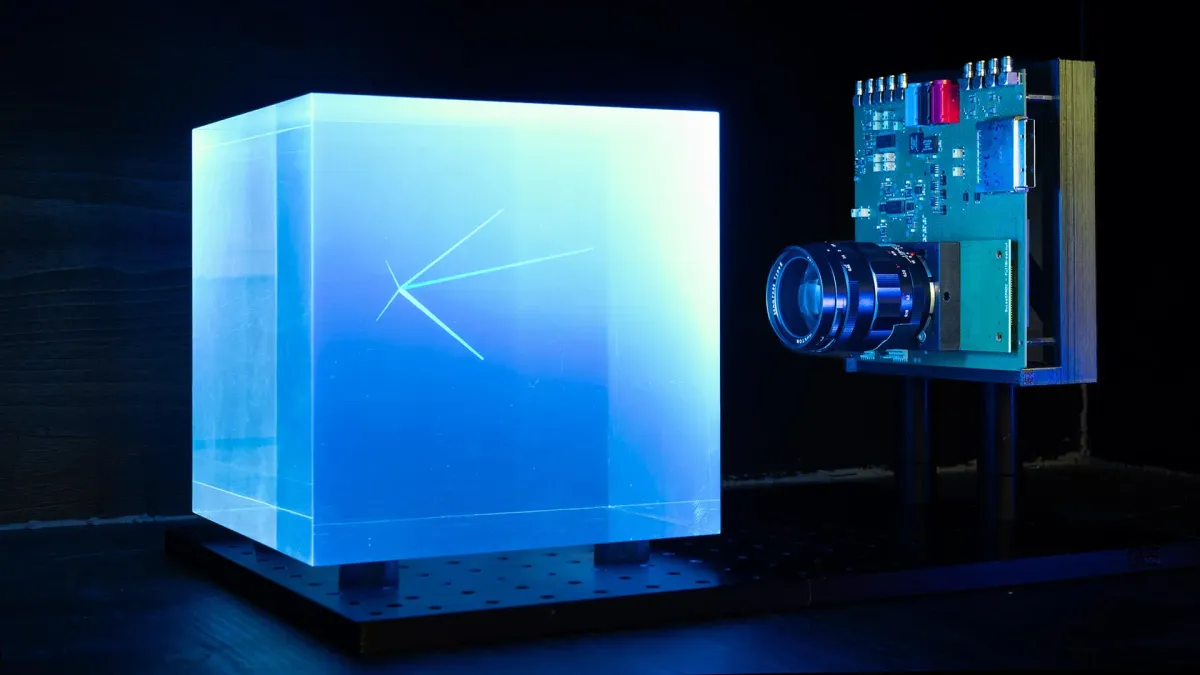
Researchers at ETH Zurich and EPFL decided to ditch the tiny pieces. Led by Till Dieminger, Dr. Saúl Alonso-Monsalve, Professor Davide Sgalaberna, and Professor Edoardo Charbon's group, they built the first prototype of a detector that can perform fast, high-resolution 3D imaging inside one large, undivided block of scintillator. Let that sink in for a moment.
Their secret weapon? A technology inspired by plenoptic cameras, also known as light field cameras. While your phone camera just captures how bright something is, a light field camera also captures the direction that light is coming from. This allows it to reconstruct a scene in 3D. How? It places a micro-lens array (imagine hundreds of tiny lenses) between the main lens and the sensor. Each tiny lens acts like its own mini-camera, seeing the same scene from a slightly different angle. Stitching all that together gives you the full, glorious light field. Combine this with single-photon avalanche diode (SPAD) array sensors, which can detect individual photons, and you've got a system that can reconstruct particle tracks from the faintest flickers of light. It's like giving a detective X-ray vision and a super-sensitive ear for whispers.
Inside the PLATON Prototype
The PLATON project's prototype combines this micro-lens array with a SwissSPAD2 imaging sensor. The genius part: the MLA was designed by Raytrix GmbH and placed directly onto the sensor. The SwissSPAD2 also boasts "gated photon detection," meaning it only bothers to record photons during specific, pre-selected time windows. Because who needs random background noise when you're trying to spot a ghost particle?
They tested PLATON with light levels ranging from hundreds of photons all the way down to a measly five. They even shot electrons from a strontium-90 source into a plastic scintillator block to map their positions. The lab results mirrored their simulations almost perfectly, which is always a good sign for scientists (and a bad sign for anyone betting against them).
The AI Upgrade and Beyond
Future versions of PLATON will get an upgraded SPAD array sensor that gives each detected photon its own exact timestamp. Think of it: not just when it appeared, but precisely when. This extra timing data should make particle track reconstruction even more accurate. They're also optimizing the plenoptic camera itself to see more and collect more light, which, according to simulations, will only boost resolution further.
But here's where it gets really interesting: they're also using a neural network (NN) with a Transformer architecture — the same kind used in large language models like the one you're reading now. Except instead of analyzing words, this Transformer crunches patterns in scintillation photons. It identifies correlations in where and when photons appear to reconstruct the original particle interaction. Simulations show a 10x10x10 cm PLATON detector could achieve sub-millimeter spatial resolution and accurately identify low-momentum neutrino interactions. That's like spotting a specific fly in a stadium from orbit.
The team even modeled a one-cubic-meter block of scintillator, and simulations suggest it could achieve a resolution of a few millimeters. That puts it on par with current plastic scintillator detectors, but without the millions of fiddly pieces. The goal? Sub-millimeter resolution in detectors larger than a cubic meter. Because if you're going to dream, dream big.
And it's not just for particle physics. The researchers have already filed three patents for using PLATON technology in positron emission tomography (PET) scans, which track radioactive tracers in the body. Particle physics has a habit of spawning technologies that change the world (hello, World Wide Web, thanks CERN!). PLATON might just be the next one in a long line of scientific mic-drops.