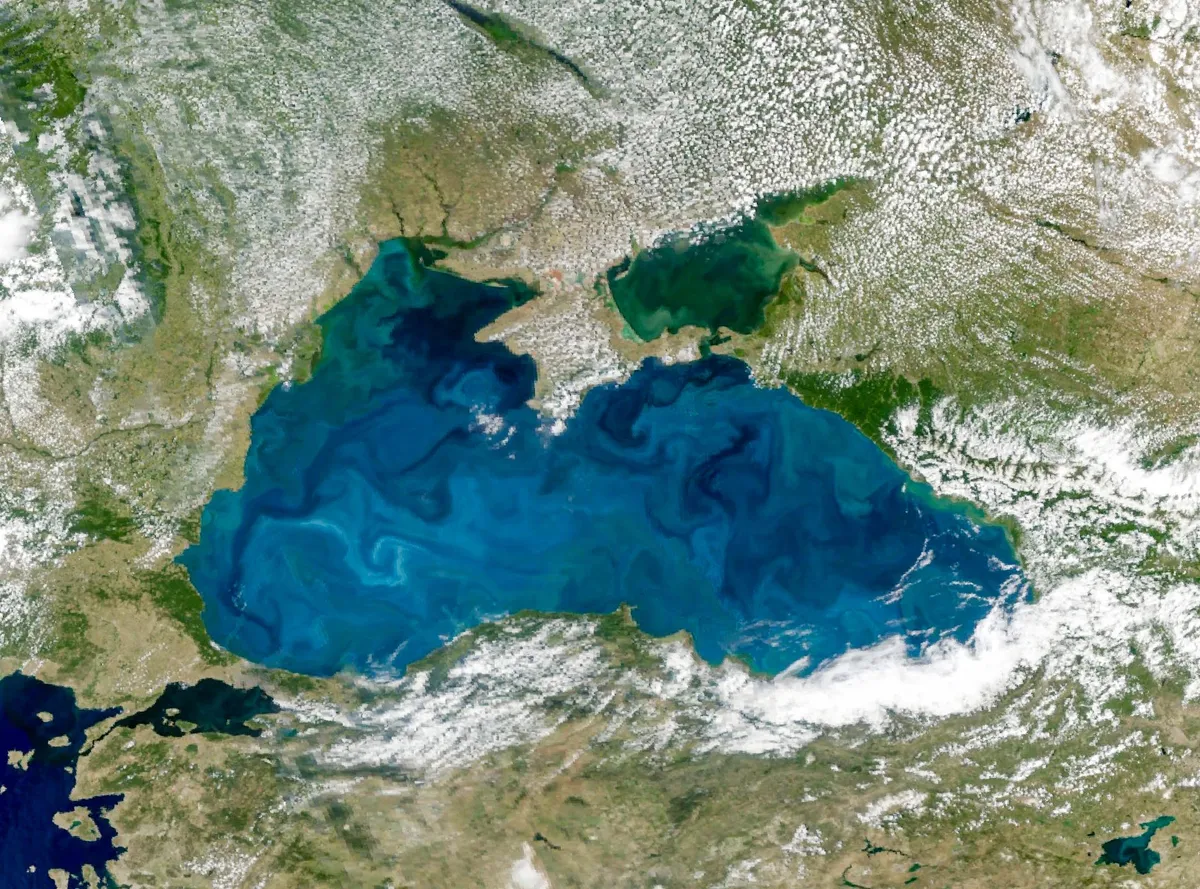
The Black Sea, usually dark, transforms into a vibrant turquoise each spring and summer. This stunning change is caused by massive blooms of microscopic plankton. NASA's PACE satellite recently captured this dazzling spectacle from space.
The Black Sea's Turquoise Secret
The Black Sea sits between Europe and Asia, connecting to the Mediterranean Sea. While its waters are often deep and dark, a dramatic color shift happens seasonally. Broad swirls of turquoise spread across its surface.
NASA's PACE (Plankton, Aerosol, Cloud, ocean Ecosystem) satellite observed this change on June 22, 2026. Its OCI (Ocean Color Instrument) showed bright blue and turquoise patterns stretching across the sea.
We're a new kind of news feed.
Regular news is designed to drain you. We're a non-profit built to restore you. Every story we publish is scored for impact, progress, and hope.
Start Your News DetoxTiny organisms called coccolithophores create this striking color. These microscopic phytoplankton have small plates made of calcium carbonate. When they gather in huge numbers, their reflective coverings make the water look cloudy and milky blue.
Coccolithophores are very common in the Black Sea during late spring and early summer. At other times, diatoms, another type of microscopic algae, might be more abundant. Diatoms have silica shells and generally make the water appear darker.
A Colorful Bloom Reaches Istanbul
The turquoise waters were also seen in the Bosphorus. This narrow channel runs through Istanbul and connects the Black Sea to the Sea of Marmara.
About a month before the PACE satellite observation, on May 27, 2026, an astronaut on the International Space Station photographed the colorful strait. The image shows blooming phytoplankton moving with the currents on both sides of the waterway.
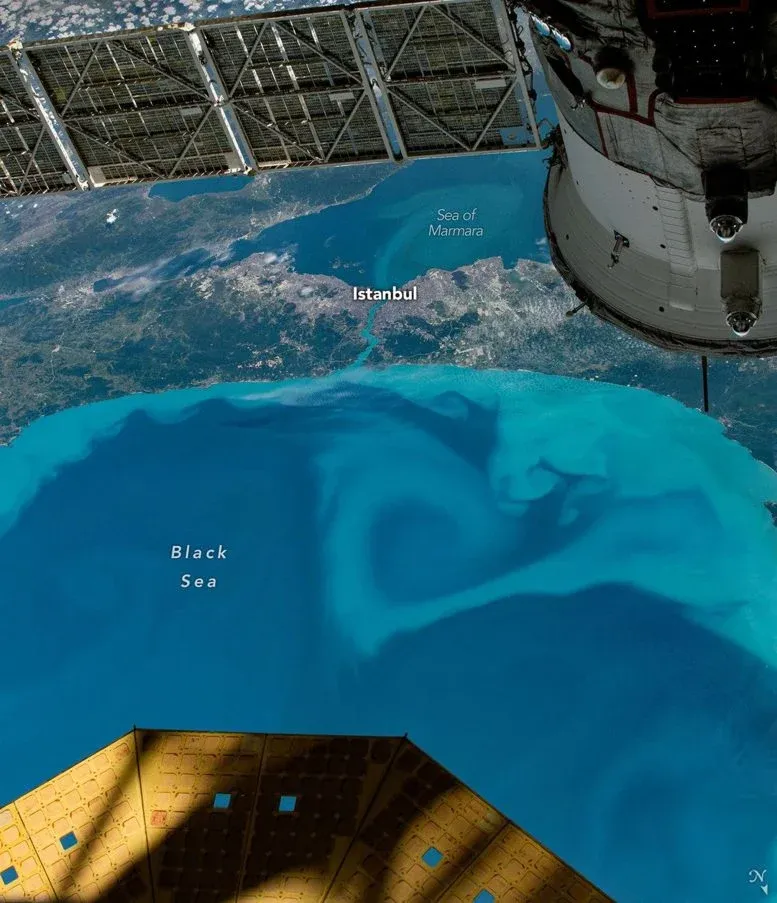 An astronaut aboard the International Space Station photographed turquoise phytoplankton blooms flowing through the Bosphorus on May 27, 2026, revealing currents on both sides of the strait.
A single coccolithophore is too small to see without a microscope. But during a large bloom, these organisms multiply so much that their collective presence is visible from space.
Satellites and astronaut observations help scientists track how these blooms form, spread, and change. This is especially useful in areas where it's hard for researchers to collect water samples directly.
Black Sea Blooms and the Carbon Cycle
These blooms are more than just a beautiful sight. Coccolithophores also play a role in the ocean's carbon cycle. They absorb carbon as they grow.
When these organisms die, some of that carbon sinks with their remains to the seafloor. Once there, it can stay out of the atmosphere for a long time.
Deep Dive & References
NASA Earth Observatory - NASA, 2024