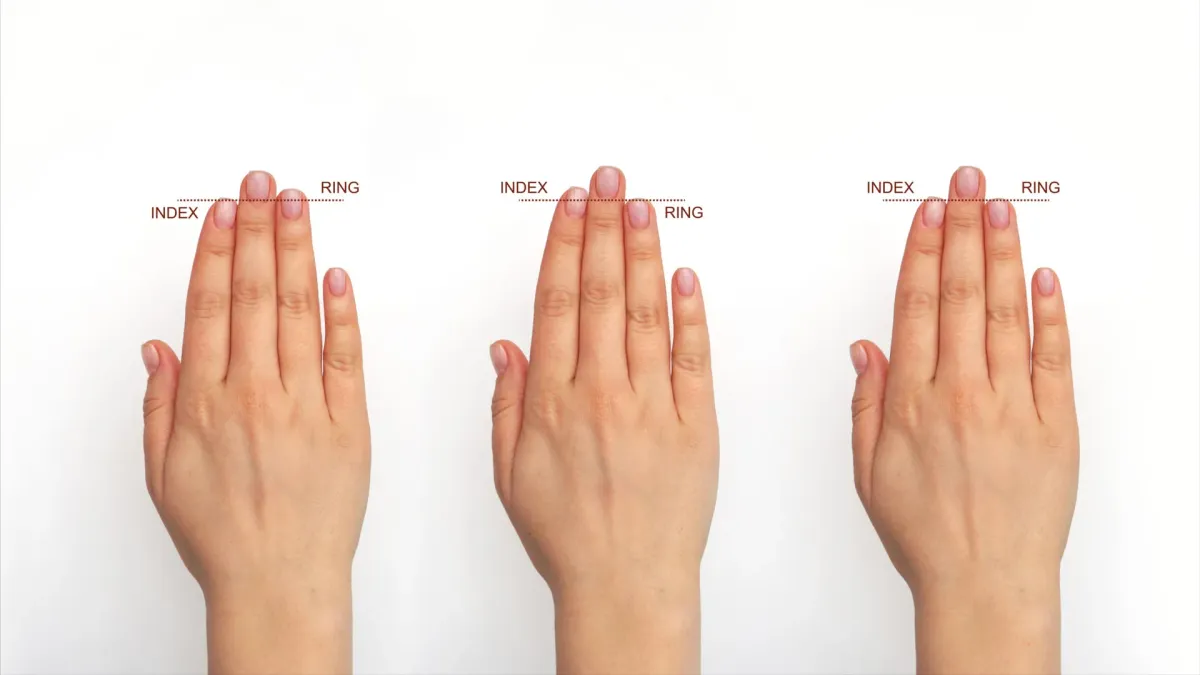
Ever wonder what your fingers are really up to? Beyond pointing at things and scrolling endlessly, a new study suggests they might just be holding a tiny, personal secret to human brain evolution. Specifically, a baby boy's finger length could hint at how prenatal estrogen helped our ancestors get those impressive craniums.
Turns out, boys with a specific finger pattern – one linked to higher estrogen exposure before birth – tended to have bigger heads. And since head size and brain size are pretty much BFFs in newborns, this is a fascinating little clue. Girls? Not so much, the study found. Apparently, our brains have different origin stories.
Leading the charge on this digits-to-domes detective work is Professor John Manning from Swansea University. He's a fan of what's called the "digit ratio," which is basically just comparing your index finger (the 2D) to your ring finger (the 4D). This ratio is a surprisingly good sneak peek into the estrogen-to-testosterone balance a fetus experienced way back in early pregnancy. A higher ratio, meaning a longer index finger, whispers tales of more estrogen than testosterone.
We're a new kind of news feed.
Regular news is designed to drain you. We're a non-profit built to restore you. Every story we publish is scored for impact, progress, and hope.
Start Your News DetoxThe Great Head-Size Reveal
For the study, researchers measured the 2D:4D ratio and head circumference of 225 newborns (100 boys, 125 girls). Head circumference is the go-to measurement for estimating brain size in tiny humans, and it's even been linked to how smart a kid might be later on. No pressure, little fingers.
The big reveal? Boys with a higher 2D:4D ratio consistently had larger head circumferences. Translation: more estrogen before birth, bigger brains for boys. This connection was a no-show for the girls, which, if you think about it, is both impressive and slightly terrifying.
These findings lend some serious weight to the "estrogenized ape hypothesis." The idea here is that as human brains swelled to their current magnificent proportions, our skeletons actually got a bit more... delicate. More feminine, even.
Professor Manning points out that this brain growth happened right alongside this "feminization of the skeleton." He also notes that those high 2D:4D ratios in males have been linked to a few less-than-ideal health outcomes, like heart issues, lower sperm counts, and a higher chance of schizophrenia. But hey, a bigger brain might just be worth a few trade-offs, evolutionarily speaking.
It seems the evolutionary push for bigger, better brains was such a strong advantage that it was worth the biological costs for males. So, next time you're idly tapping your fingers, remember: they might just be an ancient receipt for your brain's evolutionary journey.