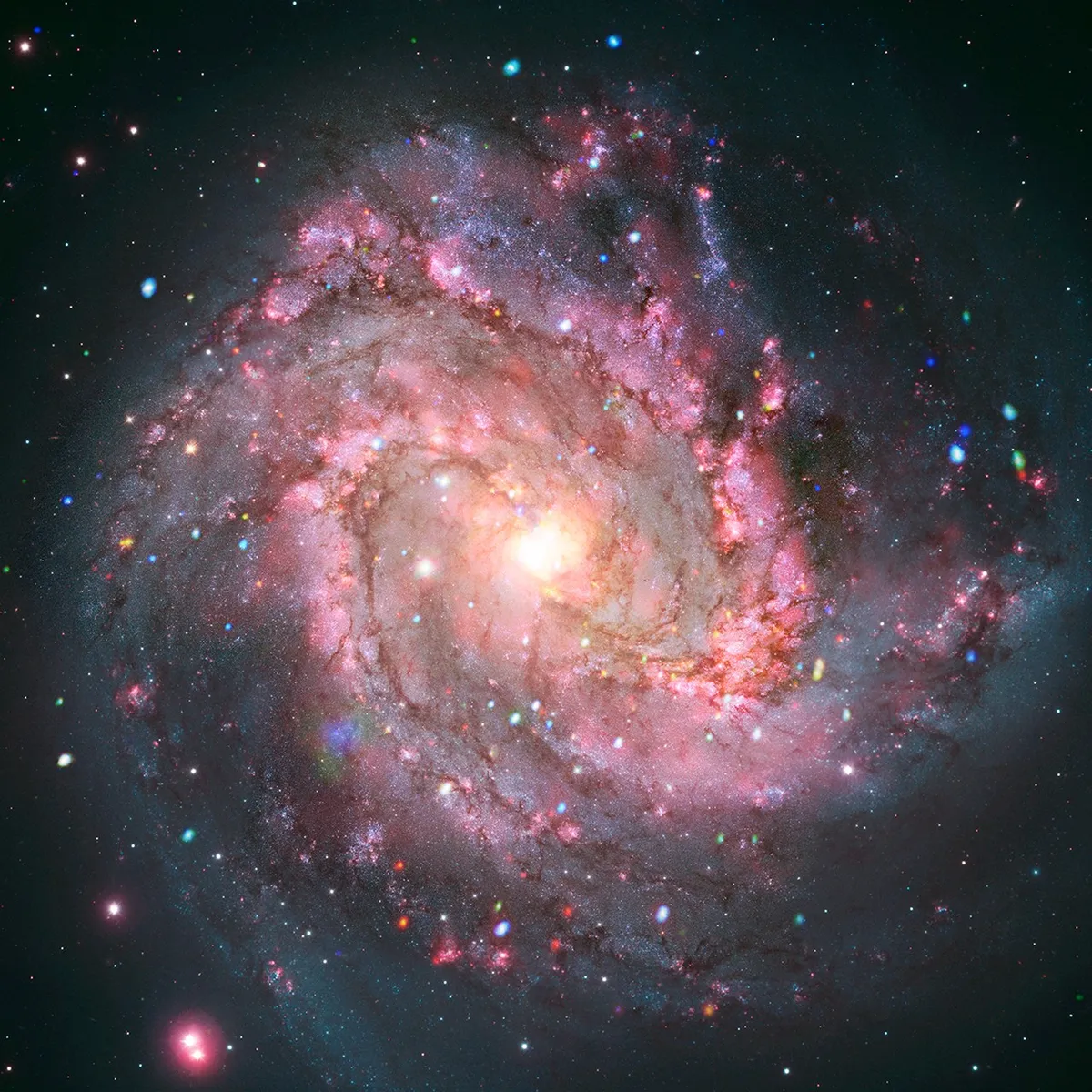
For decades, astronomers thought stellar explosions faded gracefully into the cosmic background, like a grand old fireworks display slowly fizzling out. Turns out, the universe had other plans. NASA's Chandra X-ray Observatory just caught a whole galaxy throwing a surprise party in the aftermath of its supernovae, with debris clouds dramatically shifting brightness instead of just... poofing.
This cosmic plot twist unfolded in Messier 83 (M83), a galaxy about 15 million light-years from Earth that's basically a star-making factory on overdrive. Researchers sifted through 14 years of Chandra data and found that nearly half of the supposed supernova remnants weren't playing by the rules. Instead of a slow fade, these ancient stellar ghosts were flaring, dimming, and generally doing whatever they wanted.
"We knew that individual X-ray sources could vary dramatically," said Andrea Prestwich, who led the study from the Catholic University of America. "But finding that so many supernova remnants were behaving this way was a real surprise."
We're a new kind of news feed.
Regular news is designed to drain you. We're a non-profit built to restore you. Every story we publish is scored for impact, progress, and hope.
Start Your News DetoxOne remnant, SN 1957D, has a neat explanation: it's a nearly 70-year-old explosion still slamming into nearby material, causing X-ray fireworks. But that doesn't account for the others. So, what's going on?
Stellar Survivors and Cosmic Recycling
The leading theory is straight out of a sci-fi novel: "stellar survivors." Imagine two massive stars in a cosmic dance. One goes supernova, leaving behind a black hole or a super-dense neutron star. The other star? It lives to tell the tale, now locked in orbit with its incredibly dense ex-partner.

"It may be that this galaxy contains a collection of supernova remnants where one massive star survives the supernova and becomes locked into an orbit with a black hole or neutron star," explained co-author Michael McCollough. This black hole or neutron star then starts siphoning off material from its companion. That material gets superheated, glows in X-rays, and voila – cosmic fireworks.
These systems are called high-mass X-ray binaries (HMXBs), and their variable X-ray brightness is well-known. What's new is finding over 20 strong candidates linked to supernova remnants in a single galaxy. Before this, only a handful had ever been spotted across all galaxies. Apparently, M83 is just showing off.
Another intriguing possibility? "Cosmic recycling." As in, the black hole or neutron star might be pulling back some of the very material it blasted out in the initial explosion. "And it's quite possible that both explanations are at play — different sources in our sample may have different origins," added co-author Roy Kilgard. Because why settle for one mind-bending scenario when you can have two?
These findings aren't confined to M83 either. Similar variable X-ray sources tied to supernova remnants have popped up in the galaxy M51, suggesting this cosmic disco might be common in star-forming galaxies. So, the next time you picture a supernova, remember: the show might just be getting started.