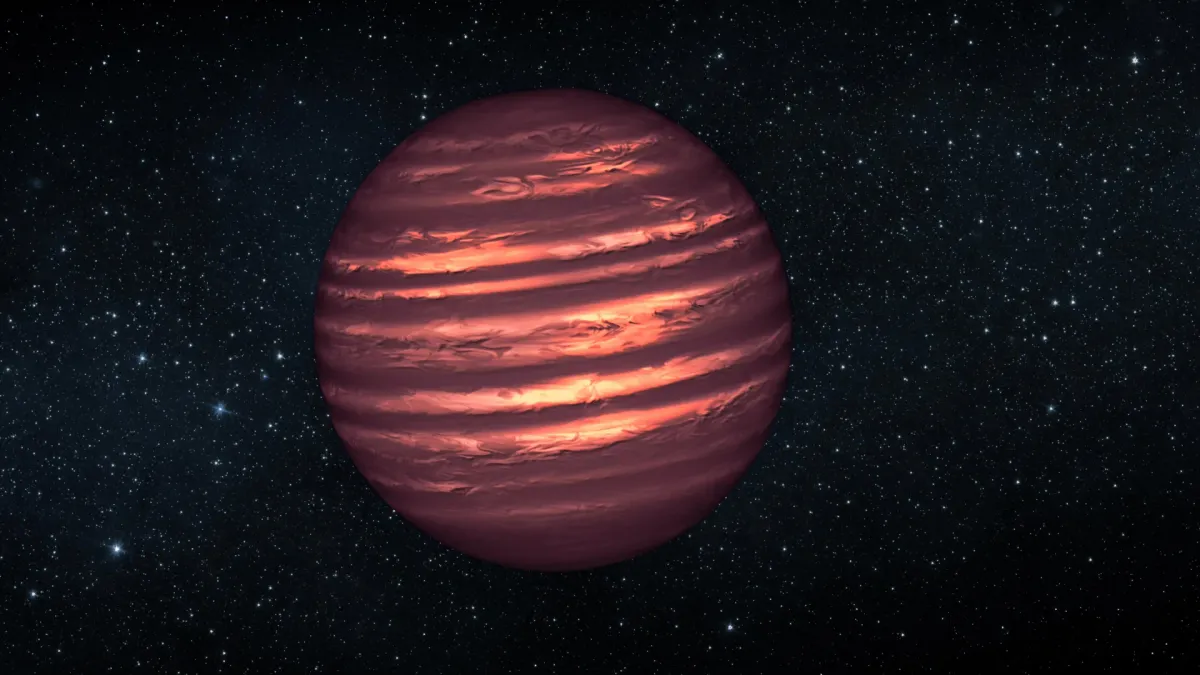
The search for Planet Nine continues, and new discoveries are making this solar system mystery even more complex.
The idea of a large, undiscovered planet at the edge of our solar system has been around for a long time. Before Pluto was found in the 1930s, astronomers suggested "Planet X." They thought its gravity could explain why Uranus's orbit didn't quite match predictions.
This mystery was solved in the 1990s when Neptune's mass was recalculated. But in 2016, Caltech astronomers Konstantin Batygin and Mike Brown proposed a new theory for Planet Nine.
We're a new kind of news feed.
Regular news is designed to drain you. We're a non-profit built to restore you. Every story we publish is scored for impact, progress, and hope.
Start Your News DetoxThe Kuiper Belt Connection
Batygin and Brown's theory focuses on the Kuiper Belt. This is a vast region beyond Neptune filled with dwarf planets, asteroids, and other objects, including Pluto. Many objects in the Kuiper Belt, also called trans-Neptunian objects, have unusual orbits. They don't move in a smooth, expected path around the Sun.
The astronomers suggested that a large, unseen planet's gravity must be pulling on these objects, causing their strange orbits. This is similar to how Earth's gravity affects the Moon's orbit, making it spiral as it goes around the Sun. Many Kuiper Belt objects show signs that something more than just the Sun's gravity is influencing them.
Initially, many astronomers were doubtful about Planet Nine. However, more powerful telescopes have provided growing evidence that trans-Neptunian objects do indeed have erratic orbits. Mike Brown stated in 2024 that it's "very unlikely that P9 does not exist." He believes there are no other explanations for the effects seen in the solar system.
For example, in 2018, a new dwarf planet candidate called 2017 OF201 was found. It's about 700 kilometers across and has a very stretched-out, elliptical orbit. This kind of orbit suggests either an early impact or the gravitational pull of Planet Nine.
Challenges to the Theory
If Planet Nine exists, why haven't we found it yet? Some astronomers question if we have enough orbital data from Kuiper Belt objects to draw firm conclusions. Other ideas for their motion include a ring of debris or even a small black hole.
The biggest challenge is that the outer solar system hasn't been observed for very long. For instance, 2017 OF201 takes about 24,000 years to orbit the Sun. While we can find an object's path quickly, seeing subtle gravitational changes might require observing it for four or five full orbits.
New discoveries in the Kuiper Belt have also complicated the Planet Nine theory. The latest is 2023 KQ14, found by the Subaru telescope in Hawaii.
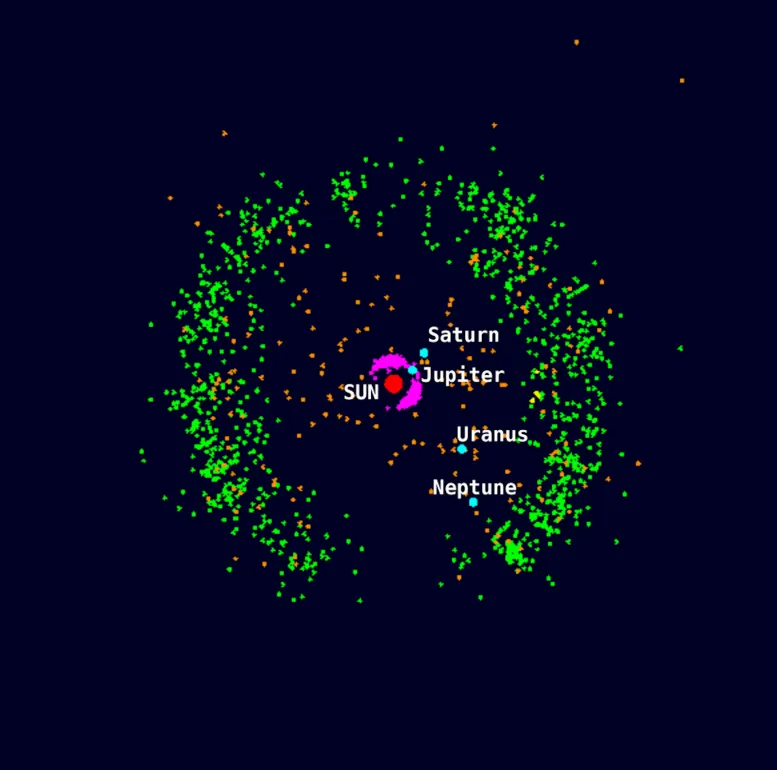
This object is a "sednoid," meaning it spends most of its time very far from the Sun, beyond Neptune's gravitational influence. 2023 KQ14's closest approach to the Sun is about 71 AU (astronomical units), and its furthest is about 433 AU. (One AU is the distance from Earth to the Sun; Neptune is about 30 AU away.)
Like 2017 OF201, this new object has a very elliptical orbit. However, its orbit is more stable, suggesting that no large planet, including a hypothetical Planet Nine, is significantly affecting its path. If Planet Nine exists, it might have to be even farther away, perhaps beyond 500 AU from the Sun.
This is the fourth sednoid discovered, and the other three also have stable orbits. This further suggests that if Planet Nine is real, it must be very far away.
Despite these challenges, the possibility of a massive planet influencing the Kuiper Belt remains. However, finding such a planet is difficult. A spacecraft like NASA's New Horizons would take 118 years to travel far enough to find it.
So, for now, we must rely on telescopes on Earth and in space. As our observing technology improves, we continue to discover new asteroids and distant objects. These discoveries will gradually reveal more about what lies at the edge of our solar system.
Deep Dive & References
New theory of a potential planet nine - NASA, 2016 Mounting evidence for Planet 9 - EarthSky, 2019 2017 OF201 discovery - arXiv, 2018 2023 KQ14 discovery - Nature Astronomy, 2025