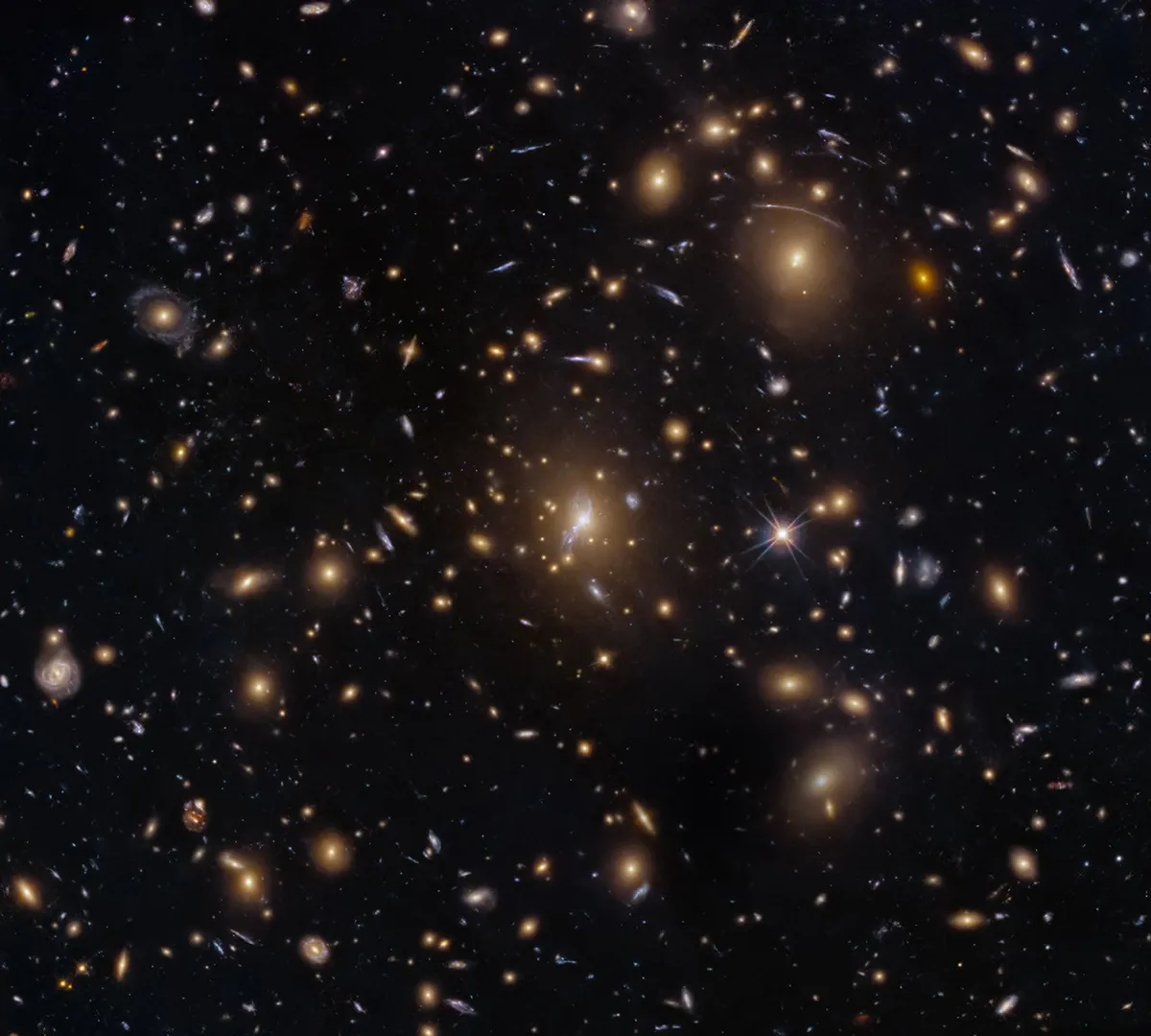
Ever wonder what a cosmic bee swarm looks like? Turns out, it's a galaxy cluster named MACS0329-0211, and the Hubble Space Telescope just gave us a stunning look. This isn't just a pretty picture; these massive galactic gatherings are essentially cosmic magnifying glasses. Their immense gravity bends light, pulling distant galaxies from the very early universe right into our view. Because apparently that's where we are now: using entire galaxy clusters as telescopes.
What's Buzzing Inside?
Zoom in on this particular swarm and you'll find a mix. There are the big, stately oval-shaped elliptical galaxies, looking like cosmic footballs. Then you've got the elegant, thin spiral and lenticular galaxies, often caught edge-on like cosmic frisbees. And, of course, some spirals are face-on, their graceful, curving arms clearly visible, probably wondering why Hubble is staring.
Up in the upper-right, keep an eye out for faint, stretched arcs of even more distant galaxies. These are the ones getting the full gravitational lens treatment, twisted and pulled into bizarre shapes. The biggest arc hovers above a particularly bright, giant elliptical galaxy, almost like a cosmic eyebrow.
We're a new kind of news feed.
Regular news is designed to drain you. We're a non-profit built to restore you. Every story we publish is scored for impact, progress, and hope.
Start Your News DetoxBut the real showstopper is near the center. Look closely and you'll spot several bright-white, intersecting curves that look suspiciously like a distorted figure eight. That's likely another distant galaxy, its light not just magnified but completely warped by the cluster's colossal gravitational pull. Which, if you think about it, is both impressive and slightly terrifying.
Hubble snagged these images as part of a mission studying galaxy clusters that shine brightly in X-rays. Using its Advanced Camera for Surveys and Wide Field Camera 3, it gathered data across visible and infrared light. Because when you're trying to figure out what a galactic bee swarm is made of, you need all the light you can get.