For years, astronomers have been staring at distant exoplanets, wondering if they're just glorified rocks or if they have the kind of protective force field that makes a planet truly liveable. Now, we have an answer. Scientists have found the clearest evidence yet that magnetic fields are indeed shaping these faraway worlds.
Turns out, if you want to find a planet's magnetic field, you don't look for a giant compass. You look at its wind. The team studied seven scorching-hot gas giants – planets similar to Jupiter, but orbiting so close to their stars they're essentially getting a permanent sunburn on one side. This creates a permanent day side and an eternal night side, leading to planetary winds that make Earth's hurricanes look like a gentle breeze.
We're talking wind speeds from a casual 7,200 km/h to an eye-watering 25,000 km/h. For context, Jupiter's fastest winds are only around 1,500 km/h. So, imagine that. These exoplanets are basically cosmic speed demons.
We're a new kind of news feed.
Regular news is designed to drain you. We're a non-profit built to restore you. Every story we publish is scored for impact, progress, and hope.
Start Your News DetoxA Planetary Brake System
Here's where it gets interesting. Lead author Julia Seidel and her team expected these incredibly hot planets to have even faster winds, fueled by all that stellar energy. Instead, using data from the European Southern Observatory’s Very Large Telescope (VLT) and the Gemini North telescope, they noticed something counterintuitive: the hotter the planet, the slower the winds.
Which, if you think about it, is like saying the hotter the stovetop, the slower the water boils. Something was putting the brakes on. And that something, scientists now believe, is a global magnetic field.
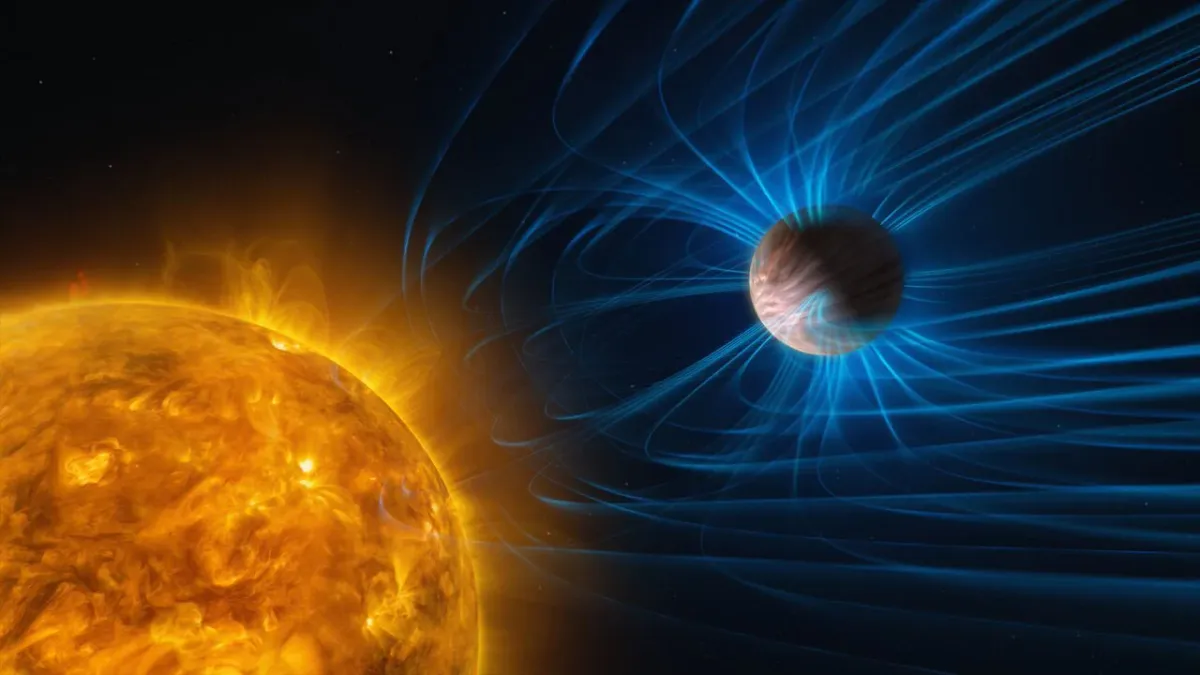
These magnetic fields interact with charged particles in the planet's atmosphere, essentially creating drag and slowing down the whole atmospheric circulation. By measuring this effect, the team could estimate the strength of these magnetic fields. The results? Fields about four times stronger than Saturn's, or half of Jupiter's. Not too shabby for a bunch of distant gas balls.
Beyond just slowing down winds, these magnetic fields have other, more dazzling implications. Think of Earth's northern and southern lights, our auroras, caused by solar particles hitting our magnetic field. On these exoplanets, with their perpetual day and night sides, the auroras could be even more spectacular – "vast curtains of colorful light" dancing across the sky, as co-author Bibiana Prinoth imagines.
This isn't just about pretty lights, though. Magnetic fields are crucial for protecting planets from harmful radiation, and for potentially holding onto water – a rather important ingredient for life. So, while we're not packing our bags for these hot Jupiter analogs just yet, finding magnetism on them is a pretty big deal for understanding where life could eventually thrive out there. Let the cosmic curtain call begin.