Around 500 million years ago, plants began moving from water to land. These early plants didn't have roots. So, they teamed up with tiny fungi called mycorrhizae. These fungi helped them get nutrients and water from the soil.
These underground partners likely helped plants spread across Earth's lands. Today, this helpful relationship supports up to 90% of all plant species.
Mapping the Hidden Networks
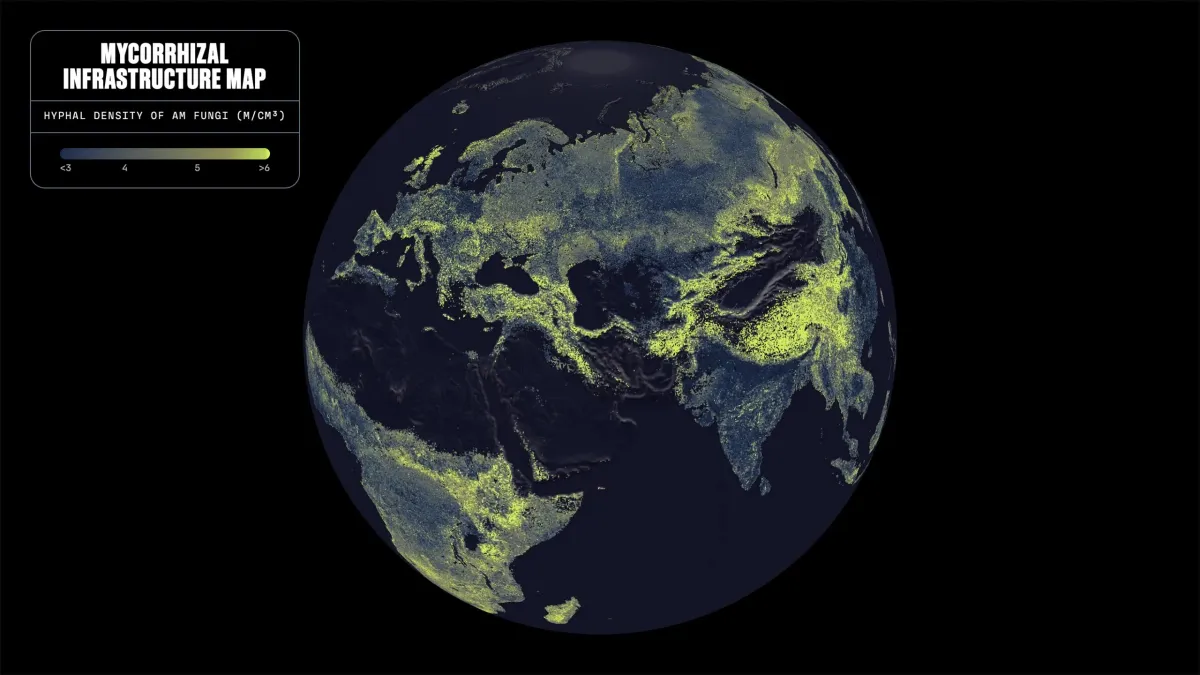
Scientists have now mapped the global spread of the most common type of mycorrhizae. These are called arbuscular mycorrhizal (AM) fungi. The study, published in Science on June 11, found that Earth's topsoil holds about 68 quadrillion miles of AM fungal networks. This is nearly one billion times the distance between Earth and the sun.
We're a new kind of news feed.
Regular news is designed to drain you. We're a non-profit built to restore you. Every story we publish is scored for impact, progress, and hope.
Start Your News DetoxThis research highlights a group of organisms often overlooked. Yet, they are vital for supporting ecosystems and keeping the climate stable.
Toby Kiers, a study co-author, is an evolutionary biologist at Vrije Universiteit Amsterdam. She is also the executive director of the Society for the Protection of Underground Networks (SPUN). Kiers told the New York Times that the sheer number is exciting. But mapping these patterns is even more thrilling.
How Fungi Help Plants and the Planet
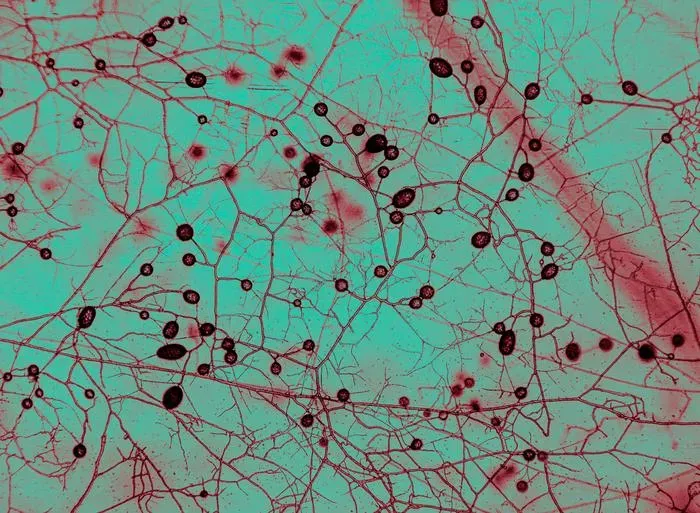
AM fungi live on and inside plant roots. They take in carbon from plant cells, which they need to survive. When a fungus absorbs carbon, it grows tiny, tubular threads called hyphae. These threads are much thinner than a human hair.
Justin Stewart, the lead author and an evolutionary ecologist at SPUN, explained to National Geographic that these threads go deep into the soil. They pull out nutrients like nitrogen and phosphorus, then trade them back to the plant.
These fungal networks move water, nutrients, and carbon throughout ecosystems. They support much of Earth's life. They also help remove planet-warming carbon dioxide from the atmosphere.
For the study, Stewart, Kiers, and their team gathered data from over 16,000 soil samples worldwide. They used a computer model with machine learning to guess the density of hyphae in areas not sampled. They looked at factors like climate and plants. However, they couldn't make predictions for areas with too little soil data, like ice caps.
The analysis showed that Earth's quadrillions of miles of AM fungi hold about 330 million U.S. tons of carbon. This is roughly four to six times the carbon in all living humans. The team also estimates that each year, the fungi move about 4.4 billion U.S. tons of carbon dioxide into soils. This equals about 11% of the carbon dioxide produced by human activity.
Stewart noted in a statement that these fungi are incredibly important and vast. He said there could be up to 32 feet of mycorrhizal network in just one teaspoon of soil.
The Impact of Human Activity
Edouard Evangelisti, a plant scientist at Côte d’Azur University, called the new research "seminal." He told Live Science that it "makes part of the invisible visible." Anne Pringle, a mycologist at the University of Wisconsin, Madison, agreed, saying the study adds a lot of information and fills a big knowledge gap.
The map also shows how human actions might affect AM fungi. Croplands have about half the fungal density of wild ecosystems. Also, about 40% of the planet's AM biomass is in wild grasslands. These include areas in South Sudan, the Tibetan Plateau, and the Florida Everglades. Yet, these are some of the least protected ecosystems on Earth.
A study in Proceedings of the National Academy of Science in February found that non-forest ecosystems, like grasslands and wetlands, are turned into farms four times more often than forests.
More research is needed to understand how specific farming methods affect mycorrhizal health. But scientists believe that soil with fewer AM fungal networks might be less able to cycle nutrients, handle stress, and store carbon.
Stewart told Live Science he hopes this research will lead to better protection for these fungi. He noted that wild grasslands are disappearing quickly. He explained that it's easier to clear grass than to cut down trees.
Deep Dive & References
Interactive online tool to explore the vast underground networks of fungi Global distribution of arbuscular mycorrhizal fungi - Science, 2026 Global patterns of grassland and savanna conversion to agriculture - Proceedings of the National Academy of Science, 2026