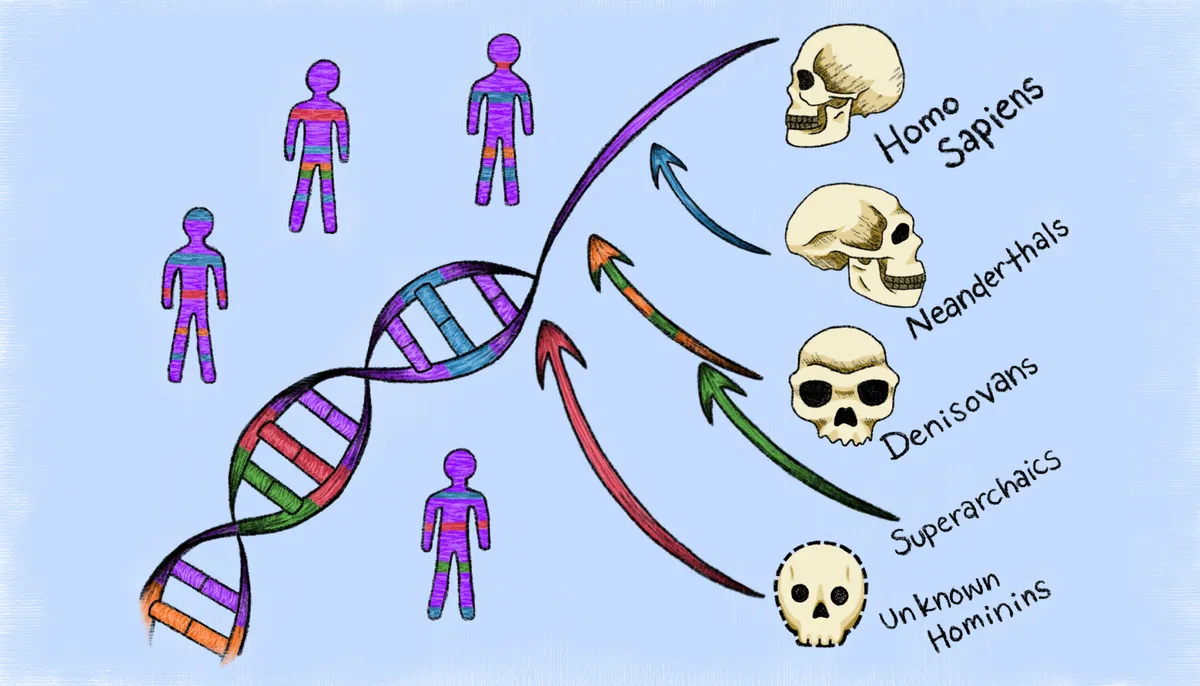
Two mysterious human relatives left their genetic footprints in the modern human genome. This happened alongside the DNA of Neanderthals and Denisovans. It shows that our ancestors interbred with many hominin groups over millions of years.
Previous research hinted that modern humans interbred with ancient hominins beyond Neanderthals and Denisovans. A new study by UC Berkeley researchers now pinpoints these inherited genome areas and sets a timeline. They used a new technique that analyzes hundreds of modern human genomes to find ancient family relationships.
Uncovering Ghost and Super-Archaic Ancestors
One unknown ancestor, called a "ghost ancestor," interbred with modern humans in Africa over 50,000 years ago. This was before Homo sapiens migrated out of Africa into Europe and Asia. These genes make up about 1% of modern human genomes. This is similar to the amount of Neanderthal DNA we carry.
We're a new kind of news feed.
Regular news is designed to drain you. We're a non-profit built to restore you. Every story we publish is scored for impact, progress, and hope.
Start Your News DetoxThis unknown hominin lineage split from the modern human lineage about 800,000 years ago. This was around the same time Neanderthals and Denisovans diverged. However, they interbred with modern humans earlier.
Yulin Zhang, a Berkeley graduate student and co-first author, explained that previous studies suggested "ghost ancestry." But they didn't know if it was only in Africans or when it happened. Zhang noted, "We were actually able to find and map genomic locations in modern humans that are from this ghost lineage and show that this ghost ancestry is in all modern humans, not only in Africans."
The other mysterious ancestor is called a "super-archaic ancestor." This hominin came from a 1.8 million-year-old lineage. It interbred with Denisovans in Eurasia, likely over 200,000 years ago. Denisovans later passed some of this super-archaic DNA to modern humans through interbreeding with Homo sapiens.
Arjun Biddanda, a postdoctoral researcher at Johns Hopkins University and co-first author, found the super-archaic discovery exciting. He said it "reveals genetic contributions from a human lineage that lived over a million years ago, despite the absence of any sequenced DNA from that population."
These findings show that early modern humans lived alongside many related hominin groups in Africa and Eurasia. They were also genetically close enough to interbreed with many of them.
Priya Moorjani, a Berkeley associate professor, noted that human evolution is often seen as a branching tree. However, new genomic data shows a more interconnected history. It's "more like a complex web of populations connected by repeated episodes of migration and mixing."
The researchers aren't sure who these ancestors were. But the timing suggests the ghost lineage overlaps with Middle Pleistocene Homo groups in Africa 800,000 years ago. The super-archaic lineage overlaps with Homo erectus in Eurasia 1.8 million years ago.
Zhang, Biddanda, Moorjani, and their team published their findings in Science on July 30.
How TRACE Traces Ancient DNA
When modern humans left Africa about 50,000 years ago, they interbred with Neanderthals and Denisovans in Eurasia. These older lineages died out but left DNA in modern humans. This was discovered by sequencing ancient DNA from their fossils.
Researchers also saw hints of much earlier interbreeding in the human genome. But without DNA from other extinct hominins, it was hard to identify their contributions.
Moorjani's team developed TRACE (TRacking Archaic Contributions via ARG Estimation). This technique finds these regions by analyzing only complete genomes from present-day humans. They used genome data from people worldwide to reconstruct ancestral recombination graphs (ARGs). This created a detailed map of how DNA segments are related over time.
Moorjani explained that "genealogies preserve a record of our evolutionary past." TRACE reconstructs these histories. By finding regions with unusually old ancestry, they can uncover genetic contributions from extinct human populations, even without ancient DNA.
Some of the oldest ancestry regions matched DNA from sequenced Neanderthal genomes. This makes up about 1% of the human genome. In people from Asia and Oceania, who have significant Denisovan DNA, TRACE also correctly identified known Denisovan regions.
However, many ancient regions had neither Neanderthal nor Denisovan DNA. The researchers found these DNA stretches came from two distinct lineages with different interbreeding times. The ghost lineage was found in all humans, both African and non-African. This means the gene flow happened before modern humans left Africa and spread globally.
Zhang said they found about 2% of the modern human genome is from archaic hominins. "In the case of the ghost lineage, modern-day Africans and non-African populations both inherited similar amounts of ghost ancestry. Each individual has about 0.5 to 1% of their genome inherited from this ghost lineage."
The other lineage was found by analyzing genomes from Oceania populations. These populations have higher amounts of Denisovan DNA, sometimes up to 4%. The super-archaic ancestry appeared in regions of Denisovan DNA. This suggests it came through Denisovans into modern humans. Denisovans have 3% to 5% super-archaic DNA, but only a small part of that is inherited by modern humans.
Biddanda noted that TRACE helped them understand how these uncharacterized hominin ancestry segments are spread throughout the human genome. He said, "We found that these contributions are widespread throughout the genome, and ghost ancestry is detected even in regions previously thought to be intolerant of Neanderthal and Denisovan ancestry."
Many archaic segments are rich in regions linked to immunity and metabolism. Moorjani said this isn't surprising. Adapting to new pathogens and food sources has been a strong selective pressure in human evolution. Interbreeding introduced new genetic variation, providing more material for natural selection. Beneficial variants could then be kept and spread.
Moorjani hopes to find signals of more lineages as global genome databases become more diverse. More Denisovan genomes would also help. Protein sequences from Homo erectus fossils might even help identify the super-archaic ancestor.
She believes these new computational methods are the next frontier. They allow us to uncover hidden parts of our past without needing ancient DNA. TRACE could also work with other species, revealing different patterns across the tree of life.
Deep Dive & References
Recovering signatures of archaic hominin introgression using ancestral recombination graph - Science, 2026