Ever wonder what happens when you hit something with a laser so powerful it instantly turns into plasma? Scientists just watched it happen, in extreme slow motion, and the results are both mind-bogglingly fast and surprisingly useful.
Researchers at Helmholtz-Zentrum Dresden-Rossendorf (HZDR) used ultrafast lasers to track exactly how copper atoms shed their electrons and transform into a superheated plasma. We're talking picoseconds here, which, for the record, is a trillionth of a second. Apparently, ions burst into existence, peak, and then vanish just as quickly. All of which sounds like a very dramatic, subatomic party.
The Ultimate High-Speed Camera
To catch this blink-and-you-miss-it action, the team deployed two seriously advanced laser systems at the European XFEL in Germany. One was an X-ray free-electron laser, and the other, an optical laser charmingly named ReLaX. Together, they create conditions usually only found near neutron stars — because apparently that's where we are now.
We're a new kind of news feed.
Regular news is designed to drain you. We're a non-profit built to restore you. Every story we publish is scored for impact, progress, and hope.
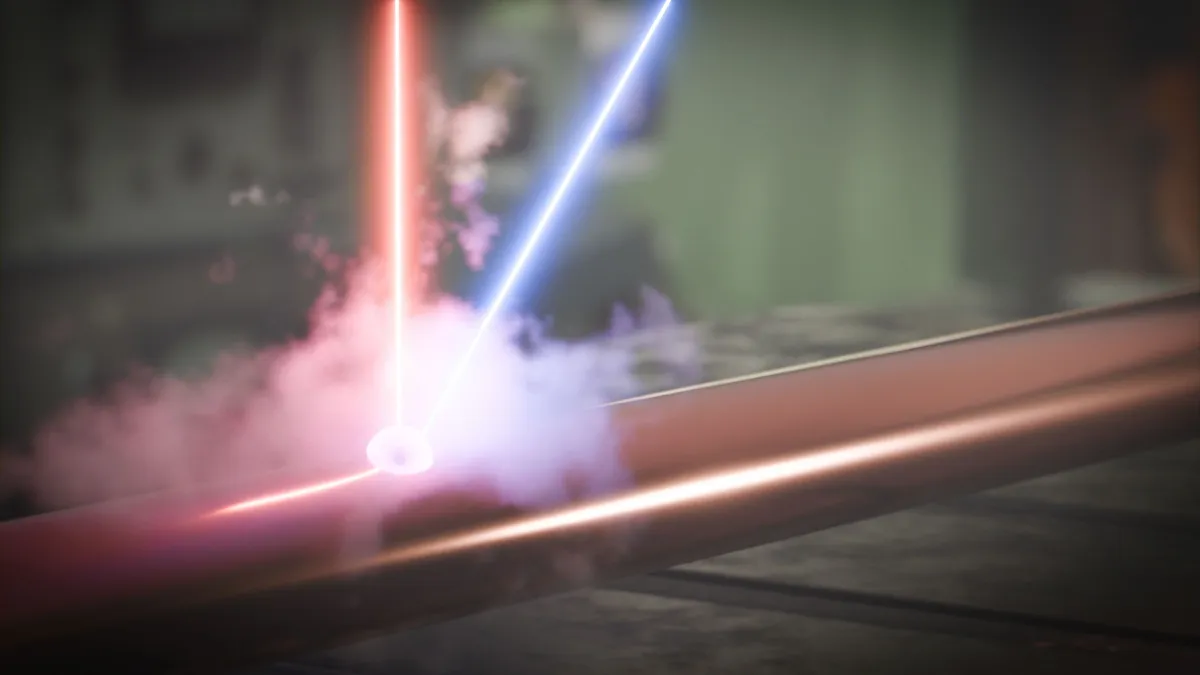
Start Your News DetoxThe process begins with a powerful light burst hitting a thin copper wire, roughly one-seventh the width of a human hair. This laser focuses an insane 250 trillion megawatts per square centimeter onto a tiny spot. For a truly minuscule amount of time, this energy instantly vaporizes the wire, heating it to millions of degrees and stripping electrons from the copper atoms, turning them into highly charged ions.
Enter the second laser: an intense X-ray probe from the European XFEL. While the first pulse creates the plasma, the second takes a series of snapshots, capturing how the plasma evolves over mere picoseconds. It’s like a microscopic, high-speed photobomb.
Watching the Ion Dance
The X-ray pulses were specifically tuned to be absorbed by Cu²²⁺ ions — that's copper atoms that have lost 22 electrons. When these specific ions absorbed the X-ray energy, they re-emitted their own unique X-ray radiation. By measuring this emission, the scientists could track exactly how many Cu²²⁺ ions were present at any given moment.
The timeline was clear: Cu²²⁺ ions appeared almost immediately, peaked after about 2.5 picoseconds, and then steadily vanished as they recombined with electrons. After just 10 picoseconds, they were gone. Professor Tom Cowan, former director at HZDR, noted that this level of precision in observing ionization had never been achieved before. Which, if you think about it, is both impressive and slightly terrifying.
Computer simulations then helped explain the rapid-fire chaos. The initial laser pulse kicks off a few electrons, which then spread out like a wave, knocking even more electrons out of surrounding copper atoms. Eventually, these energetic electrons lose steam and are recaptured by the ions, bringing everything back to a neutral state. Talk about a glow-up, then a quick cool-down.
This whole atomic peep show isn't just for kicks. Dr. Ulf Zastrau, who manages the HED-HIBEF experiment station, says these findings are crucial for improving simulations for future laser fusion facilities. Understanding these electron waves and superheated plasmas is key to designing efficient fusion reactors — which could one day give us a whole new way to power the planet. And all because someone wanted to see what happens when you hit copper with a really, really fast laser.