For many people, chatbots using large language models (LLMs) are now part of daily life. These AI systems are growing fast. But making them bigger is becoming very expensive and uses a lot of resources.
A team led by Borja Aizpurua at Multiverse Computing in Spain found a way to make LLMs better using quantum computing. They published their findings in a new preprint. This method could be a smarter solution than just adding more hardware.
The Challenge of Parameters
LLMs, like those in ChatGPT and Claude, learn from many adjustable parameters. These parameters help the model process and create text. Models with more parameters usually perform better.
We're a new kind of news feed.
Regular news is designed to drain you. We're a non-profit built to restore you. Every story we publish is scored for impact, progress, and hope.
Start Your News DetoxHowever, each parameter needs memory to store it. As models get larger, their memory needs grow. This becomes hard and costly to manage. For example, GPT-5.5 might have between two and five trillion parameters.
Using Quantum Circuits
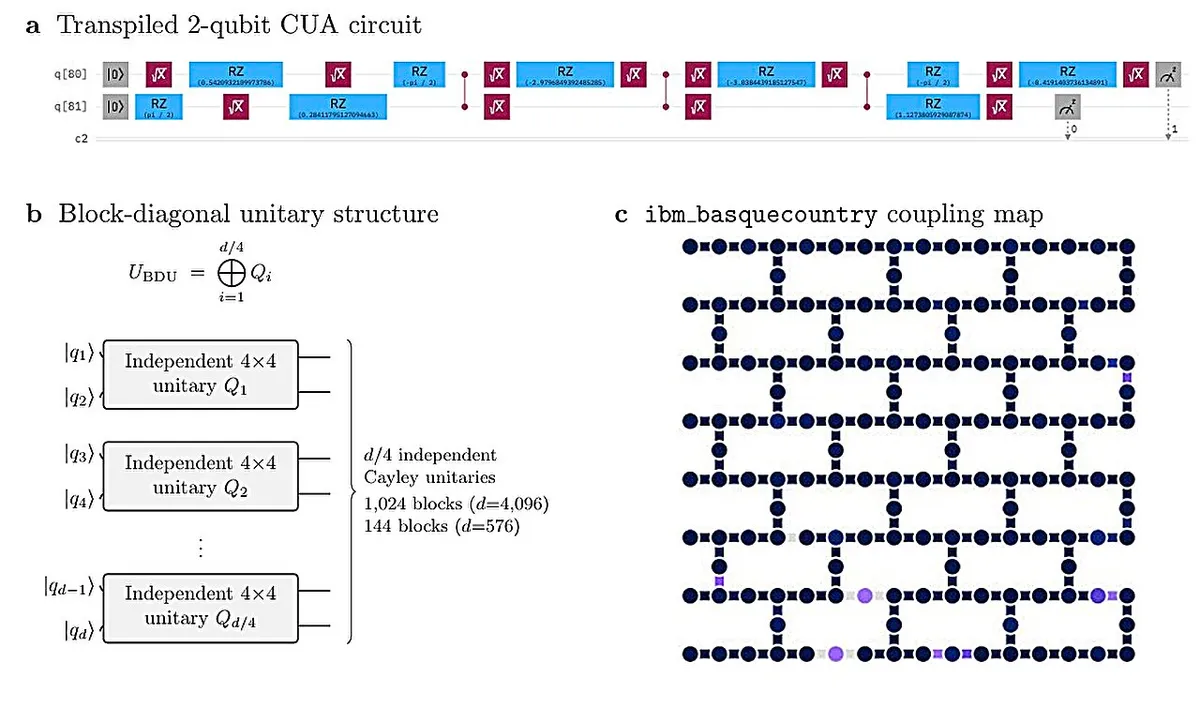
To deal with these limits, the Multiverse Computing team looked at quantum computing. Instead of adding many new classical parameters, they put small quantum circuit blocks into an existing LLM.
These quantum blocks can hold complex math in a very small space. This means they can do what would normally need many more traditional parameters. The system is a mix: the original LLM runs on a standard computer, and the quantum parts run on IBM's 156-qubit quantum processor.
Improving Performance
Aizpurua's team used this method on Llama 3.1 8B, a Meta model with eight billion parameters. They reduced "perplexity" by 1.4%. Perplexity measures how well a model predicts the next word. They achieved this by adding only 6,000 extra parameters. This is less than one ten-thousandth of a percent increase.
The team also tested their system on SmolLM2. This is a smaller model with 135 million parameters. They chose it because it was easier to study. They found that performance improved as the quantum parts got bigger. The quantum-enhanced model could answer questions correctly that two regular versions of the same model got wrong.
Preparing for Future Processors
The researchers admit that the performance gains are small for now. They are limited by current quantum hardware. But their results are promising. They show that quantum enhancement can work on a real, widely used model.
The team believes that as quantum processors get more powerful, the improvements will grow. This could create a new way to develop better AI. It might avoid the huge infrastructure costs that could define the future of AI.
Deep Dive & References
Quantum-enhanced Large Language Models on Quantum Hardware via Cayley Unitary Adapters - arXiv, 2026