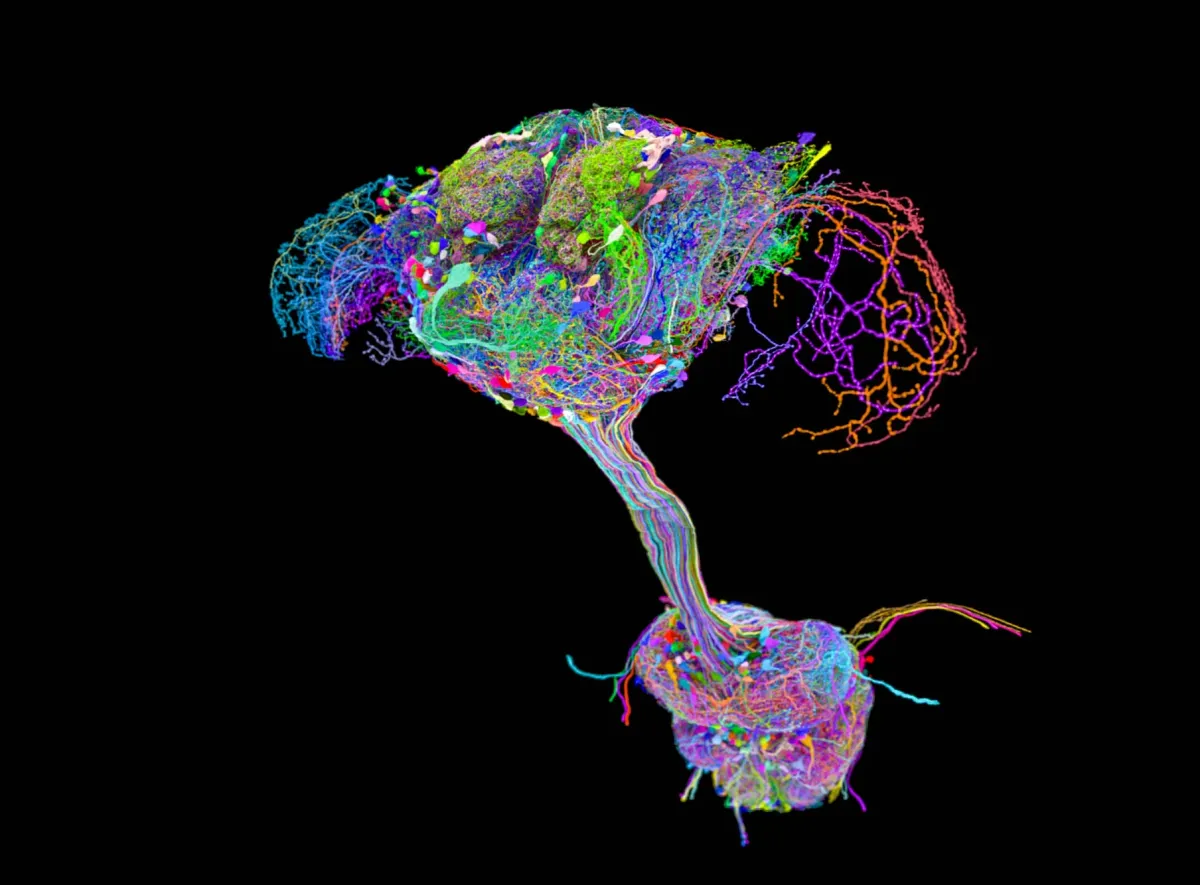
Scientists have created the first complete map of all neuron connections in a fruit fly's central nervous system. This map shows how the brain and body are wired together.
The research suggests that complex behaviors in fruit flies come from many neural circuits working together, rather than a single control center in the brain. This new understanding could change how we think about nervous systems.
Mapping the Fruit Fly Nervous System
An international team, including researchers from Harvard Medical School and Princeton University, created this detailed map. It's called a connectome.
We're a new kind of news feed.
Regular news is designed to drain you. We're a non-profit built to restore you. Every story we publish is scored for impact, progress, and hope.
Start Your News DetoxThe map includes the fruit fly's brain and its nerve cord, which is like a spinal cord. This complete view helps scientists study how the brain and body work together for actions like walking and flying.
Rachel Wilson, a co-senior author from Harvard Medical School, noted that seeing all neurons and their connections as one unit offers new insights.
Wei-Chung Allen Lee, another co-senior author, emphasized the importance of a complete central nervous system connectome. It helps link the brain and body to understand behavior fully.
The team found that many fruit fly behaviors are not controlled by one part of the brain. Instead, local neural circuits in the body parts involved in the action often manage them.
This full connectome is available online for researchers worldwide. The study was published in Nature in June 2026.
Why Fruit Flies Are Important
Understanding how neurons connect and create behavior is a big question in neuroscience. Drosophila melanogaster, the fruit fly, is a great model for this.
Fruit flies are easy to study in labs. Their nervous systems are relatively simple, with about 160,000 neurons. Yet, they can do complex things like navigate, interact socially, learn, and react to senses.
They also have advanced genetic tools, allowing scientists to control and record activity from specific neurons.
In 2024, the FlyWire Consortium published a connectome of the fruit fly brain. At the same time, Lee and his team were mapping the fruit fly's nerve cord, which controls legs, wings, and processes sensory data.
Helen Yang, a co-first author, explained that linking the brain and nerve cord connectomes is crucial. It helps understand how information moves between the brain and body.
Alexander Bates, another co-first author, added that nerve cord neurons are very useful. They are tied to sensation and movement, making them easier to interpret.
Mala Murthy, a co-author from Princeton, said the new connectome is a major step forward. It helps understand how brain circuits get feedback and control body actions.
Arie Matsliah, also a co-author, noted that for the first time, scientists can follow information flow from sensation to action across an entire nervous system.
How the 3D Map Was Built
To create the connectome, researchers made thousands of thin slices from a single fruit fly. They used electron microscopy to image these slices, creating millions of images of neurons and their connections.
AI tools then aligned these images to build a unified 3D map.
The final connectome shows how each neuron connects to others in the brain and nerve cord at the synapse level. While it doesn't cover the entire fly body, researchers used known neurons and past studies to link central nervous system neurons to many appendages and sensory organs. This effectively "embodied" the connectome.
Lee compared the resource to Google Maps. Researchers can now use it to form new hypotheses and test them in the lab. He said the connectome shows that many previous hypotheses were too simple.
Surprising Findings in Motor Control
The researchers used the connectome to study motor control, like how a fruit fly moves its legs.
A common idea was that the brain acts as a central controller for decisions about actions. However, the team found something different.
Motor control in the fruit fly is largely organized locally. For example, the movement of one leg is mainly controlled by its own neural circuits. These local circuits then communicate with circuits for other legs to coordinate movements like walking.
This same pattern was seen in circuits for wings, the mouth, and other body parts. Motor circuits also connect with other systems, like visual and endocrine systems, which provide extra information to shape behavior.
Bates said their findings suggest that control for actions is highly distributed in local modules that link up and work together in different ways.
What's Next for the Connectome
The researchers believe the connectome will support many future studies. Yang compared it to the Human Genome Project, another open resource that led to many scientific advances.
The team plans to add more information, such as details about neuropeptides, which are small protein-like molecules neurons use to communicate.
The connectome could also reveal basic principles of how nervous systems work across different species, including humans. Bates noted that many discoveries in fruit flies have applied to mammals, including findings about navigation, smell, and memory.
Matsliah hopes to bring full-connectome mapping to more complex organisms. He believes advances in AI, computing, and open science make this increasingly possible.
A key question is whether the distributed control of neural circuits seen in fruit flies also exists in other animals. Lee is now studying this in mice.
Yang expects this distributed control is not unique to flies. She noted that while we lack this level of detail in other animals, we know they have many local circuits.
Implications for AI
This work might also impact artificial intelligence. The connectome provides real biological data that could help design artificial agents. These agents move through virtual worlds, which are used to study intelligence and improve AI training.
Yang finds it amazing that a tiny fly can do so much, often more than current AI agents and robots. She believes there might be lessons for AI in how the nervous system is organized.
Deep Dive & References
Distributed control circuits across a brain-and-cord connectome - Nature, 2026