Scientists have used swirling water waves to simulate a quantum effect. They uncovered rotating patterns that could help us better understand hidden quantum phenomena.
In quantum physics, particles can be affected by forces they don't directly touch. A famous example is the Aharonov–Bohm (AB) effect. Here, electrons change due to a magnetic field even when they avoid the field itself. This effect was predicted in 1959, but it took over 20 years to prove. This was because the changes in electron wave behavior were very hard to measure.
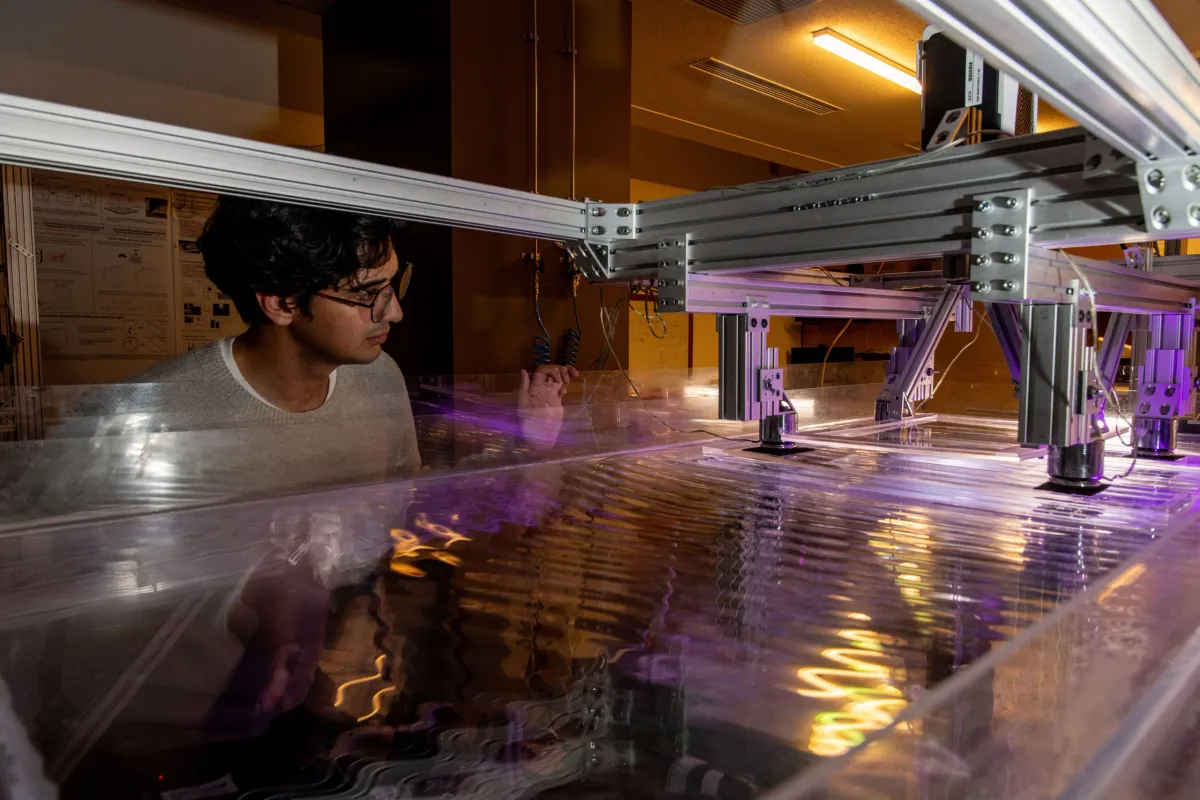
Now, researchers from the Okinawa Institute of Science and Technology (OIST), with the University of Oslo and Universidad Adolfo Ibáñez, have recreated and expanded the AB effect. They used a simple setup: a water tank.
We're a new kind of news feed.
Regular news is designed to drain you. We're a non-profit built to restore you. Every story we publish is scored for impact, progress, and hope.
Start Your News DetoxTheir findings, published in Communications Physics, show that water waves moving towards a swirling vortex from opposite directions create dramatic rotating patterns. These patterns include lines of temporarily still water that spread out and slowly turn.
"This was something new and unexpected," said Aditya Singh, a PhD student at OIST and co-first author. He noted that this fluid system helps reveal "topological effects"—wave behaviors across the whole system—that quantum experiments can't show.
From Quantum Theory to Water Tank Experiments
The research was inspired by a 1980 study by physicist Michael Berry. He showed that the AB effect could be recreated in a classical fluid system. In the quantum version, electrons move around a tightly wound wire called a solenoid.
When electric current runs through the solenoid, it creates a magnetic field inside the coil. Even though electrons travel outside this field, their wave properties still change.
Berry replaced the solenoid with a vortex at the drain of a water tank. Instead of electrons, he sent water waves across the tank. These waves moved around the vortex, not through it. The waves formed a distorted, pitchfork-like pattern around the vortex, showing a change.
Jonas Rønning, co-first author, explained that waves traveling in the opposite direction create a mirror image pattern. He added, "The question for us was, what happens if you send waves from both directions at the same time? We thought that the patterns might cancel each other out, or both pitchfork-like patterns would be visible, but our intuition was completely wrong."
Opposing Water Waves Create Rotating Patterns
To find out, the team created a vortex in the middle of a large, custom-built water tank. They sent waves from opposite sides so they collided. Using light under the tank and a high-speed camera, they tracked how the wave patterns changed over time.
Without a vortex, opposing waves usually form a standing wave pattern. In this pattern, the waves appear fixed in place. These patterns have stationary wavefronts where the waves share the same phase.
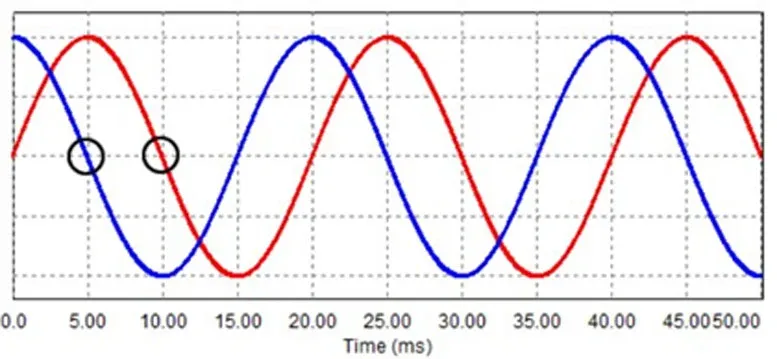
Adding a vortex completely changed this behavior. The vortex shifted the phase of the waves, changing how the standing waves interfered. This created rotating nodal lines, which are regions where the wave height drops to zero.
"When we first saw these lines, we thought they were an experimental artifact," Singh said. "But when we also saw them in our simulations, we dropped everything and quickly worked out the mathematics underlying how they arise."
Rotating Nodal Lines Reveal Hidden Physics
The nodal lines behaved unusually. They always rotated in the opposite direction of the vortex. More nodal lines appeared as the vortex flow became stronger.
The researchers don't yet know if these nodal lines have practical uses. However, Professor Mahesh Bandi, senior author, said the system offers many possibilities for future study.
"One direction is to make the system more complex by introducing multiple vortices and arranging them into a lattice," Bandi said. He explained that this setup would mimic conditions in some superconducting materials, with water waves acting like a supercurrent. "We don’t yet know what we’ll see—and that’s exactly what makes it worth doing."
The findings show how simple classical analogies can provide insight into the quantum world. Bandi noted that theorists might predict these effects, but quantum experiments wouldn't see them. "With analogues like this, we can," he concluded.
Deep Dive & References
Topology made visible through standing waves in a spinning fluid - Communications Physics, 2026