A 200-year-old light experiment has inspired a new way to create special light structures. These structures could help shape the future of computing and photonics.
Scientists at Nanyang Technological University (NTU Singapore) found a much simpler method to make "optical skyrmions." These are stable, tiny light formations with swirling patterns, often compared to a hedgehog's spikes.
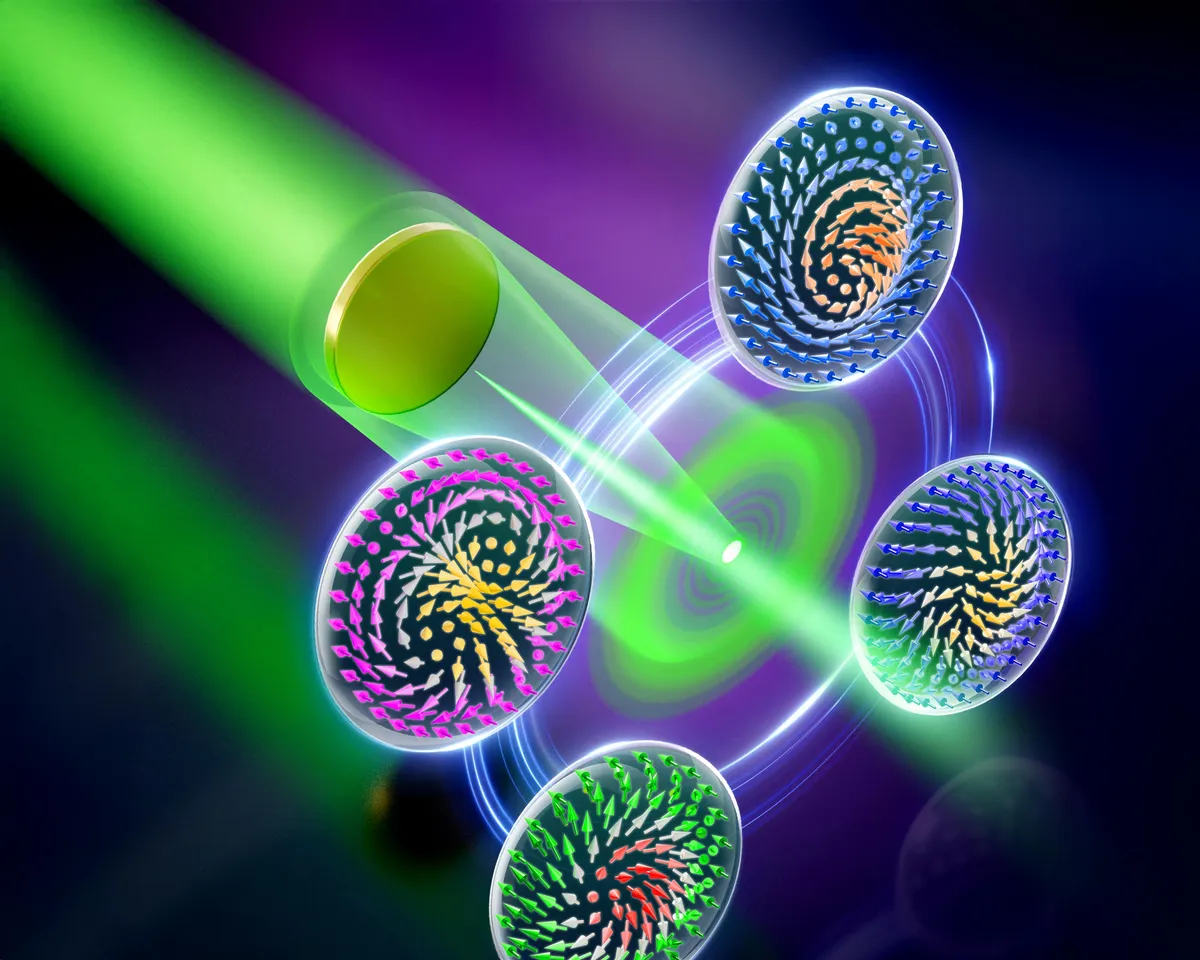
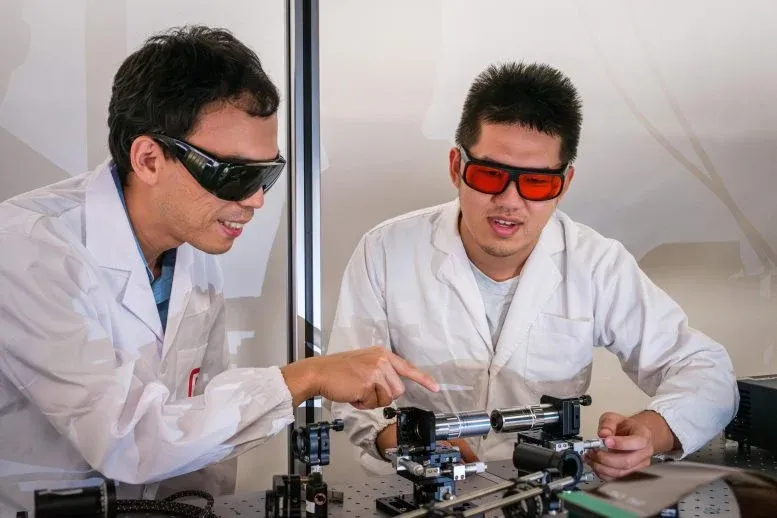
Instead of complex materials, the researchers used a laser aimed at a small circular disc. This setup uses a classic effect called the "Poisson spot." This new method could make it easier for scientists to create and study optical skyrmions.
We're a new kind of news feed.
Regular news is designed to drain you. We're a non-profit built to restore you. Every story we publish is scored for impact, progress, and hope.
Start Your News DetoxA Simpler Way to Make Optical Skyrmions
Skyrmions are important for research because they can carry and store information. They might lead to new technologies for data storage, communication, and computing.
The journal Optica published these findings. Assistant Professor Shen Yijie from NTU led the research.
Asst Prof Shen explained that optical skyrmions can now be made using a simple effect where light bends around an object. This avoids expensive, complex materials or specialized techniques.
He noted that this makes optical skyrmions more accessible. It lowers the technical barrier for researchers to study how they could be used in future research.
From History to Modern Tools
A Poisson spot is a bright point in the center of a shadow cast by a circular object when light, like from a laser, shines on it.
This effect was key in a 19th-century debate about light. Scientists wondered if light was only particles or if it could also bend like a wave. Wave theory predicted the bright spot, proving light's wave-like behavior through diffraction.
Light diffraction happens when light bends and spreads around an object or through a small opening.
Four Skyrmion Patterns in One Light Spot
The researchers found their Poisson spot system could create four related patterns at once. These included spin skyrmions, Stokes skyrmions, electric-field skyrmions, and magnetic-field skyrmions.
Spin refers to light's rotation-like features. Stokes parameters describe polarization, which is the direction light waves vibrate.
This "four-in-one" ability offers a new way to compare how different optical skyrmions form and interact within a single light field. Computer simulations showed these structures as swirling arrows, illustrating how light properties changed across the Poisson spot.
Shaping Light Properties
Scientists can control many aspects of light, such as its intensity, phase, polarization, spin, and electric and magnetic fields. Each property can create different stable patterns, even if stretched.
By changing the conditions of the light field, researchers might control the size, shape, and behavior of skyrmions more precisely.
Asst Prof Shen said that in their light spot, several types of optical vectors could form patterns at the same time. These light components are connected but don't always form identical patterns. Producing and comparing several skyrmions in one system could reveal new links between light's properties.
Future Uses in Photonics and Computing
Skyrmions were first discussed in particle physics. They later became important in condensed matter physics and magnetic materials. Now, they are a growing focus in photonics, appearing as stable, particle-like patterns in light.
Previous studies usually made optical skyrmions using metamaterials. These are tiny, engineered structures that manipulate light in unique ways.
These new findings provide a base for more research into topological light. This work could lead to advancements in photonics, advanced materials, information processing, and computing.
Deep Dive & References
Optical skyrmions in Poisson spots - Optica, 2026