For over half a century, physicists have been pondering a rather audacious idea: What if you could siphon energy from a black hole? Not just any black hole, mind you, but one of the super-spinny ones. Now, a team of researchers has figured out how to do it in a lab, without the inconvenient presence of an actual cosmic vacuum cleaner.
It all started with Sir Roger Penrose back in the 1960s. He theorized that if a particle entered a black hole's "ergosphere" — that wild region where the black hole's rotation drags spacetime along with it — the particle could split. One piece would fall in, and the other would escape with more energy than it started with. Think of it as a cosmic energy booster shot.
A few years later, physicist Yakov Zel’dovich expanded on this, suggesting that even waves could get an energy upgrade if they interacted with something spinning fast enough. The problem? Getting something to spin that fast is, well, tricky. Especially if you want to study it without getting sucked into a singularity.
We're a new kind of news feed.
Regular news is designed to drain you. We're a non-profit built to restore you. Every story we publish is scored for impact, progress, and hope.
Start Your News DetoxThe Stationary Spinner
Enter the clever folks at the CUNY Graduate Center. Instead of trying to build a mechanical contraption that would inevitably tear itself apart, they built a radio frequency device that mimics ultrafast rotation. Nothing physically moves, but the system's properties change in such a way that it creates what they call "synthetic rotation." It's like a magician's trick, but for astrophysics.
This ingenious setup allows them to simulate speeds that would make a regular spinning object blush, blowing past the limitations of mechanical machines. Suddenly, those theoretical interactions between waves and extreme rotation aren't just thought experiments; they're happening right there on the lab bench.
Lead researcher Andrea Alù explained that their method lets waves with specific rotational characteristics essentially "steal" energy from this synthetic spin. Lead author Hadiseh Nasari noted that this experiment drags ideas about extreme rotational dynamics from the blackboard straight into practical application. It's a new playground for exploring everything from astrophysics to quantum science.
How to Fake a Spin
The goal was simple: Could electromagnetic waves entering a stationary device behave as if they were interacting with something spinning incredibly fast? And, crucially, could those waves actually gain energy from this fake motion?
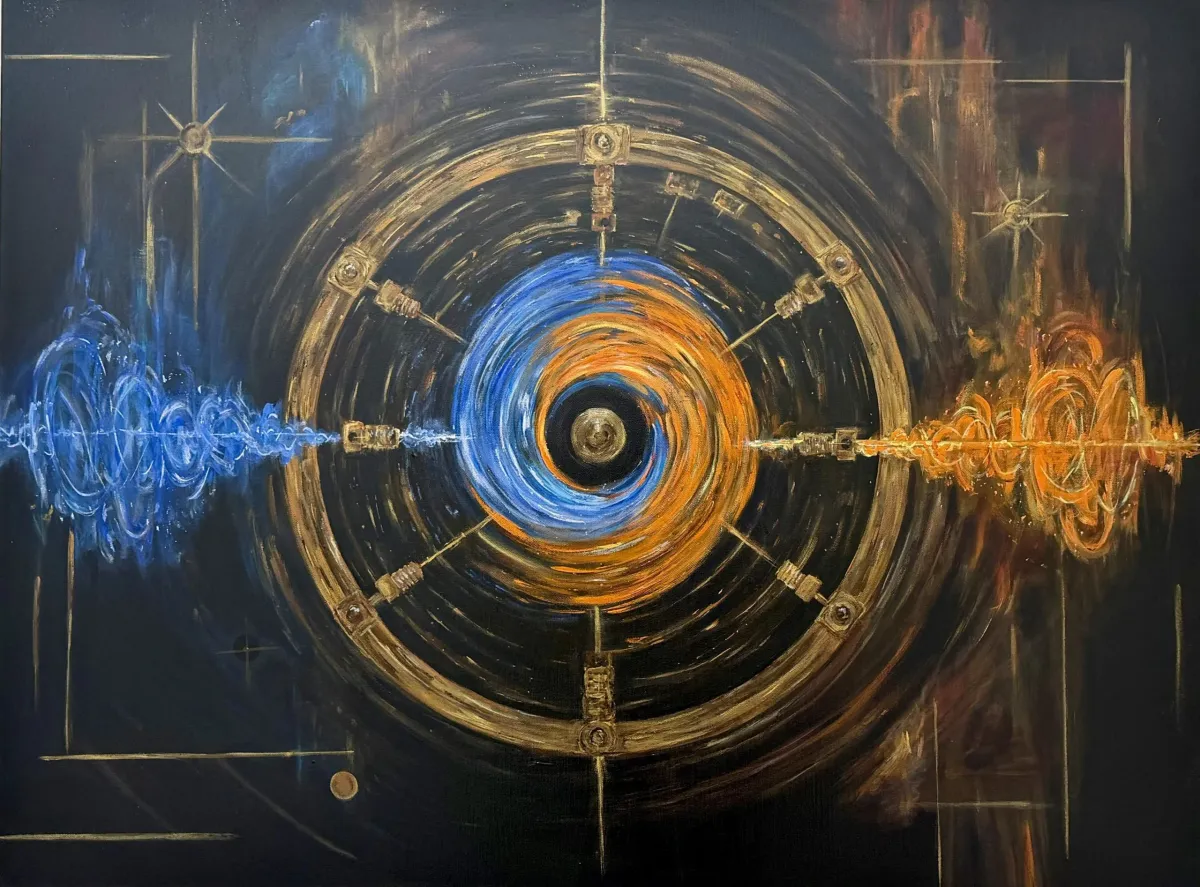
The team constructed a ring-shaped network of electronic resonators. Then, they rapidly and precisely changed the properties of these resonators in a moving pattern around the ring. Nothing in the device physically rotated, but the electromagnetic waves passing through it experienced the system as if it were spinning at mind-boggling speeds.
Co-lead author Hady Moussa confirmed that waves with the right rotational characteristics absorbed energy from the system and were amplified. They had, in effect, reproduced the core physics of the Penrose–Zel’dovich process using engineered metamaterials — special structures designed to control waves in ways normal materials can't. No black holes, no impossible RPMs, just some very clever physics.
This achievement doesn't just validate a 50-year-old theory; it creates an entirely new platform for scientists. Imagine a lab where you can study phenomena from the universe's most extreme environments, all without leaving Earth. This could have massive implications for wireless communications, optics, and even quantum computing. Because apparently, the best way to understand a black hole is to build a fake one in your basement.