When scientists want to figure out what a material is made of, they often blast it with light and see what happens. It's called spectroscopy, and it's how we identify atoms by how they absorb, emit, or scatter light. Each atom has its own light signature, like a cosmic fingerprint.
Now, add isotopes to the mix. These are atoms with the same identity but different weights — think of them as the slightly heavier cousins in the atomic family. They're incredibly useful for dating materials or figuring out where they came from, whether it's an ancient artifact or a meteorite that just dropped by.
Raman spectroscopy is particularly good at sniffing out these isotopes based on their mass, and it can do it without harming tiny, precious samples. The catch? Scientists didn't have a clear roadmap for how these isotopes actually change the Raman signals. It was a bit like trying to read a map where half the roads were invisible.
We're a new kind of news feed.
Regular news is designed to drain you. We're a non-profit built to restore you. Every story we publish is scored for impact, progress, and hope.
Start Your News DetoxThe Missing Manual Arrives
Enter Associate Professor Masashi Arakawa from Kyushu University. He's just developed a theoretical model that fills in those missing roads. He focused on oxygen isotopes in forsterite, a silicate mineral, and figured out exactly how they mess with Raman spectroscopy results. His findings, published in The Journal of Physical Chemistry C, are basically the instruction manual scientists have been waiting for.
Arakawa explains that in Raman spectroscopy, atoms show up at specific frequencies based on their weight. While previous studies hinted that isotopes caused frequency shifts, they mostly looked at artificial materials. Natural samples, on the other hand, are a chaotic mix of randomly distributed isotopes, which is where things get complicated.
Four Ways Isotopes Get Weird
Arakawa's research identified four key ways oxygen isotopes make Raman spectra do unexpected things:
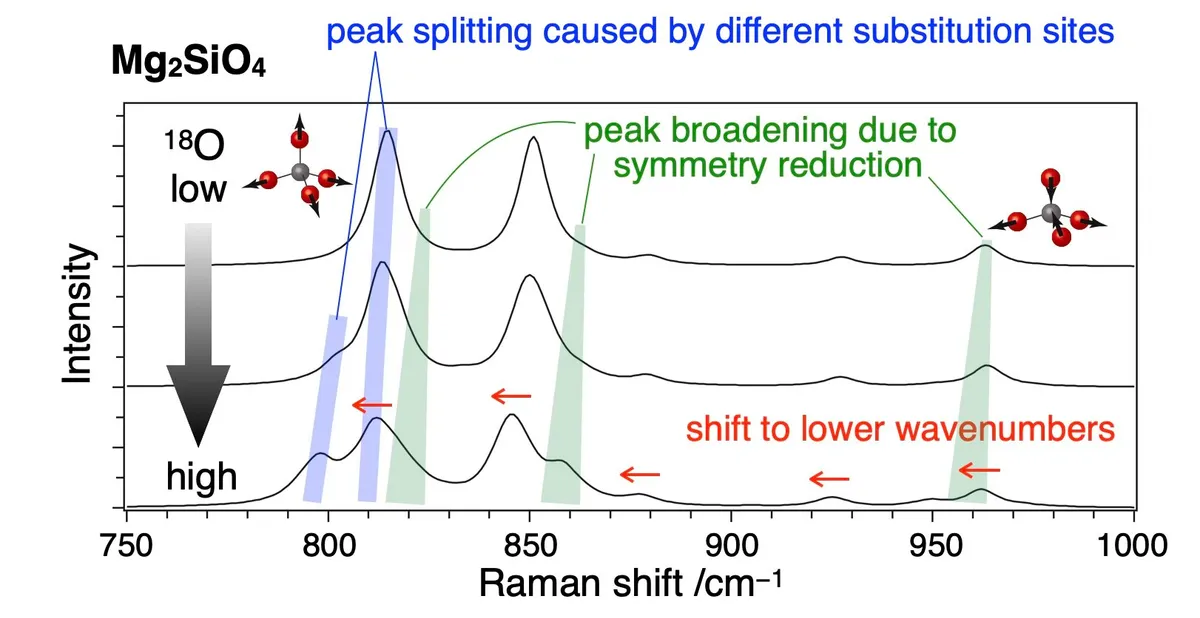
- Frequency Shift: Heavier isotopes are lazier. They cause the vibrational frequencies to drop to lower wavenumbers because, well, they're heavier.
- Symmetry Change: Oxygen isotopes are apparently rebels. They reduce the material's symmetry, which then activates vibrational modes that Raman spectroscopy couldn't see before. It's like they're flipping a switch.
- Peak Splitting: The exact spot an oxygen isotope sits within a material can have a huge impact, causing the signal peaks to split. Location, location, location, even for atoms.
- Peak Broadening: Because isotopes are spread out randomly, the spectroscopy signals end up looking broader, like a smudge instead of a sharp line.
This framework is a big deal. It means scientists can now accurately interpret Raman spectra from natural materials, especially when traditional isotope analysis is too tricky or damaging. Arakawa hopes this new understanding will help us unravel the origins and makeup of truly exotic materials, like those mysterious rocks that fall from the sky or the ones we scoop up from other planets. Because apparently, even atoms have stories to tell, and now we have a better way to listen.