Researchers in Sweden have found a way to make machine learning much faster by teaching AI the basic laws of physics. This new method helps speed up the creation of advanced optical parts for things like quantum computers and camera lenses.
The team from Chalmers University of Technology in Sweden built a digital "super-brain" that already understands how nature works. This built-in knowledge cuts down the time needed for calculations by 90%.
A Smarter AI for Optical Design
Philippe Tassin, a professor at Chalmers, explained that giving the AI system knowledge of physics made it much smarter. His team works in nanophotonics, which is about controlling light at tiny scales. When light interacts with very small structures, it behaves differently.
We're a new kind of news feed.
Regular news is designed to drain you. We're a non-profit built to restore you. Every story we publish is scored for impact, progress, and hope.
Start Your News DetoxTo get around the limits of natural materials, the researchers use computers to design artificial optical materials. These new materials could lead to lighter, thinner, and better lenses for cameras and eyeglasses. They could also help build future quantum computers.
The team is working with experts on Sweden's first large-scale quantum computer. They are looking at nanostructured materials that can precisely control light. One idea is to use special crystals to send information between quantum computers or over long distances. These crystals can reflect light very well.
Faster Simulations, Quicker Breakthroughs
The researchers use supercomputer simulations, machine learning, and neural networks to study how different materials act. These tools help them figure out material properties and guide the design process.
Tassin noted that even though he knows electromagnetism equations well, he can't always predict how a material will behave just by looking at it. The physics is too complex for humans to grasp easily, but the computer can.
Training these neural networks used to take a lot of data. Creating just one piece of data could take up to an hour, and they needed as many as 40,000 simulations. Viktor Lilja, a doctoral student on the team, said it could take a whole month to get enough data to train the network. If they needed to add more information, it would take another month.

Now, this process is ten times faster. Tasks that once took 30 days can be done in about three days. This is because the neural network already understands key physics principles before it even starts training.
How the AI Learned Physics
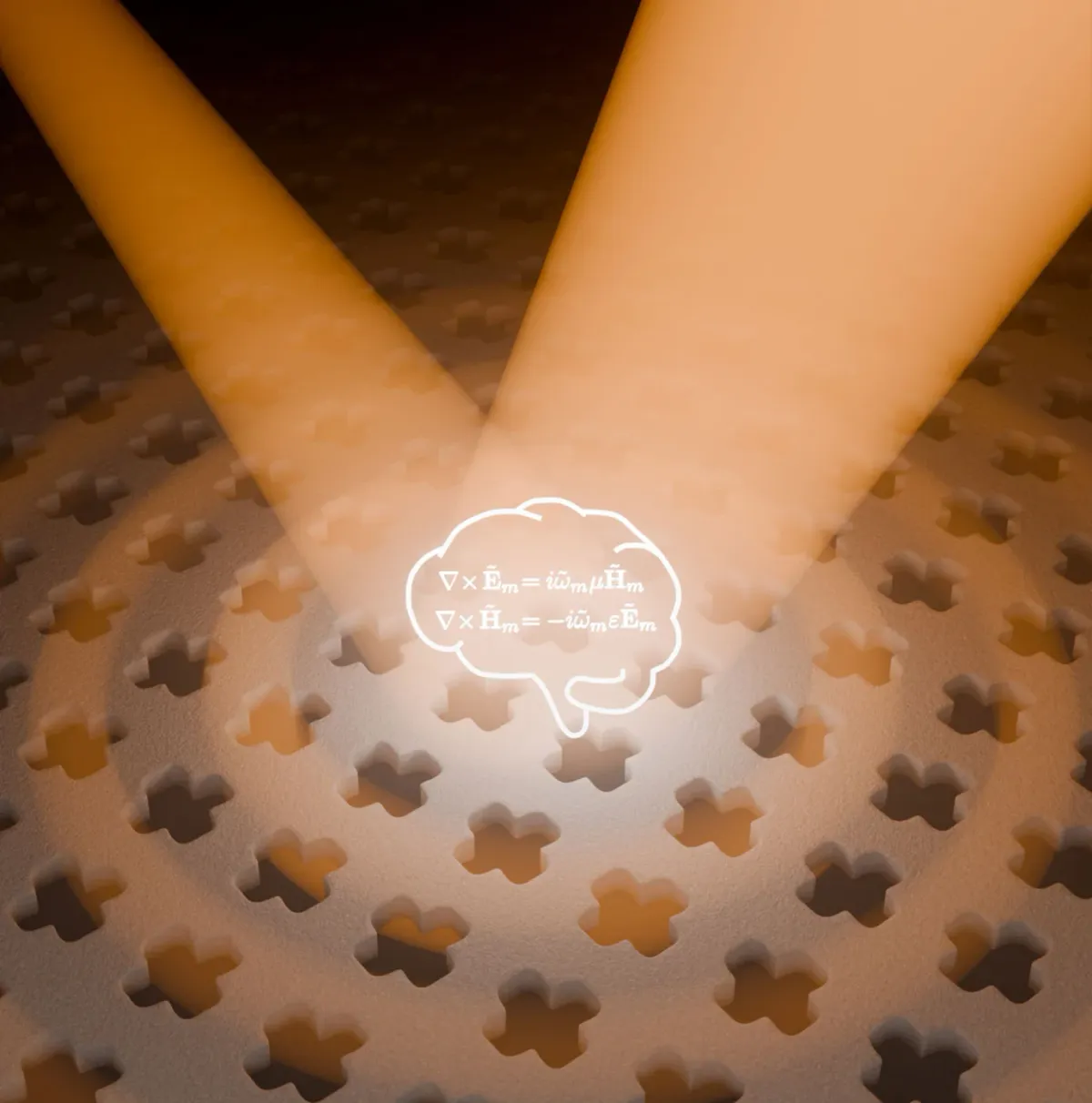
The researchers realized that optical parts must always follow the laws of physics and electromagnetism. Instead of making the neural network learn these rules from scratch, they built the laws directly into the system.
This means the AI doesn't have to relearn the same physics every time. The idea came about when they were trying to make the network's predictions easier for people to understand by adding known equations into the model. They found that this also made the network much more capable and reduced the amount of training data needed. This work was published in the journal Laser & Photonics Reviews.
Lilja explained that once the network is trained, it can analyze any structure and give its optical properties in a millisecond. This new method provides better estimates and avoids obvious mistakes.
For Tassin, the biggest benefit is the time saved. Working much faster means they can speed up the design of new optical components.
Deep Dive & References
A General Framework for Knowledge Integration in Machine Learning for Electromagnetic Scattering Using Quasinormal Modes - Laser & Photonics Reviews, 2026