Imagine a world where your phone never gets hot, your laptop battery lasts for weeks, and data centers don't need their own power plant just to stay cool. That's the promise of superconductors: materials that carry electricity with zero energy loss. No heat, no resistance, just pure, unadulterated electron flow.
Sounds like magic, right? Well, it's real, but it's been mostly stuck in labs. The main problem? Most superconductors only work when they're colder than a polar bear's toenails – we're talking minus 200 degrees Celsius. And, oh yeah, strong magnetic fields tend to kill their vibe entirely. Not ideal for, say, anything that exists in the real world.
But now, scientists at Sweden's Chalmers University of Technology have pulled a genuinely clever move. Instead of trying to reinvent the superconductor itself, they just gave it a better bed to sleep on. And suddenly, these finicky materials are working at higher temperatures and shrugging off magnetic fields like it's no big deal.
We're a new kind of news feed.
Regular news is designed to drain you. We're a non-profit built to restore you. Every story we publish is scored for impact, progress, and hope.
Start Your News DetoxThe Bedside Manner of Breakthroughs
For decades, the go-to strategy was to mess with the superconductor's chemical recipe. Tweak this atom, swap that molecule. It worked, to a degree, but it was like trying to fix a leaky faucet by rebuilding the entire house. The Chalmers team, however, took a page from interior design.
They focused on cuprates, a family of copper-oxide materials already known for superconductivity at relatively high temperatures. The superconducting layer they were working with was impossibly thin – just a few nanometers, less than one-millionth the width of a human hair. These delicate films have to be grown on a supporting surface, or "substrate."
Here's where the magic happened: they didn't change the superconductor. They changed the substrate.
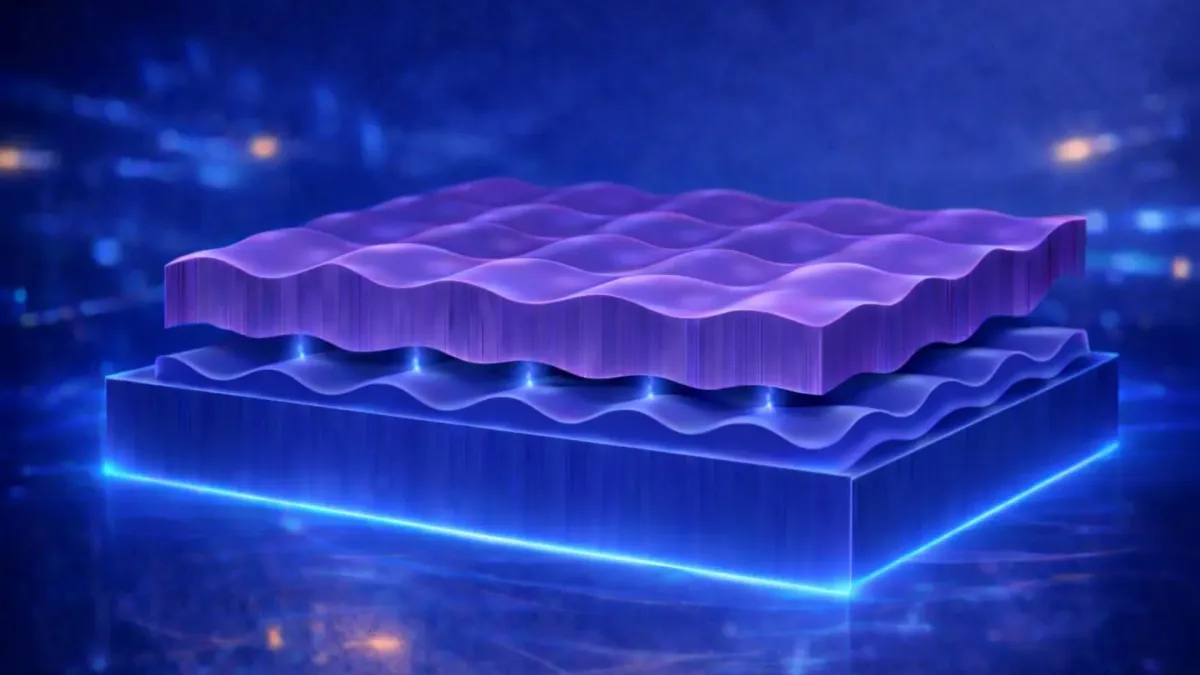
Think of it like this: the atoms in the substrate form a pattern that guides how the atoms in the superconducting layer arrange themselves. The researchers realized they could sculpt that guiding surface. Before laying down the superconducting film, they treated the substrate in a vacuum at high temperatures, creating an orderly pattern of microscopic ridges and valleys. Like tiny, atomic-scale corduroy.
Floriana Lombardi, the lead author, explained, "By sculpting the surface that the superconductor rests on, we were able to induce superconductivity at significantly higher temperatures than previously possible." And the kicker? "We also found that the material remained superconducting even when exposed to strong magnetic fields." Let that satisfying number sink in.
The Ripple Effect of Ridges
These minuscule surface features fundamentally changed the electronic environment where the substrate and the superconductor met. It created conditions that stabilized and strengthened the superconducting state, giving the electrons a preferential direction to flow. Which, if you think about it, is both impressive and slightly terrifying.
This isn't just a lab trick; it's a whole new design principle. Instead of endless chemical tinkering, future researchers might just need to become master sculptors of surfaces. It means we could be looking at superconductors that work at much higher temperatures, perhaps even room temperature, unlocking their full potential for ultra-efficient electronics, advanced quantum computers, and power grids that don't hemorrhage energy.
So, the next time your phone is cool to the touch, you might just have a tiny, perfectly ridged surface to thank.