Imagine a material that's super strong, holding its shape under pressure, but then — poof — with a little jostling, it just... falls apart. Like a very committed Jenga tower that decides to un-commit. That's exactly what researchers at the University of Colorado Boulder are cooking up, and it could change everything from how we build bridges to how robots move.
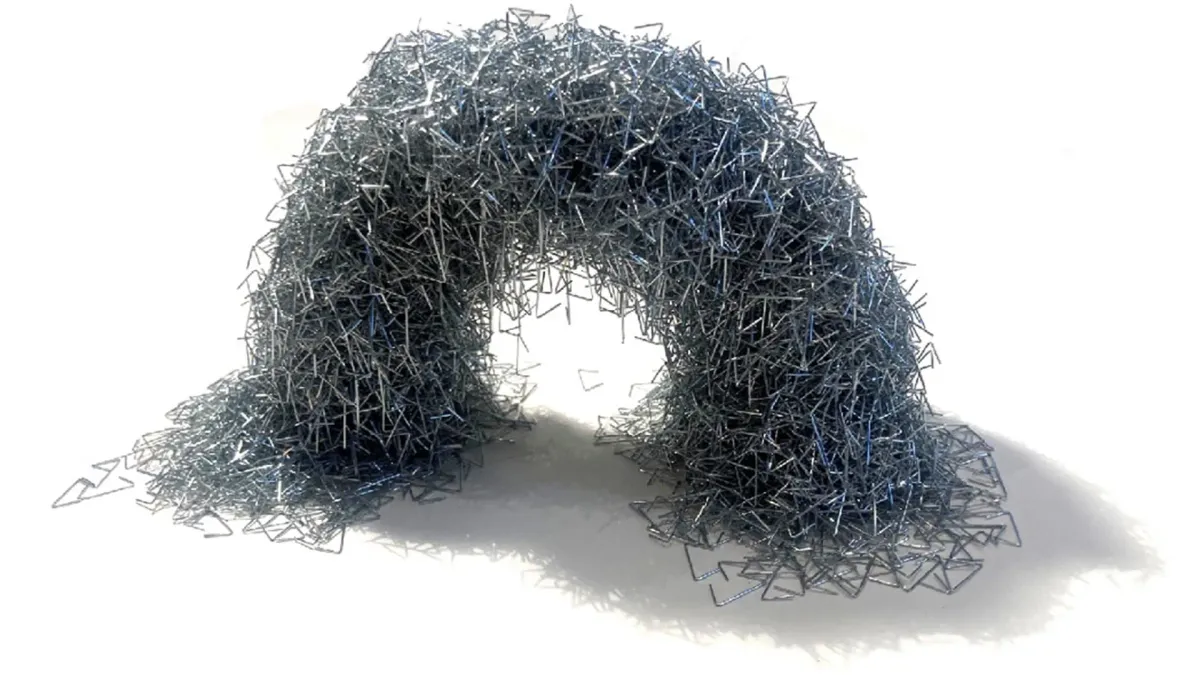
Their secret? Tiny particles designed to interlock like a pile of office staples. Squeeze those staples tight, and they become surprisingly rigid. Give them a good shake, and they're just, well, staples again. It's a concept that's both elegant and slightly unsettling, opening up a whole new realm of materials science.
Professor Francois Barthelat, who heads the aptly named Laboratory for Advanced Materials & Bioinspiration, and his team have been exploring how these "entangled particles" work. They're finding that when particles get all intertwined and connected, they create a strength that's usually reserved for things like bird nests or even our own bones. Because apparently that's where we are now: taking engineering cues from robins.
We're a new kind of news feed.
Regular news is designed to drain you. We're a non-profit built to restore you. Every story we publish is scored for impact, progress, and hope.
Start Your News DetoxThe Magic of the Staple Shape
It turns out, the shape of these microscopic building blocks is everything. Youhan Sohn, a PhD student on the team, points out that smooth, round sand grains just can't get it together. They slide past each other. But change that shape, and suddenly you've got particles that can link up and create mechanical properties that are seriously impressive.
After a lot of computer simulations (because who wants to test a million shapes by hand?), the team landed on a winner: a "two-legged" particle, much like a staple. This unassuming shape created the most entanglement and, surprisingly, offered a holy grail in material science: both high tensile strength (how much it can stretch without breaking) and toughness (how much energy it can absorb).
Saeed Pezeshki, another PhD student, put it simply: their staple-like material is both strong and tough. Which, if you think about it, is both impressive and slightly terrifying.
But here’s the kicker: these materials aren't permanently strong. With just the right vibration, the researchers can control how strongly the particles entangle. Gentle vibrations lock them in place, making the material strong. Stronger vibrations? The whole network unravels. Barthelat describes it as a "strange material," not quite a liquid, not quite a solid. It just… is.
From Bridges to Bumblebee Bots
The implications are pretty wild. Imagine a future where bridges and buildings aren't demolished with wrecking balls, but simply vibrated into their constituent parts, ready to be reused or fully recycled. Goodbye, construction waste; hello, sustainable deconstruction.
And then there are the robots. Pezeshki has been chatting with other students who envision "swarm robotics" where tiny robots could entangle, perform a task, and then disentangle when finished. Barthelat, ever the realist, compares it to the T-1000 from Terminator 2 — a liquid metal shapeshifter. He's quick to add that it's expensive and scaling up is a challenge. But still, the image of a building dissolving into dust or a robot reconfiguring itself on the fly is hard to shake. (Pun absolutely intended.)
The team isn't stopping at staples. They're now experimenting with particles that have even more "legs," like spiky burrs that cling to your socks. The goal? Even stronger entanglement, leading to even stranger, more adaptable materials. Because apparently, the future of engineering looks a lot like something you'd find stuck to your dog.