Researchers in Japan have found a way to understand how AI models make predictions in materials discovery. Their new method helps explain why an AI model predicts certain material behaviors. This could make designing new materials much more efficient.
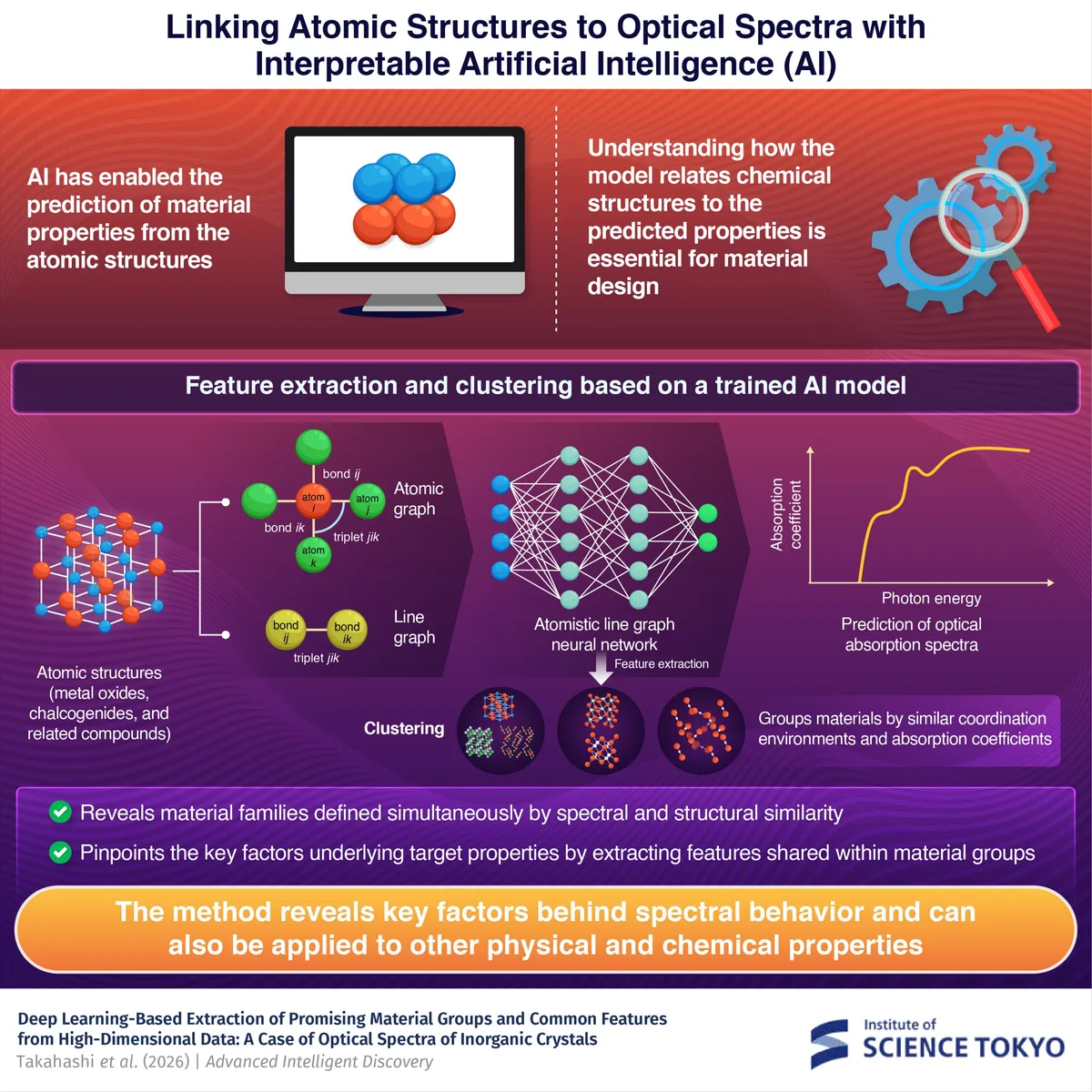
The method works by looking at the "features" an AI model learns. These features link a material's crystal structure to how it absorbs light. The researchers then group materials that have similar structures and light absorption patterns.
Making AI Predictions Clearer
AI is great at predicting how materials will act based on their atomic structure. This helps scientists find new materials faster. But many AI models are like "black boxes." They give answers without explaining how they got them. This makes it hard to understand why a material has certain properties. It also limits how much these models can help in designing new materials.
We're a new kind of news feed.
Regular news is designed to drain you. We're a non-profit built to restore you. Every story we publish is scored for impact, progress, and hope.
Start Your News DetoxScientists at the Institute of Science Tokyo developed a way to open this black box. They analyzed an AI model that was trained to predict optical spectra from atomic structures. They pulled out the key features the model learned about this relationship. Then, they grouped materials with similar optical spectra and structural traits.
Assistant Professor Akira Takahashi said this method helps understand how AI models make predictions. It shows the key factors for desired spectral shapes. This gives useful insights for designing materials.
Understanding Complex Data
Material properties are often described by complex spectral data. For example, optical absorption spectra show how a material interacts with light. This data is much richer than a single number, making it hard for traditional AI to interpret.
The researchers used an existing AI model called ALIGNN. They trained it to predict optical absorption spectra from the atomic structures of 2,681 metal oxides and related compounds. They then extracted features from the model's internal layers. They used a method called hierarchical clustering to group similar materials.
This process classified materials into groups with shared structural features. These included elemental makeup, atomic coordination, and bond angles. The groups also had similar spectral shapes. The model learned these patterns from atomic structure alone. It did not need information about oxidation states or electronic configurations. This shows the model captured important links between structure and properties.
Broader Impact on Material Design
Optical properties are vital for many uses. They affect how a material looks, which is important for dyes. They also control how a material interacts with light in devices like solar cells. Knowing which elements and structures create these spectra is key to designing such materials.
This new approach can do more than just analyze optical spectra. It can also show how a material's structure affects its behavior under different conditions, like heat or pressure. This opens doors for designing materials with specific, useful properties. The method can be applied to various spectral properties. It helps researchers find common factors in different materials. It also helps them understand why certain spectral characteristics appear.
Takahashi noted that it has been hard to interpret what machine learning models learn about spectral properties. He believes this new method will be widely useful for materials research.
Deep Dive & References
- Deep Learning-Based Extraction of Promising Material Groups and Common Features from High-Dimensional Data: A Case of Optical Spectra of Inorganic Crystals - Advanced Intelligent Discovery, 2026