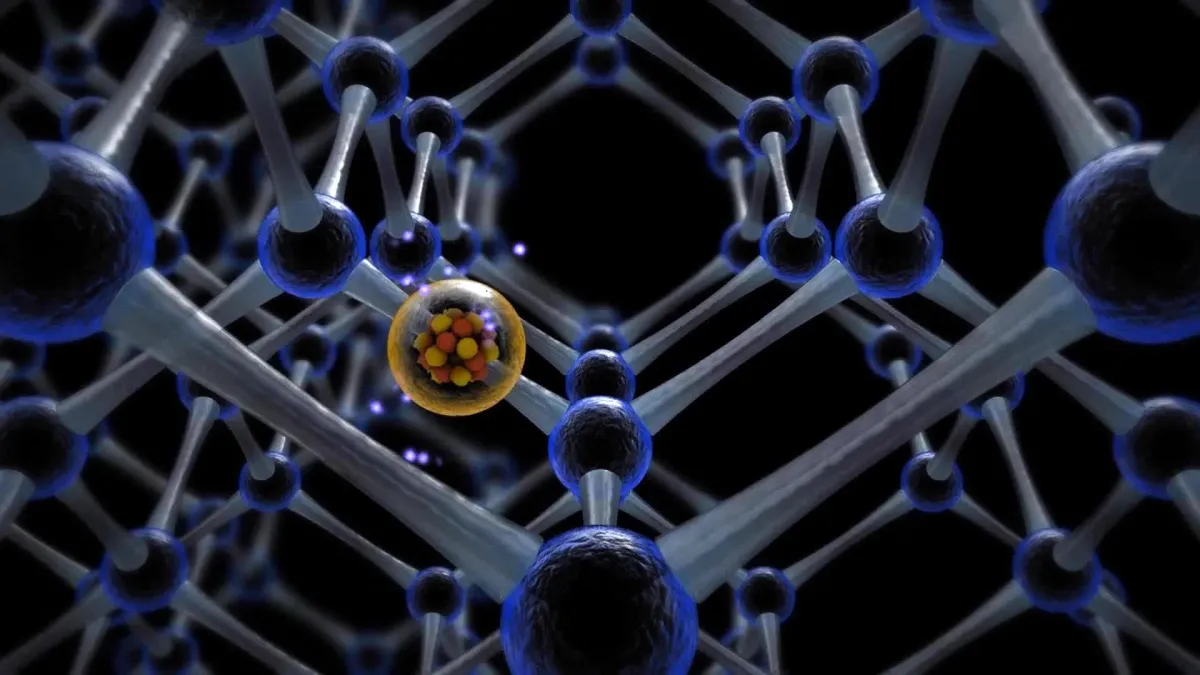
Researchers at Harvard have found a new way to protect quantum information. They used microscopic sound waves to help a quantum bit, or qubit, stay stable about three times longer. This breakthrough could help build smaller, more efficient quantum computers and networks.
Sound Waves for Quantum Information
Quantum networks often use the spin of an electron in a diamond to store quantum information. Tiny sound waves, called phonons, can then carry this information between different parts of the network.
The Lončar lab at Harvard has been a leader in this field. They developed a "phononic cavity" that traps these sound waves. This helps them interact more strongly with the electron spin in a qubit.
We're a new kind of news feed.
Regular news is designed to drain you. We're a non-profit built to restore you. Every story we publish is scored for impact, progress, and hope.
Start Your News DetoxPhonons have some big advantages over light, which is more commonly used. They have much shorter wavelengths at the same frequency. This means smaller components can be built and packed closer together.
Phonons also easily interact with both solid-state spins and electromagnetic fields. This makes them useful for hybrid quantum systems that combine different types of qubits.
The Challenge of Protecting Quantum Memory
A big problem with using phonons is keeping quantum memory safe. Qubits are very sensitive to their surroundings. They need to stay in their quantum state long enough to store and process information. This is called coherence.
Usually, researchers use microwave pulses to protect quantum memories from outside interference. But these methods don't work well for qubits inside phononic cavities. This has made it hard to have both strong interaction with phonons and long-lasting quantum memory at the same time.
"Dressed" Qubits Use Sound for Protection
The Harvard team found a solution. They used "all-mechanical coherence protection" for a silicon-vacancy spin in a diamond. Instead of microwaves, they continuously applied a mechanical field made of phonons.
This turned the qubit into a "dressed" qubit. It's like the qubit is "wearing" a continuous sound field. This makes it less sensitive to low-frequency noise from its environment.
This protection comes from a continuous mechanical field. This field works well with phononic cavities. So, the same structures that connect parts of a quantum network could also protect the information.
This means phonons could do two jobs: carry quantum information and protect it from noise.
Eliza Cornell, a lead researcher, explained that they are solving two problems. They want the spin to interact strongly with phonons and to have a long coherence time. Their method extends the coherence time while keeping the qubit in a cavity.
Longer Quantum Coherence
This new method made the coherence time of the silicon-vacancy spin about three times longer. This shows that continuous mechanical noise suppression can improve quantum coherence in real devices. It suggests that microscopic sound waves could be key to building more reliable and compact quantum systems.
Deep Dive & References
- All-mechanical coherence protection and fast control of a spin qubit - Nature Physics, 2026