Researchers at Yale have found a new species of eyeless cavefish. This discovery challenges the old idea that underground places are "evolutionary dead ends."
The study looked at three species of Southern cavefish. These fish all came from an ancestor that had already adapted to living underground. They spread through aquifers, which are underground water systems, in soluble rock across the southeastern United States.
This finding strongly suggests that new species can form even in environments completely underground.
We're a new kind of news feed.
Regular news is designed to drain you. We're a non-profit built to restore you. Every story we publish is scored for impact, progress, and hope.
Start Your News DetoxWhat the Discovery Means for Evolution
Chase Brownstein, a Yale graduate student and lead author, explained that what happens underground matters for evolution. Their analysis showed that three species split from each other after their ancestor moved into caves. The underground geology was key to this process.
The results were published in Integrative Organismal Biology. Thomas Near, a Yale professor, was the senior author.
Charles Darwin once called cave-dwelling organisms "wrecks of ancient life." This led to the belief that underground ecosystems were "evolutionary dead ends." The idea was that species adapted to these places stopped creating new species.
This new research focused on three Southern cavefish species. They diverged after their ancestors moved into underground habitats. These include Typhlichthys subterraneus, Typhlichthys eigenmanni, and the newly identified Typhlichthys styx.
Uncovering Typhlichthys styx
The team studied genetic data and created an evolutionary tree for Southern cavefish. These fish live in cave systems from the Appalachians to the Ozarks.
Their analysis found a third distinct lineage in Tennessee, Alabama, and Georgia. This was in addition to the two known species. All three lineages shared a common ancestor about 8 million years ago.
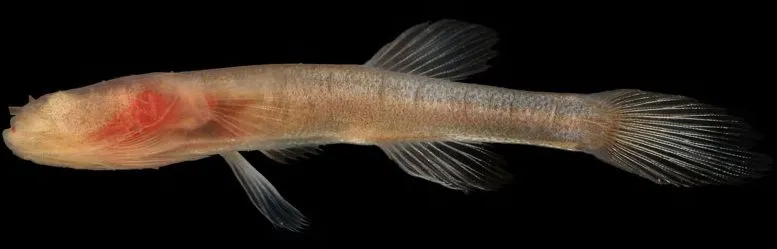
Researchers also used CT scans to compare the fish. The scans showed skeletal differences in the new lineage. All Southern cavefish lost their eyes after adapting to darkness. However, the new species still has remnants of interorbital bones that were once part of the eye socket. These bones are missing in the other two species.
Brownstein noted that both genetic and anatomical data confirm this is a distinct species.
Aquifers and Speciation
The distribution of Southern cavefish populations doesn't match surface rivers. This made it hard to understand how they spread.
The team looked at underground geological features. They found that major evolutionary splits matched the boundaries of regional aquifers. These aquifers are underground formations that store groundwater. They created networks of openings and channels in karst landscapes, which are formed when water dissolves soluble rocks. This allowed cavefish to spread over long distances.
Brownstein explained that aquifers acted like underground rivers, helping the cavefish to form new species within the cave systems.
Protecting Cavefish and Biodiversity
Many populations of Typhlichthys styx and other Southern cavefish are at risk. Human activities like dam building, too much water use, and pollution from industry and farming threaten their groundwater.
Near highlighted that this study is part of important biodiversity research at Yale. He also serves as the Bingham Oceanographic Curator of Ichthyology at the Yale Peabody Museum.
He stressed that discovering new species is vital for addressing the biodiversity crisis. You cannot protect a species if you don't know it exists. This work helps us understand and protect our planet's diverse life.
Deep Dive & References
Aquifer-Mediated Speciation in Cave-Adapted Fishes - Integrative Organismal Biology, 2026