Imagine a bustling Silk Road trading post, a vibrant hub where East met West, ideas flowed, and goods exchanged hands. Now imagine it all vanishing beneath the waves, swallowed by an earthquake in the early 15th century. That's the story of Turu-Aygyr, a medieval city currently being explored by Russian and Kyrgyz scientists in Kyrgyzstan's Lake Issyk-Kul.
The Russian Geographical Society, along with archaeological institutes from both nations, launched a joint mission last November to explore this submerged marvel. Turu-Aygyr was once a crucial pit stop on the ancient Silk Road, which, for over a thousand years, connected China to pretty much everywhere else. Then an earthquake hit, the city went under, and nomads moved in. Though, according to Valery Kolchenko, who heads the Kyrgyz team, the city might have already been a ghost town when the tremors began.
Unearthing a Drowned World
Maksim Menshikov, the mission's lead researcher, notes that the Karakhanids, a Turkic dynasty, ruled this region from the 10th to the 13th centuries. It was a spiritual melting pot: pagan Tengrianism, Buddhism, and Nestorian Christianity all had a presence. Islam, apparently, was more of an exclusive club for the nobility and the merchant class. Because, of course, trade always needs its own distinct set of beliefs.
We're a new kind of news feed.
Regular news is designed to drain you. We're a non-profit built to restore you. Every story we publish is scored for impact, progress, and hope.
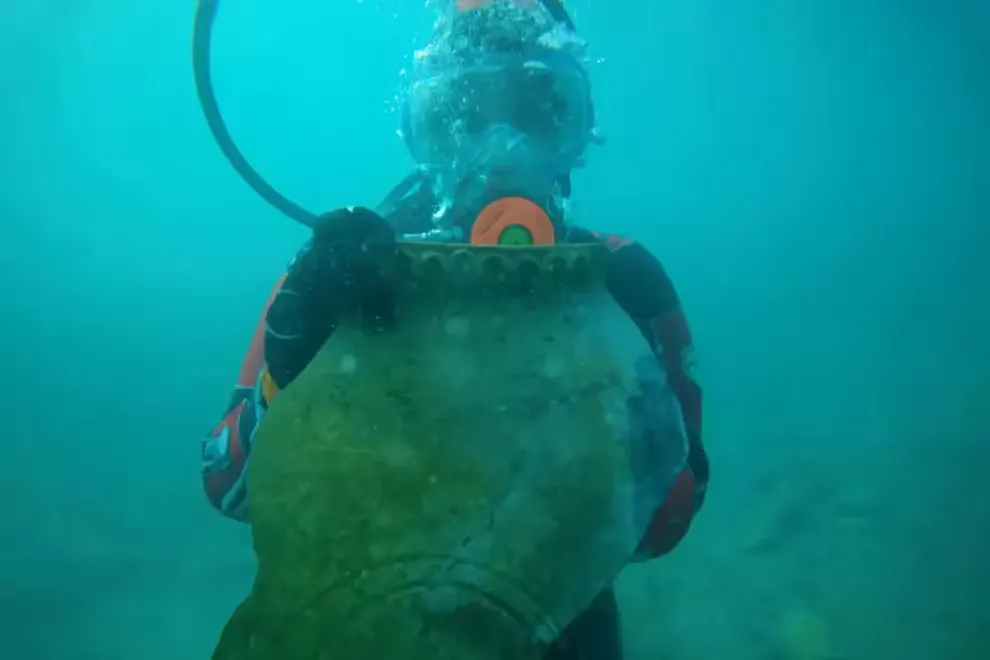
Start Your News DetoxThe team is currently working at four sites along the lake's northwest shore, in waters just three to 13 feet deep. At one spot, they've unearthed baked brick buildings and a millstone – because even a medieval city needs its daily bread. A decorated architectural piece suggests a grander complex, perhaps a mosque, bathhouse, or madrasa. They've also found stone-and-wood structures, and by analyzing the wood, they hope to nail down the exact date of that fateful earthquake. Let that satisfyingly precise number sink in.
A second site revealed a Muslim burial ground, with bodies respectfully interred on their right sides, facing Mecca. This points to a 13th-century origin, when Islam really took hold in Central Asia. Two sets of human remains have been carefully removed for study, offering a direct line to the people who once called Turu-Aygyr home. What did they eat? What ailed them? Did they, too, complain about the price of silk?
Archaeologists are also cross-referencing their findings with ancient Chinese descriptions of the region. Turns out, even without direct control, China found the area fascinating enough to document, especially during the Tang dynasty. Menshikov hopes this will allow them to weave together historical texts with tangible archaeological evidence. Meanwhile, a third site yielded medieval pottery, and a fourth hinted at more structures. More to explore, more history to literally dredge up. Which, if you think about it, is both impressive and slightly terrifying.