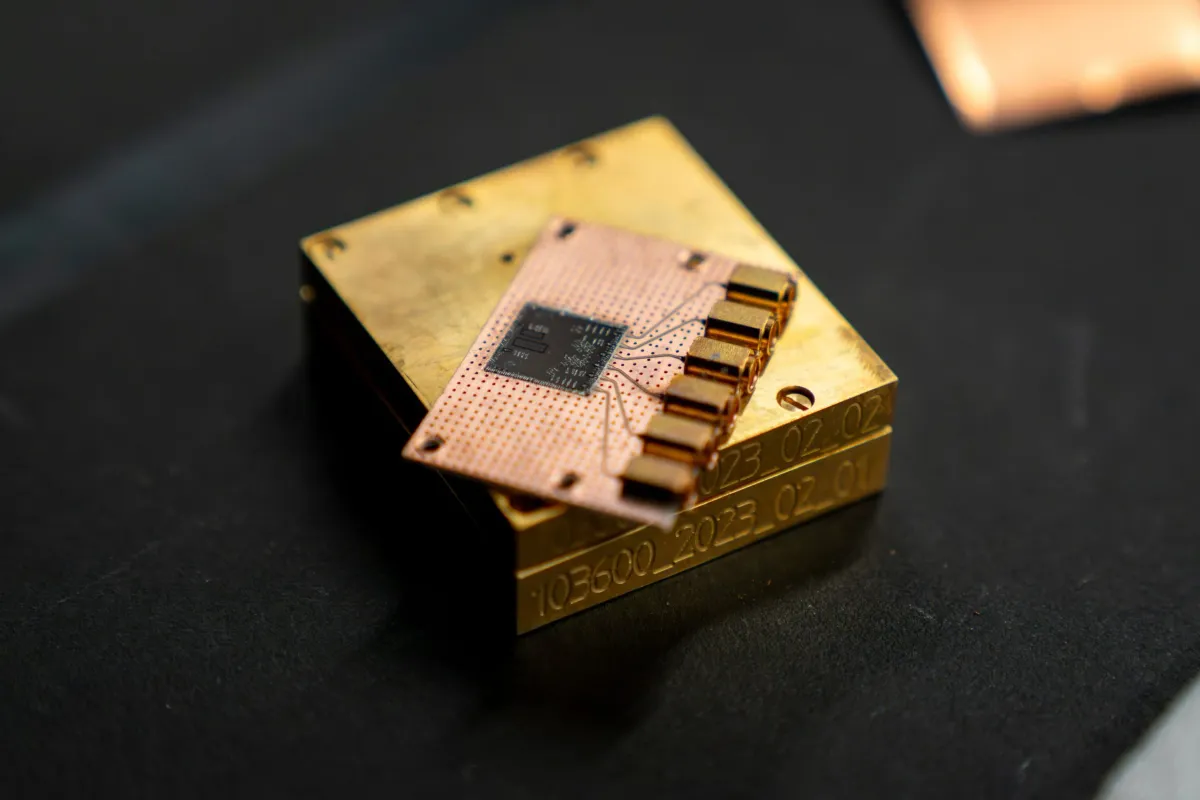
Imagine a quantum computer — a future super-brain that needs its parts to talk to each other, even when they're miles apart. The problem? Getting those distant bits (called qubits) to stay connected usually requires constant babysitting from a team of physicists and a whole lot of measurements.
Now, a team at the Institute of Science and Technology Austria (ISTA) has found a way to make those connections autonomous. They've essentially built a "quantum bath" of light particles that automatically creates and maintains these quantum links, no human intervention needed. It's like setting up a self-cleaning, self-maintaining quantum network, and it confirms a theory first cooked up two decades ago.
The Bath That Entangles
Entanglement is the quantum party trick where particles get so intertwined, they share a connection no matter how far apart they are. Extending this between qubits is crucial for building bigger, badder quantum computers and the networks that will link them.
We're a new kind of news feed.
Regular news is designed to drain you. We're a non-profit built to restore you. Every story we publish is scored for impact, progress, and hope.
Start Your News DetoxBefore this breakthrough, getting qubits to entangle meant either shooting a controlled photon from one to another, or having both emit photons that researchers then tried to match up. That second method, while Nobel-Prize-worthy, still required constant checks and wasn't always a sure thing.
Enter ISTA PhD student Alejandro Andrés-Juanes and Professor Johannes Fink. Their system sends correlated light particles from a shared source to two separate qubits, automatically synchronizing them. This is the first time this 20-year-old idea has actually worked in a real-world experiment.
The trick was bridging the gap between "continuous variable entangled states" (which are easy to make but less useful) and "discrete variable systems" (the on/off states that qubits actually use). Their quantum bath stabilizes these entangled states remotely, making the whole process hands-free.
Entanglement That Sticks Around
One of the biggest headaches in quantum computing is keeping qubits coherent and entangled long enough to actually do something useful. They're notoriously fragile.
Fink explains that their quantum bath is the source of entanglement, constantly creating a new, stable state using a continuous flow of correlated photons. This means the entangled qubit state lasts even longer than the qubits' own natural lifespan, and it's always ready for action. No more frantic scrambling to use entanglement before it vanishes into thin air.
They connected the qubits to this light source using microwave photons, which are perfect for controlling quantum info and already used in top-tier superconducting qubit systems. Optical photons, which could send quantum information through fiber optic cables, are also on their radar.
While this autonomous process isn't quite as efficient as actively controlled methods yet — transferring about 10% of the bath's available entanglement — it's a promising prototype. The original prediction assumed ideal conditions that are tough to replicate, which might be why it took over two decades to prove. But now, it's confirmed, and it could pave the way for fault-tolerant quantum processors. Because apparently, even quantum computers need a good, relaxing bath.