For the first time, a Chinese woman has won the Fields Medal, often called the Nobel Prize of mathematics. This year, two mathematicians from China received the award.
Fields Medals are given every four years to two to four mathematicians under 40. The award recognizes both past achievements and future potential. This is only the third time a woman has won the award in its 90-year history.
New Fields Medal Winners
The International Congress of Mathematicians in Philadelphia presented the medals. The recipients included Hong Wang and Yu Deng from China, John Pardon from the U.S., and Jacob Tsimerman from Canada.
We're a new kind of news feed.
Regular news is designed to drain you. We're a non-profit built to restore you. Every story we publish is scored for impact, progress, and hope.
Start Your News DetoxUlrike Tillmann, vice-president of the International Mathematical Union (IMU), praised all four winners. She noted their "tremendous contributions" to their fields. Tillmann also expressed happiness about another woman winning, saying it should feel normal for women to contribute at the highest level.
Hong Wang, from Guilin City, is the first Chinese woman to win the medal. She recalled feeling happy as a child when she solved her first math problem, gaining a clearer understanding.
Wang works at NYU and France's Institut des Hautes Études Scientifiques. She became well-known for solving the Kakeya conjecture in three dimensions with Joshua Zahl. The IMU stated that solving this problem opened doors for many theorems in harmonic analysis, partial differential equations, and geometric measure theory.
Yu Deng, from Shenzhen, was recognized for his work on creating mathematical rules to explain physics. His key paper was co-authored with Zaher Hani and Xiao Ma. The IMU called his work "a leap forward" in understanding physics from basic principles.
This marks the first time two Chinese scholars have won the prize simultaneously. Yau Shing-Tung was the first ethnic Chinese winner in 1982, followed by Terence Tao in 2006.
John Pardon was honored for his work in topology and geometry. Jacob Tsimerman was praised for expanding logical frameworks into algebraic geometry.
Reactions and Reflections
The winners were revealed early due to a website vulnerability. On Chinese social media, many celebrated the news. Users expressed joy, with one saying, "Two Chinese mathematicians! And one is a Chinese woman!" Another noted, "This is what you call truly bringing honor to your country."
Wang and Deng both started their higher education at Peking University in Beijing. However, they completed their advanced studies and research in the U.S. and Europe. Deng transferred to MIT and earned his PhD at Princeton. Wang studied in France and finished her PhD at MIT. Both now work outside China.
This has led to discussions on Chinese social media about China's research capabilities compared to the U.S. Some users questioned why many talented students leave China for higher education abroad. One user suggested that Chinese higher education should break up "academic cliques."
Despite concerns about a "brain drain," some high-profile Chinese scholars have recently returned home. They cite a less welcoming academic environment in the U.S. In 2025, Beijing launched a "K-visa" to attract foreign tech experts. The QiMing project also aims to recruit STEM talent.
The IMU also announced other awards. Graeme Segal of Oxford University received the Chern Medal. Shayan Oveis Gharan of the University of Washington received the Abacus Medal.
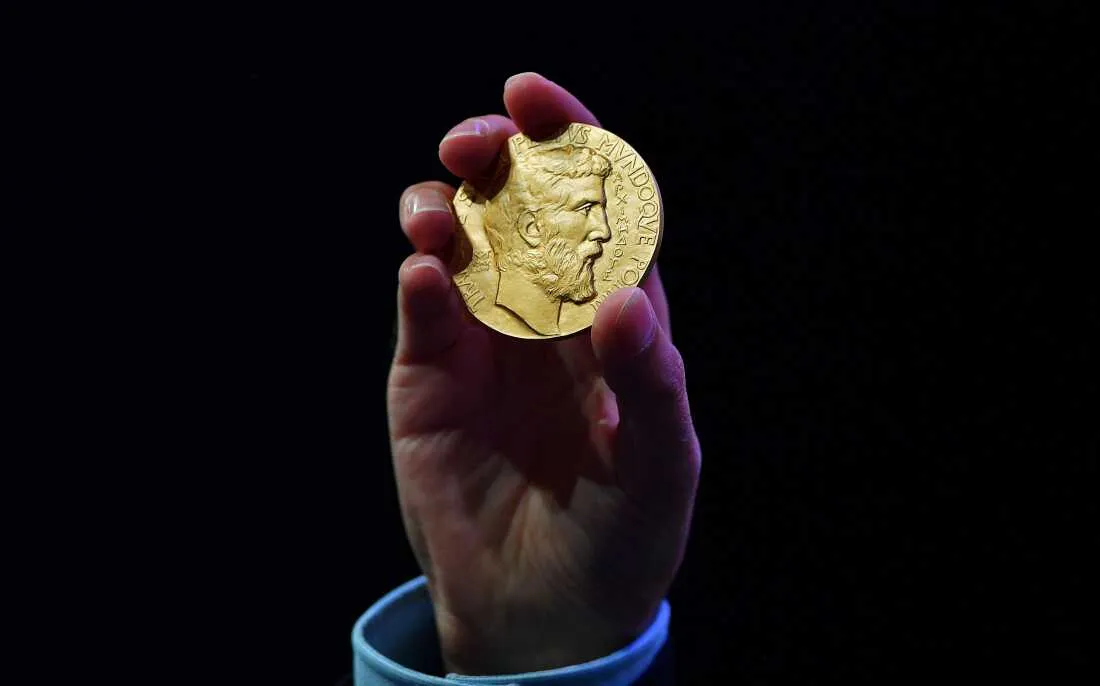
Fields Medalists receive a gold medal featuring Archimedes and 15,000 Canadian dollars (about $11,000 USD). For Deng, the main motivation is curiosity, not fame or money. He finds joy in solving questions and expanding understanding of the physical universe.