
Scientists have found a "cannibal star" that helps explain a long-standing mystery in astronomy. This star is a white dwarf that pulls material from a nearby companion star. This discovery not only solves a puzzle but also gives scientists a new way to understand similar signals across the galaxy.
Unraveling Cosmic Signals
An international team, led by researchers at the University of Sydney, found strong evidence about where a puzzling type of cosmic signal comes from. They also discovered a rare star system. This system offers a unique chance to study extreme conditions in space.
Using CSIRO’s ASKAP radio telescope, the team found a small white dwarf star. It was pulling gas from a larger companion star. As this stolen gas spirals towards the white dwarf, the system sends out strong bursts of radio waves and X-rays. This happens every 1.4 hours.
We're a new kind of news feed.
Regular news is designed to drain you. We're a non-profit built to restore you. Every story we publish is scored for impact, progress, and hope.
Start Your News DetoxThese findings were published in Nature Astronomy.
Kovi Rose, a PhD student at the University of Sydney and CSIRO, was the lead author. He said this discovery is the first confirmed explanation for mysterious objects called long-period radio transients. These unusual signals have only been seen in a few places in the Milky Way.
Rose explained that astronomers have been puzzled by long-period radio transients for years. Only about a dozen have been found, and their origins were unclear. Now, they have shown that one of these signals comes from a white dwarf actively taking material from another star.
A Rare Binary Star System
The newly found object is called ASKAP J1745−5051. It is made of a white dwarf and a red dwarf star orbiting each other very closely. The white dwarf is about the size of Earth but has almost as much mass as the Sun. Its companion is much larger but only has about one-tenth of the Sun’s mass.
These two stars complete an orbit in just over an hour.
Gas from the red dwarf flows towards the white dwarf, heating up intensely and releasing X-rays. At the same time, the stars' magnetic fields create regular radio bursts. This creates the repeating signal astronomers observed.
Rose noted that these emissions are linked to the system's orbit. However, the radio and X-ray signals do not peak at the same time. This suggests they are made in different parts of the system.
Researchers believe the radio bursts come from where the magnetic fields of the two stars interact. This happens with the stream of charged material being pulled from the companion star. These interactions create focused beams of radio waves.

Solving the Mystery
When long-period radio transients were first found, some astronomers thought they might be slowly spinning neutron stars called pulsars. But current theories suggest that neutron stars spinning this slowly shouldn't be able to make these signals.
The new findings support a different idea. At least some long-period radio transients seem to come from binary star systems with white dwarfs.
Professor Murphy, Head of School at the University of Sydney School of Physics, said that some similar objects had been linked to binary systems before. But this is the first time they can clearly see both stars and the process of one star taking material from the other.
This system is also only the second known long-period radio transient that produces regular X-rays. It is the first time scientists have confirmed what causes the repeating pattern.
A Cosmic "Rosetta Stone"
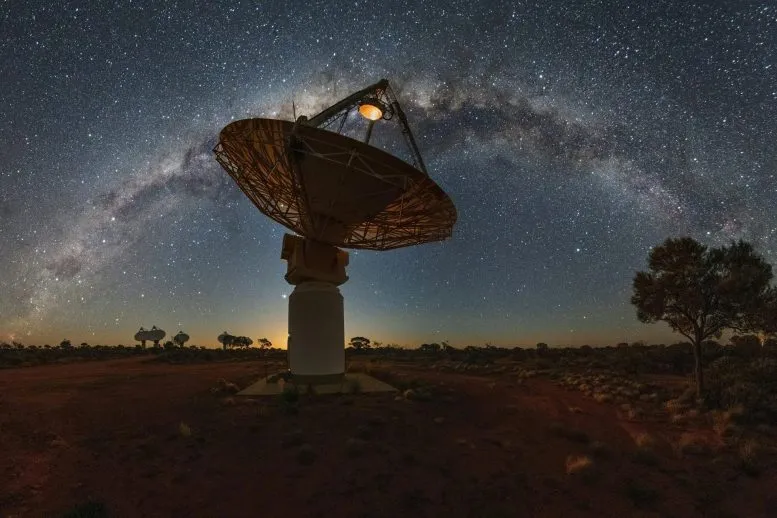
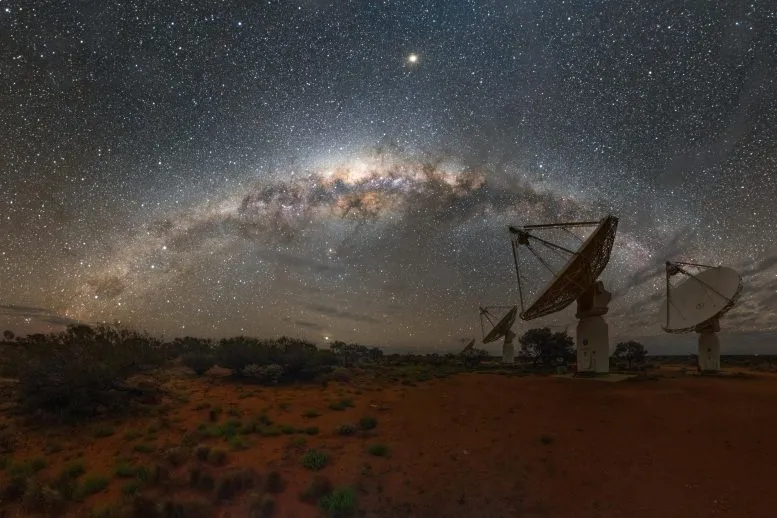
ASKAP J1745−5051 was found using the ASKAP radio telescope, operated by CSIRO. ASKAP's ability to detect faint signals, see fine details, and cover a wide area of the sky helps astronomers find unusual signals.
Researchers believe this new system could become an important reference. It can help them understand other long-period radio transients.
Rose compared the system to a "stellar Rosetta stone." It could help decode these signals and determine if other long-period transients are more like pulsars or white dwarf systems.
This discovery also provides a way to study physical processes that cannot be created in labs on Earth. Scientists can use the system to learn how matter behaves in strong magnetic fields and under intense gravity.
Future Observations
The team plans to keep studying the system using radio, optical, and X-ray telescopes. Future observations will help them understand how the emissions are made. They also want to see if similar processes can explain other long-period radio transients.
Rose noted that each new discovery helps piece together the bigger picture. He added that they are just beginning to understand this new class of cosmic events.
Deep Dive & References
Periodic radio and X-ray emission from an accreting white dwarf binary - Nature Astronomy, 2026
The research involved scientists from Australia, the United States, Canada, China, Spain, and Israel. Observations were made using telescopes in Australia, South Africa, Chile, and space telescopes. Funding came from various organizations, including the Australian Research Council and NASA.