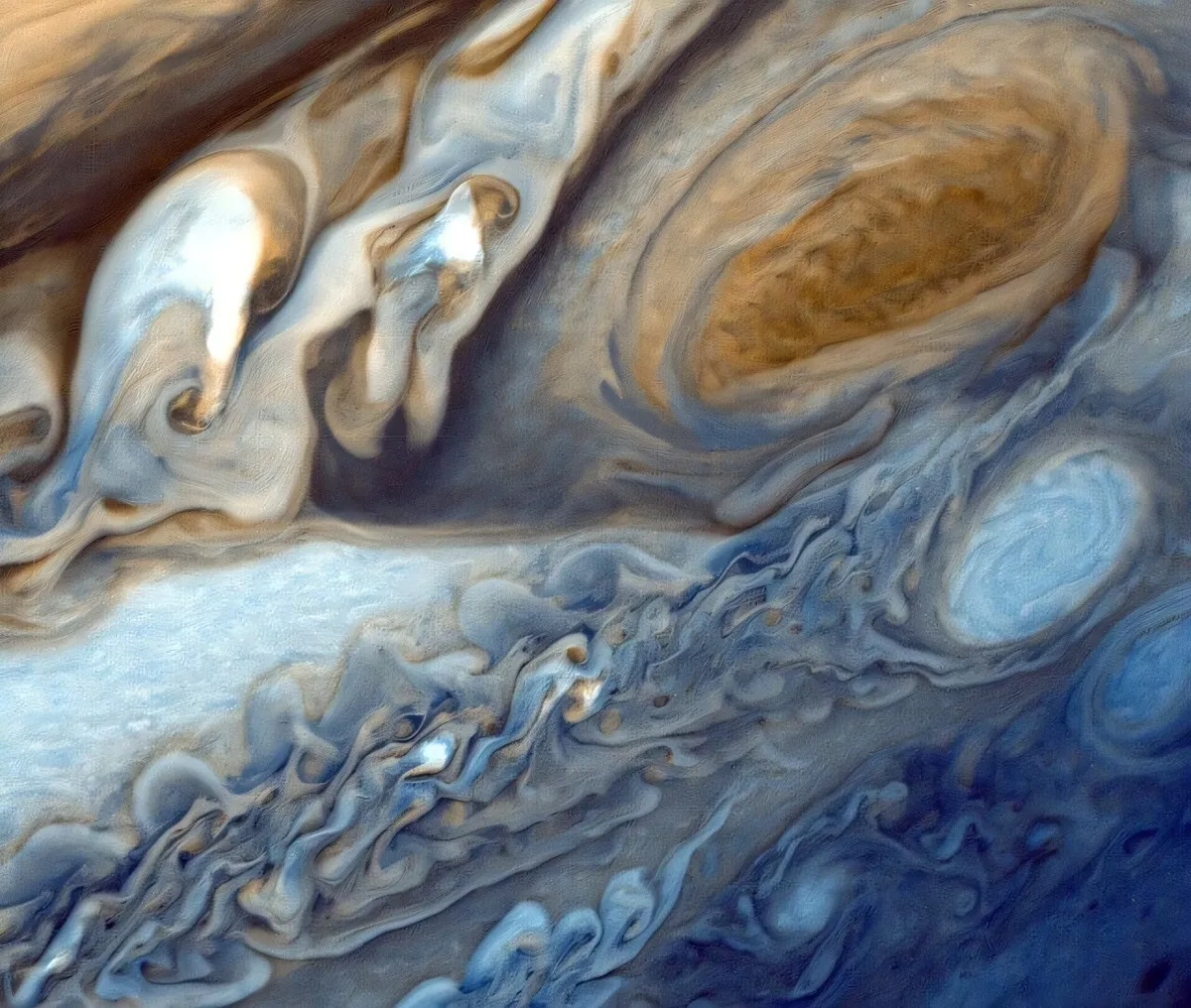
Turns out, Jupiter isn't just a pretty face with a giant red spot. It's also a cosmic particle accelerator, flinging electrons around at nearly the speed of light. And this isn't just a fun fact for your next dinner party; it might be a universal blueprint for how particles get supercharged across the entire universe.
Think of a bow shock like the wake a ship makes, but in space. When a planet's magnetic field slams into the solar wind, it creates this sudden, dramatic pressure change. Most space shocks are "collisionless," meaning particles don't actually bump into each other. Instead, invisible electromagnetic forces do all the heavy lifting, converting shock energy into heat.
Scientists have long suspected these collisionless shocks are where cosmic rays get their extreme speed — a process charmingly called relativistic electron acceleration. The problem? Catching it in the act has been tougher than herding cats in zero gravity. Until now.
We're a new kind of news feed.
Regular news is designed to drain you. We're a non-profit built to restore you. Every story we publish is scored for impact, progress, and hope.
Start Your News DetoxJupiter's Cosmic Particle Accelerator
Savvas Raptis and his team, like cosmic detectives, dove into data from NASA's Juno spacecraft. Juno, bless its plucky little heart, flew right through the dramatic shockwave where Jupiter's magnetic field meets the solar wind. This is Jupiter's bow shock, a truly spectacular cosmic fender-bender.
Juno's instruments picked up on something called a "foreshock" — a turbulent area upstream of the main shock, stretching several times Jupiter's radius. Inside this chaotic foreshock, temporary plasma structures were doing the impossible: accelerating particles to relativistic speeds. Essentially, Jupiter is running a particle accelerator the size of a small solar system.
The researchers even found that the size of these foreshocks directly relates to the energy particles can gain. It's like a cosmic speed limit, set by the scale of the shock itself. By combining Jupiter's data with observations from other planets, the team forged a link between foreshock size and the absolute highest particle energies. Which, if you think about it, is both impressive and slightly terrifying.
This whole discovery means that missions to our own cosmic neighbors, and even studies of our sun, are providing vital clues to grander universal mysteries. We're talking about refining theories that explain how super-energetic particles form across the cosmos. So, next time you look at Jupiter, remember it's not just a gas giant — it's a cosmic speed factory, revealing the universe's most extreme secrets.