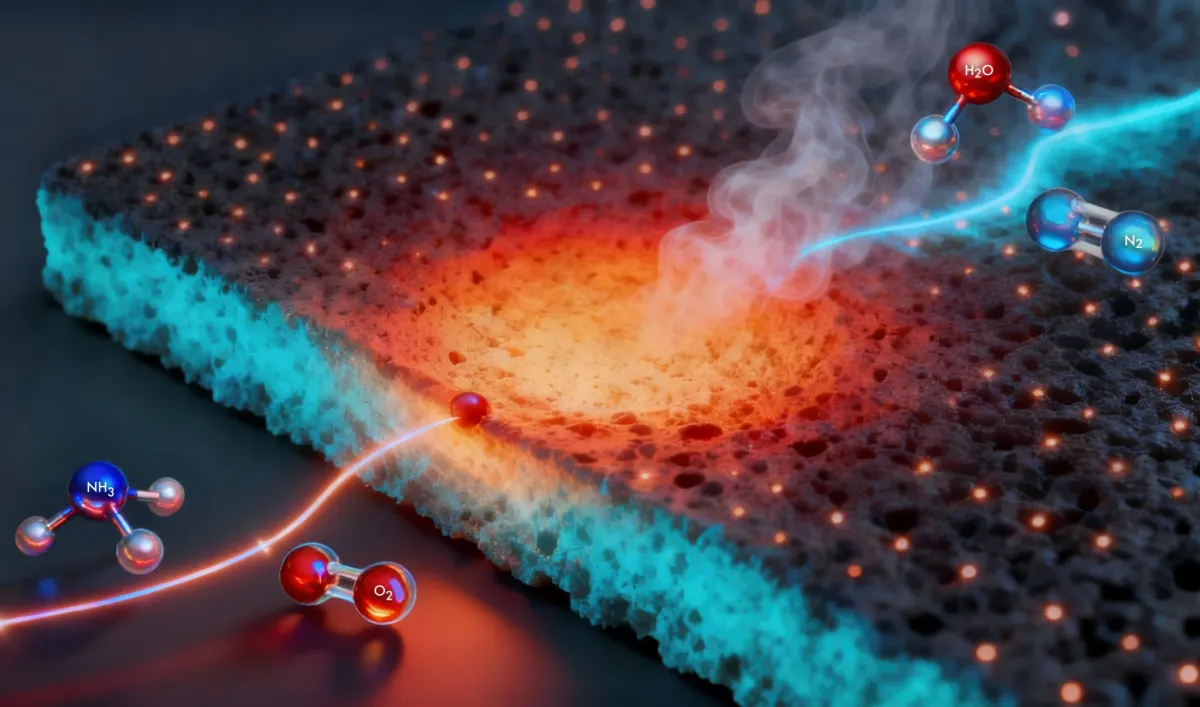
Ammonia. The stuff that cleans your windows and, until now, stubbornly refused to become the clean fuel we desperately need for heavy industry. It's a promising contender, made from air, water, and renewable electricity, storable as a liquid, and shippable via existing infrastructure. The only catch? It's a real diva to ignite, burns sluggishly, and has a nasty habit of belching out nitrogen oxides (NOx) when things get hot.
But a team of researchers from the College of Design and Engineering (CDE) just cracked the code. They've developed a platinum catalyst that not only gets ammonia burning at a surprisingly low 200°C (392°F) but keeps it running cleanly all the way up to a scorching 1,100°C (2,012°F). That's hot enough to make steel, without the carbon dioxide or the harmful exhaust.
Led by Professor Yan Ning and Assistant Professor He Qian, their study in Joule reveals a process that transforms ammonia into harmless nitrogen and water, with barely a whisper of NOx. This isn't just a lab curiosity; it's a potential game-changer for industries that need intense, on-demand heat without the planetary baggage.
We're a new kind of news feed.
Regular news is designed to drain you. We're a non-profit built to restore you. Every story we publish is scored for impact, progress, and hope.
Start Your News DetoxThe Platinum Whisperer
Industrial furnaces are picky. They need steady, powerful heat. Ammonia could provide it, but it's always been a high-maintenance fuel. It only burns cleanly within specific fuel-to-air ratios, has a high "light-off" temperature, and its flame can be unstable. Crank up the heat to stabilize it, and boom — NOx emissions climb. Assistant Professor He put it plainly: heavy industry needs both high-quality heat and clean exhaust. The team aimed to deliver both.
Their solution involved high-temperature catalytic ammonia combustion, using a surface catalyst to help ammonia and oxygen play nice. The trick was finding a material that could both kickstart the reaction at lower temps and endure the extreme heat of industrial operations.
They landed on a material that uses single atoms of platinum, spread out over a super-tough alumina support, beefed up with zirconia. Each platinum atom acts as its own tiny reaction site, preventing the platinum from clumping together under intense heat. This design keeps the catalyst stable even above 1,000°C (1,832°F).
Lab tests showed the catalyst could ignite ammonia at a mere 215°C (419°F) — a significant drop from the usual 500°C (932°F) or more. It then maintained stable combustion at 1,100°C (2,012°F), converting all the ammonia into nitrogen and water, with almost no NOx. And here's a fun twist: the catalyst actually got more effective after its first use and stayed stable through repeated high-temperature abuse. Because apparently that's where we are now.
At lower temperatures, those isolated platinum atoms meticulously break down ammonia molecules, helping them combine with oxygen into nitrogen and water — the cleanest possible burn. At higher temperatures, the catalyst's structure actively steers the reaction away from forming NOx. Imaging confirmed the platinum atoms stayed perfectly dispersed and active for 80 hours, proving its durability.
Professor Yan highlighted the elegance of the design: a heat-stable support paired with isolated metal atoms allows for both early ignition and resilience in extreme conditions, naturally favoring nitrogen over nitrogen oxides. Assistant Professor He added that industries could integrate this tech with minimal system changes, getting clean heat without having to rebuild their entire plants. Which, if you think about it, is both impressive and slightly terrifying.
With help from the NUS Centre for Hydrogen Innovations, pilot trials are now in the works. Ammonia, it seems, is finally ready for its close-up in the world of heavy industry. And all it took was a little platinum magic.