NASA-backed scientists have new ideas about how early Earth got the elements needed for life. They also suggest Jupiter played a key role in spreading these elements around the young solar system.
This study looked at the ratio of phosphorus to nitrogen in iron meteorites and younger objects called chondrites. The findings were published in Science Advances.
Debjeet Pathak from Rice University said the study suggests Earth got its phosphorus and nitrogen mainly from the inner solar system. It did not need much help from outer solar system chondrites.
We're a new kind of news feed.
Regular news is designed to drain you. We're a non-profit built to restore you. Every story we publish is scored for impact, progress, and hope.
Start Your News DetoxHow Our Solar System Formed
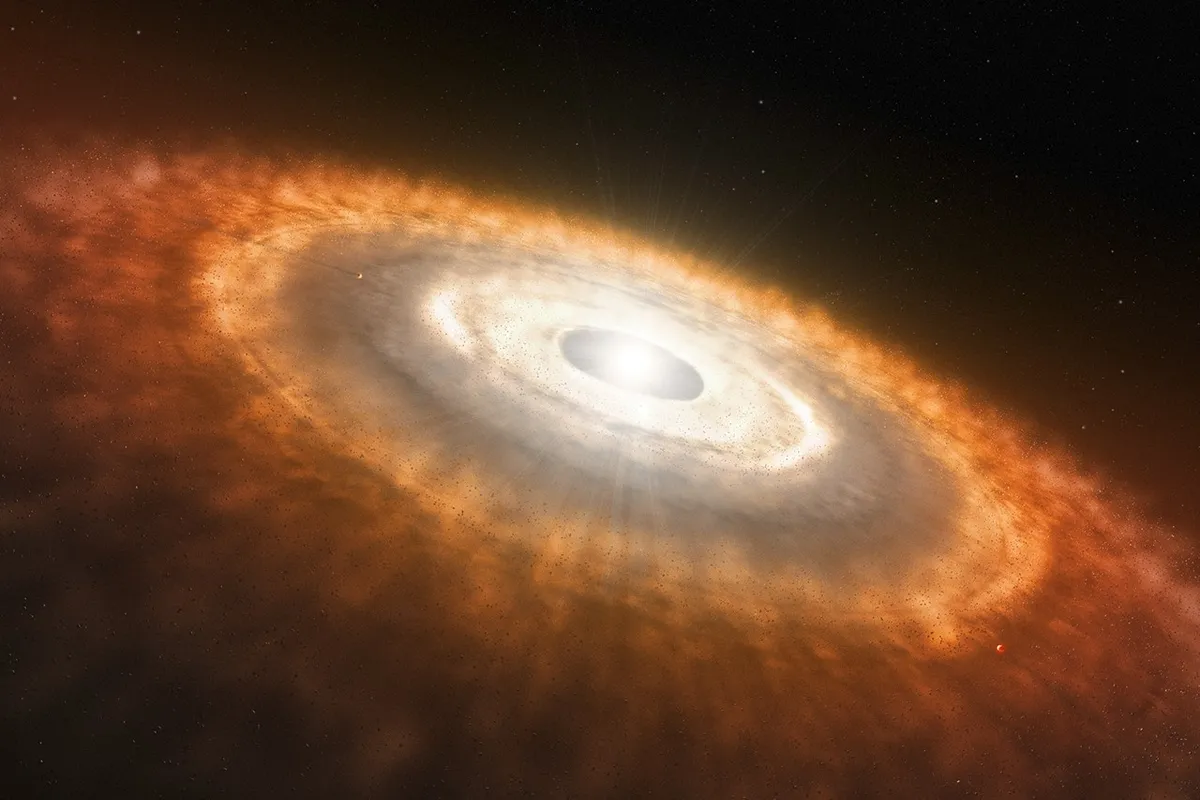
Our solar system began over 4.5 billion years ago from gas and dust swirling around the early Sun. This gas held the basic materials for planets, moons, and life. Nitrogen and phosphorus are two elements vital for life.
All life on Earth needs carbon, hydrogen, nitrogen, oxygen, phosphorus, and sulfur (CHNOPS). These elements came from space, formed inside stars, and then spread in gas and dust clouds. Gravity pulled this material together, creating new stars and smaller objects like planets.

In the solar system's early days, gas and dust clumped into bodies called planetesimals. These objects crashed into each other, leaving broken pieces everywhere. Many of these pieces eventually became part of planets and moons. Other pieces still exist today as asteroids. If they hit Earth and are found, they are called meteorites.
Meteorites offer a look into the early solar system before Earth even existed. Iron meteorites and chondrites are two types. Iron meteorites are dense, metallic, and mostly made of iron-nickel. Chondrites are stony and make up most meteorites found on Earth.
Each type of meteorite comes from planetesimals that formed at different times. Iron meteorites come from the oldest planetesimals. Chondrites came from a second group of planetesimals that formed two to three million years later.
Building a Habitable Planet
Understanding how Earth formed and when is important for astrobiologists. They study how and when our planet became suitable for life. Early Earth needed a supply of life's ingredients, like nitrogen and phosphorus, for the first living cells to form.
Scientists have debated where Earth's essential elements came from. Some evidence pointed to chondrites from the outer solar system moving inward to Earth later in its formation. However, this new study tells a different story.
Using lab tests and computer models, the team mapped phosphorus-nitrogen (P/N) ratios across the early solar system. They found differences between the first (iron meteorites) and second (chondrites) generations of planetesimals.
The experiments showed that the first generation had a higher P/N ratio in the outer solar system. This ratio decreased closer to the inner solar system. This trend was opposite for the second generation, with higher P/N ratios in the inner solar system.
Scientists believe that during the first generation's formation, material flowed outward, increasing the P/N ratio in the outer solar system. Then, Jupiter appeared.
Jupiter's Role in Element Distribution
Rajdeep Dasgupta of Rice University, a senior author of the study, noted that Jupiter's presence and growth were crucial. They determined how basic chemical ingredients for habitable worlds were spread.
As Jupiter grew to its massive size, its strong gravity limited the movement of phosphorus and nitrogen. This meant that when the second generation of planetesimals formed, those in the inner solar system had a higher P/N ratio.
Dasgupta added that it's still unknown if a planet like Earth could get its life-essential elements without a Jupiter-like planet.
Further modeling shows that Earth's current P/N signature matches best with inner solar system planetesimals. These are either related to iron meteorites or chondrites.
Debjeet Pathak, the lead author, said the study suggests Earth got its phosphorus and nitrogen mainly from the inner solar system. It did not need a large amount from outer solar system chondrites.